
Applications
23/04/2026
21 views
0 likes
The Antarctic Ice Sheet has been growing since 2020 – and scientists have now identified why. Research funded by the European Space Agency (ESA) looked at factors affecting Antarctica’s delicate environmental dynamics. Despite accelerating loss of ice through glacier melt, exceptionally heavy snowfall in recent years is adding to the mass of the icy continent.
The research was produced as part of a project funded by ESA’s Climate Change Initiative. The project’s findings were published in February in Nature Communications Earth & Environment journal.
A research team from the Danish and Dutch Meteorological Institutes, the University of British Columbia and the University of Canterbury, used satellite data to study the ice mass of Antarctica since 2002. Initially, they saw a net annual loss of between 90 and 142 gigatonnes of ice from the continent – the higher value is roughly equivalent to the volume of water in Lake Tahoe.
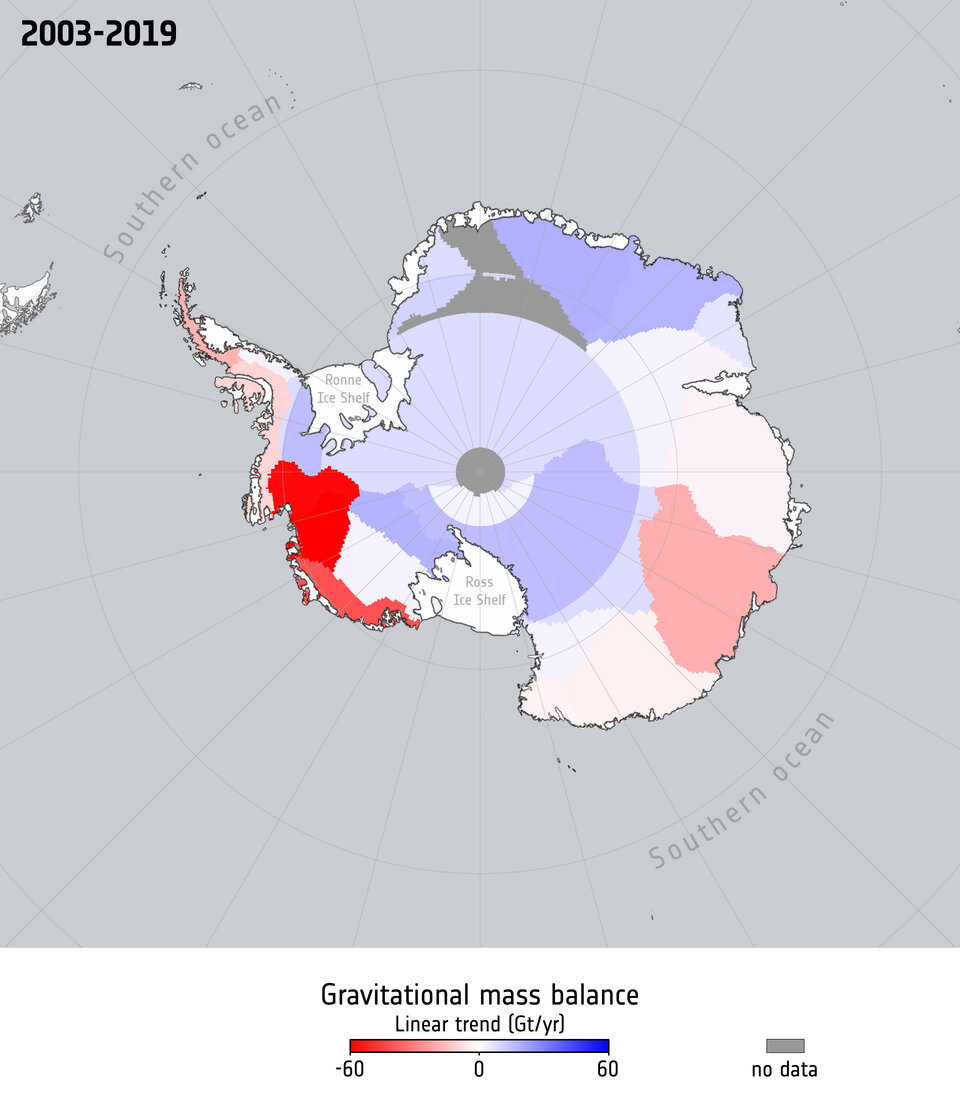
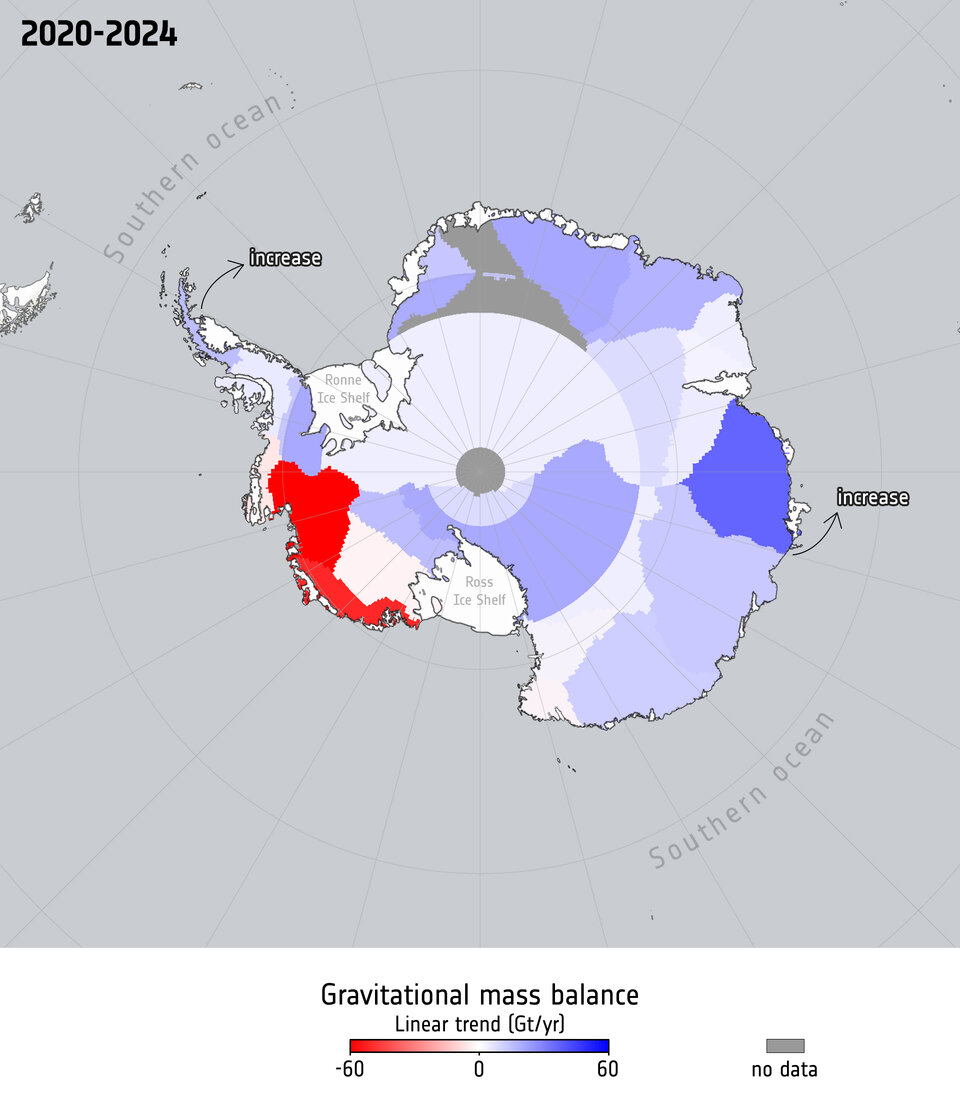
Use the slider to see how the net increase of mass on Antarctica has accelerated since 2020.
The project used observations by NASA and DLR’s Gravity Recovery and Climate Experiment (Grace) mission. By 2016, the satellite’s data began to reveal a slowdown in net ice loss.
According to the study’s lead author, Marlen Kolbe, this slowdown switched to a net gain at a rate of roughly 68 gigatonnes per year, between 2020 and 2024. As of late 2025, there is no clear indication of a return to net mass loss, though whether the trend will continue or level off remains unclear and will also depend on changes in dynamical discharge.
“What makes this remarkable is that the ice sheet isn’t losing less ice – it’s actually losing more. Ice discharge by iceberg calving has increased by nearly 100 gigatonnes per year compared to the previous two decades. The snowfall surge has simply outpaced it – for now,” explained Marlen.
Why Antarctica has seen increased snowfall
One of the factors influencing the increased volume of snowfall over the Antarctic continent is the transport of moisture in the atmosphere, particularly through atmospheric rivers, which carry enormous amounts of water vapour over thousands of kilometres. The researchers analysed the atmospheric rivers that reach Antarctica and found a pattern change: the ‘rivers’ were more frequent and more intense from 2020 onwards. Helped by strong westerly winds, more water vapour was transported over certain parts of the continent. Satellite data show the strongest mass gains were over East Antarctica (specifically Wilkes Land), Queen Maud Land, as well as the Antarctic Peninsula.
Ruth Mottram, climate scientist at the Danish Meteorological Institute and study co-author noted, “A warmer atmosphere holds more moisture. The physics is well understood – it’s one of the most famous equations in climate science, the Clausius-Clapeyron relationship: for every degree of temperature increase, you get a 7% increase in moisture content in the atmosphere.”
The study also tested the theory of whether a reduction of sea ice – less ice means more evaporation from the sea – was a factor behind the increased snowfall. The team conducted experiments using a high-resolution regional climate model driven by the ERA5 reanalysis, which assimilates satellite sea ice concentration records, including those from the ESA Climate Change Initiative. Their experiments indicate that sea ice loss may account for about 11% of the winter snowfall increase, and around 3% in summer.
Climate models have projected an increase in the mass of the Antarctic Ice Sheet due to enhanced snowfall, although warmer oceans are also expected to drive ice loss from below. The study shows how both processes are happening simultaneously and investigates the dynamics surrounding this delicate tipping point. Specifically, if the floating ice shelves around Antarctica continue to get thinner and break up, the glaciers they are holding back will themselves accelerate and release even more ice into the ocean.
Ruth Mottram noted, “Antarctica is finely balanced right now. Yes, the snowfall increase has pushed the mass budget into positive territory, but the flow of ice into the ocean is also accelerating. A few years with fewer atmospheric rivers could easily tip things back the other way.”
Why does Antarctica’s delicate balance matter?
The Antarctic Ice Sheet consists of enough frozen water to potentially raise global sea levels by around 58 m if it were to melt entirely. As the largest freshwater reservoir on Earth, any change in its mass balance has far-reaching consequences – for future sea level rise and coastlines, ocean circulation and the global climate system as a whole.
It was previously thought that Antarctica would be slow to respond to climate change, compared with the Greenland Ice Sheet. More recent data suggest the southern hemisphere ice sheet has far more in common with Greenland than was previously observed, with evidence of rising temperatures, more melting and iceberg calving, as well as a reduction of sea ice.
How do satellites measure ice mass from space?
Satellite gravimetry is the measurement of Earth’s gravity field from space to map mass distribution, variations in gravitational pull, and temporal changes in mass. Satellites such as NASA’s Grace mission carry high-accuracy instruments such as the K-Band Ranging system and Microwave Instrument. These instruments measure miniscule changes in the distance between satellites, down to one millionth of a metre. The tiny measurements can be used to detect the changes in Earth’s gravity field caused by shifting masses of water and ice.
Anna Maria Trofaier, a cryosphere scientist at ESA, added, “This study in particular shows that while we can capture the changes and decadal trends in sea ice loss and Antarctic ice mass balance in our satellite data records, it is the combination with the model that helps us understand why we are measuring strong mass gains in certain regions of Antarctica. ESA and its Climate Change Initiative have played a pivotal role in developing these science-ready datasets.”
Like