
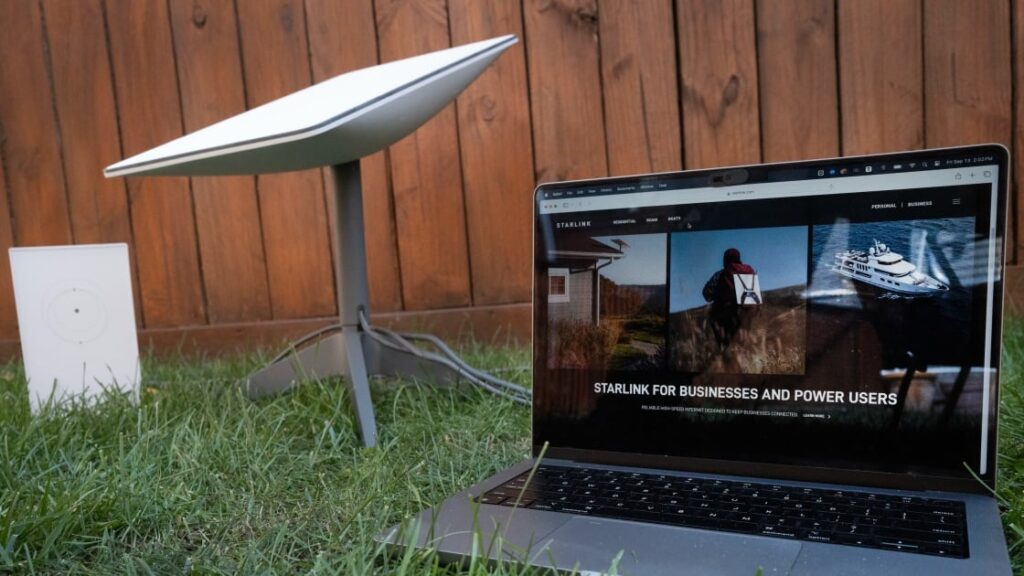
Starlink customers probably haven’t used it, but SpaceX is shutting down a little-known GPS feature that can be used to track and identify a Starlink dish’s location.
On Tuesday, the company began notifying customers about the demise of an open-source software framework, gRPC, integrated into Starlink hardware. “Effective May 20, dish location will no longer be available via the local device gRPC API,” SpaceX said in the email.
The company didn’t explain why, describing it as an update to Starlink’s “Location Data Access.” But regular users don’t need to worry. You can still see your dish’s location through the Starlink Mobile app under the “Subscription” section.

(Credit: Paul Sutherland/Starlink)
The GPS data on the gRPC API isn’t leaking your location either. It needs to be manually turned on by the user, which used to be possible by visiting the Debug Data section.
Instead, the change is expected to affect third-party software and Starlink resellers, particularly when it comes to managing fleets of Starlink dishes used on the road or at sea, according to Paul Sutherland, a software developer.
Sutherland is behind a desktop Starlink monitoring app called Nexus Telemetry. He told PCMag that the gRPC API is “very, very accurate” at enabling a customer to see the real-time location of a Starlink dish. The same API has been a helpful way for third-party tools to manage multiple Starlink dishes, including on RVs or boats, to see their GPS locations.
But in a blog post, Sutherland noted the location function came with a security trade-off. “If you’d enabled it, any device on your network, including guest devices, could silently read your precise GPS coordinates,” he wrote. “That’s a privacy issue in itself: your exact home location, accessible to any device on your LAN without consent. Beyond that, any app with network access could bypass the operating system’s location permission prompts entirely by just querying the dish over HTTP instead of asking the OS for location services.”
It’s why Sutherland suspects SpaceX might be clamping down to prevent the function from posing a threat to enterprise or even military customers, like those in Ukraine. “If [hackers] compromise a network with Starlink, they would be able to find the location of that [dish] device,” he told PCMag. “If they were broadcasting in a secret location, they would be able to pinpoint where it is.
“In a conflict zone or any situation where physical location is sensitive, that’s a real risk. Removing unauthenticated access to location data makes sense from that perspective,” he added. “That said, the change affects every Starlink user globally, not just those in sensitive locations, so I think the primary driver is the general privacy and security concern rather than any specific military use case.”
Recommended by Our Editors
Still, the restriction threatens to block legitimate access to location data for third-party tools, including Nexus Telemetry. Users managing fixed Starlink dishes can simply log where their equipment is based, but not so for dishes on moving vehicles. Sutherland wrote: “For mobile users, RVs, vans, and boats, it’s more of a problem. The whole point of polling the dish was that the location updated automatically as you moved. You’ll now need an alternative source,” which would involve installing a third-party GPS device. In response, Nexus Telemetry plans on adding support for dongle-based USB GPS receivers.
One Starlink reseller noted the restriction also means “reduced troubleshooting accuracy, more reactive operations, and diminished ability to automate and enforce SLAs [service level agreements] at an individual site level.” Although SpaceX is still offering a “Telemetry API” for enterprise customers, it limits location data to approximate grid cells rather than specific coordinates.
“Such a move just brings unnecessary issues for many users who are using gRPC for legitimate reasons,” added Jianping Pan, a computer science professor at the University of Victoria in Canada who studies satellite internet systems.
SpaceX didn’t immediately respond to a request for comment. But despite the looming restriction, it’s possible the company will reopen location access through the API, though it’ll be protected by authentication. Some users have also speculated that the restriction might block bad actors from equipping drones with Starlink. But Sutherland said: “I’d say the drone angle is unlikely since the local API is only accessible from devices on the dish’s own network, and drone operators already have onboard GPS.”
About Our Expert

Michael Kan
Principal Reporter
Experience
I’ve been a journalist for over 15 years. I got my start as a schools and cities reporter in Kansas City and joined PCMag in 2017, where I cover satellite internet services, cybersecurity, PC hardware, and more. I’m currently based in San Francisco, but previously spent over five years in China, covering the country’s technology sector.
Since 2020, I’ve covered the launch and explosive growth of SpaceX’s Starlink satellite internet service, writing 600+ stories on availability and feature launches, but also the regulatory battles over the expansion of satellite constellations, fights with rival providers like AST SpaceMobile and Amazon, and the effort to expand into satellite-based mobile service. I’ve combed through FCC filings for the latest news and driven to remote corners of California to test Starlink’s cellular service.
I also cover cyber threats, from ransomware gangs to the emergence of AI-based malware. In 2024 and 2025, the FTC forced Avast to pay consumers $16.5 million for secretly harvesting and selling their personal information to third-party clients, as revealed in my joint investigation with Motherboard.
I also cover the PC graphics card market. Pandemic-era shortages led me to camp out in front of a Best Buy to get an RTX 3000. I’m now following how the AI-driven memory shortage is impacting the entire consumer electronics market. I’m always eager to learn more, so please jump in the comments with feedback and send me tips.