
The universe looks like it is mostly empty space. Remove the stars, planets, dust, and gas, and what remains is nothing at all.
Physics tells a stranger story. The vacuum is not truly empty. It is filled with restless energy and fleeting quantum fluctuations. These are brief disturbances that can produce virtual particle pairs before they disappear again. These particles cannot be observed directly. However, their effects can shape the behavior of matter in measurable ways.
Now physicists working at the U.S. Department of Energy’s Brookhaven National Laboratory and Stony Brook University have found new evidence. Some of those hidden vacuum fluctuations may leave a direct imprint on the particles we can detect. Their study points to a link between short-lived virtual quark-antiquark pairs in the vacuum and real particles produced in high-energy proton collisions. The findings offer a new way to study one of the biggest unresolved problems in physics. Specifically, the question is how quarks become bound into matter.
“The vacuum is now understood to have a rich and complex structure, characterized by fluctuating energy fields and a condensate of virtual quark-antiquark pairs,” physicist Zhoudunming Tu said. “High-energy proton-proton collisions could liberate virtual quark-antiquark pairs from the vacuum that subsequently…form hadrons.”
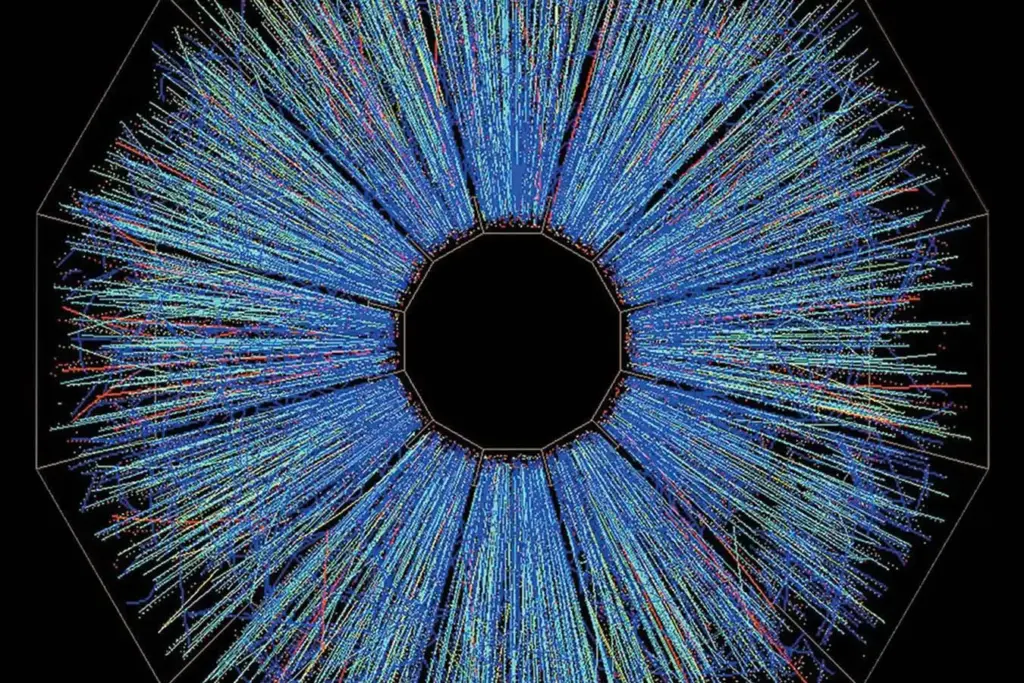
When an energetic quark or gluon gets knocked free during a proton-proton collision, this free “parton” first generates a shower of other partons, which then “fragment” to form hadrons (h) such as kaons (K), pions (π), and protons (p). The higher the energy of the initial quark or gluon, the higher the number of hadrons. (CREDIT: Charles Joseph Naim/Stony Brook University) A vacuum that does not stay quiet
The work centers on quarks, the particles that help make up hadrons such as protons and neutrons. In ordinary conditions, quarks cannot exist alone. The strong force locks them inside composite particles, a phenomenon known as confinement.
That sounds settled, but the details remain murky. Physicists know that quarks are light, yet protons and neutrons are much heavier than the simple sum of their quark masses. Light quarks have masses of only several MeV. In contrast, protons and neutrons weigh in around 1 GeV. That means most of the mass of ordinary matter must come from something else, from the dynamics inside hadrons, not just from the quarks themselves.
Spin adds another layer of mystery. Experiments have found that quarks account for only about 35 percent of the proton’s total spin, far below what older quark models once suggested. Researchers are still trying to understand how confinement helps generate both mass and spin in the particles that build the visible universe.
What happens when protons are smashed together
Tu and his colleagues approached that puzzle by looking not at stable matter, but at what happens when protons are smashed together at extreme speeds. In the Relativistic Heavy Ion Collider, or RHIC, protons were accelerated to 99.996 percent of the speed of light. Those collisions released enough energy to disturb the vacuum and turn virtual quark-antiquark pairs into real particles.
The team focused on strange quarks and strange antiquarks. According to the theory behind the experiment, these pairs should emerge from the vacuum with their spins aligned in parallel. If that spin pattern survived the messy transition from free quarks to bound particles, it could serve as evidence. It would mean the particles had originated from the vacuum condensate.
Study co-authors Dmitri Kharzeev, Charles Joseph Naim, Zhoumunding Tu, Jaydeep Datta, and Abhay Deshpande at the Center for Frontiers in Nuclear Science at Stony Brook University. (CREDIT: Stony Brook University) Following spin through a violent transition
That transition is called hadronization. Once strange quarks are liberated, they cannot remain isolated for long. They quickly combine with other quarks to form hadrons. In this study, some of them became lambda hyperons and anti-lambda hyperons. These are short-lived neutral particles that each contain a strange quark or strange antiquark.
The lambda hyperon decays in about one ten-billionth of a second. But that is long enough for the STAR detector at RHIC to capture the particles it leaves behind. Those decay products make the hyperon especially useful. By tracing the directions of the daughter particles, the researchers can reconstruct the hyperon’s spin. And because the strange quark carries the spin of the lambda hyperon in the nonrelativistic SU(6) quark model, the measurement also preserves information about the original strange quark.
This gave the team a way to ask a very specific question: if a strange quark and strange antiquark began as a linked pair in the vacuum, do their spin correlations remain visible after hadronization?
The answer, at least for some pairs, was yes.
Proton-proton collision events
Using about 600 million proton-proton collision events collected by STAR in 2012, the researchers measured several combinations of hyperon pairs. They found that short-range lambda and anti-lambda pairs showed a positive spin correlation of 0.388, with a 4.4 standard deviation significance relative to zero. By contrast, short-range lambda-lambda and anti-lambda anti-lambda pairs, along with all long-range pairs, showed spin correlations consistent with zero.
That distinction mattered. The short-range lambda and anti-lambda pairs behaved the way the vacuum-based picture predicted. Their spins appeared aligned in a way consistent with the strange quark and strange antiquark having come from the same spin-correlated virtual pair.
Illustration of tracing the QCD evolution of the spin of a strange quark–antiquark pair to a ΛΛ̄ hyperon pair and how it can be measured by the STAR experiment at RHIC. (CREDIT: Nature)
The researchers also compared their results with measurements involving kaon pairs and with simulations using the PYTHIA 8.3 Monte Carlo model. Those baseline cases showed no spin correlation, as expected.
A new handle on confinement
The researchers argue that the observed signal is strong evidence for vacuum quark pairs originating from the chiral condensate, a feature of the QCD vacuum tied to spontaneous chiral symmetry breaking. In this picture, the vacuum itself contains a condensate of virtual quark-antiquark pairs, including strange pairs. Additionally, high-energy collisions can excite that vacuum enough to turn some of them into real, measurable particles.
The result also gives scientists a fresh way to examine nonperturbative QCD, the regime where the usual simplifying methods break down. This is the hard part of the strong force. It is the part tied to confinement and the emergence of hadron structure.
The team found that the spin correlation was strongest when the lambda and anti-lambda pairs were close together in angle and rapidity. As the separation between the particles increased, the spin correlation weakened and became consistent with zero. The researchers suggest that this loss may reflect decoherence caused by interactions during hadronization or by the involvement of multiple initial quark pairs.
Within uncertainties, the short-range results were compatible with a model in which the original strange quark pairs were fully spin aligned. Another model, known as the Burkardt-Jaffe model, predicted a smaller polarization and was disfavored by the data.
“[We found a link between] the virtual spin-correlated quark pairs from the [vacuum] to their final-state hadron counterparts,” Tu said. “Our findings provide a new experimental model for exploring the dynamics and interplay of quark confinement and entanglement.”
3D and 2D invariant mass distributions of pπ− pairs, paired with pπ+ pairs, are shown in the top-left and top-right panels, respectively. (CREDIT: Nature) Practical implications of the research
This study does not solve confinement. It does, however, offer a new experimental route into one of particle physics’ toughest questions.
By tracing spin correlations from vacuum quark pairs to final-state hadrons, the work may help researchers understand how hadron mass and spin emerge from quark confinement. It may also provide a more direct probe of the QCD vacuum and the quark condensate. Both are central to understanding the strong force.
The method could be useful in future studies of quantum decoherence, orbital angular momentum, hyperon spin structure, and chiral symmetry restoration in extreme forms of matter. It may also help guide lattice QCD calculations and future experiments designed to explore how the building blocks of matter acquire their most basic properties.
Research findings are available online in the journal Nature.
Related Stories