
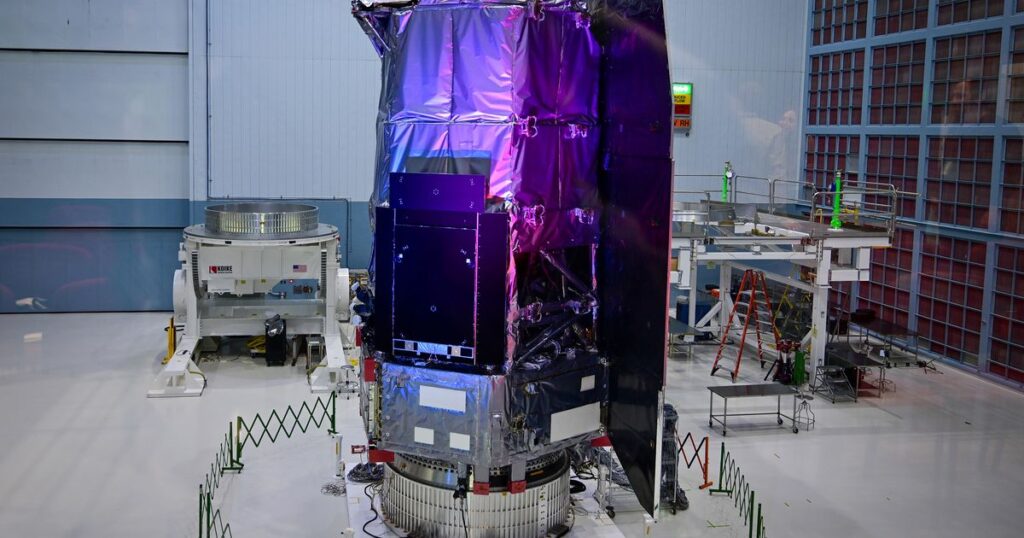
GREENBELT, Md. – NASA’s newest space telescope is ready for its date with a Falcon Heavy rocket in September, ahead of schedule and under budget, agency officials said Tuesday.
The Nancy Grace Roman Space Telescope made its public debut Tuesday at NASA’s Goddard Space Flight Center in Greenbelt. Built on a similar frame as the Hubble Space Telescope, astronomers hope Roman will settle essential questions about dark energy, exoplanets and astrophysics.
“The farther we reach into space, the greater our capacity to understand the unknown,” NASA Administrator Jared Isaacman said in a media event at Goddard.
He said the telescope beat deadlines and came in under its $4 billion-plus budget – a feat the agency will try to learn from and repeat, Isaacman added.
He also thanked the team at Goddard managing the development, as well as contributing NASA centers and private industry partners for their hard work and coordination.
The telescope is named after Nancy Grace Roman, NASA’s first chief astronomer and a leading proponent of putting telescopes like Hubble into space, above Earth’s turbulent atmosphere, where the view is clearer. Roman will image planets around other stars, look for lone black holes and rogue planets not orbiting any star, and identify new galaxies.
Roman Chief Scientist Julie McEnery said the telescope will scan more of the sky, faster, and in better detail than existing observatories.
“Roman’s primary instrument combines exquisite performance and sensitivity with an outstanding ability to sweep across large regions of the sky,” McEnery said.
McEnery described a second instrument, the Roman coronograph, as doing magic with physics.
“We take advantage of the wave properties of light to cancel out the light of a bright star, so that we can image faint planets next to it,” she said. “To do this magic, we have to have an optical system that can adjust itself to maintain sufficient precision. This will be the first time we’ve had a system in space with this kind of active optics, and it will set us on a path for future observatories to do extraordinary new things.”
If the September launch proceeds on schedule, the first images could come in June 2026, officials said. First, the Falcon Heavy rocket has to boost the telescope on its million-mile journey to join its neighbor, the James Webb Space Telescope, in deep space.
Roman will capture and transmit 1.4 terabytes of data each day, said Nicky Fox, NASA’s associate administrator for science, as much as Hubble can transmit in about three months.
“It’s doing fundamentally different science that could not be done with any individual observatory together,” she said. Hubble, Webb and Roman “together will complement each other, giving us a more complete picture of the cosmos and advancing our understanding of the universe.”