
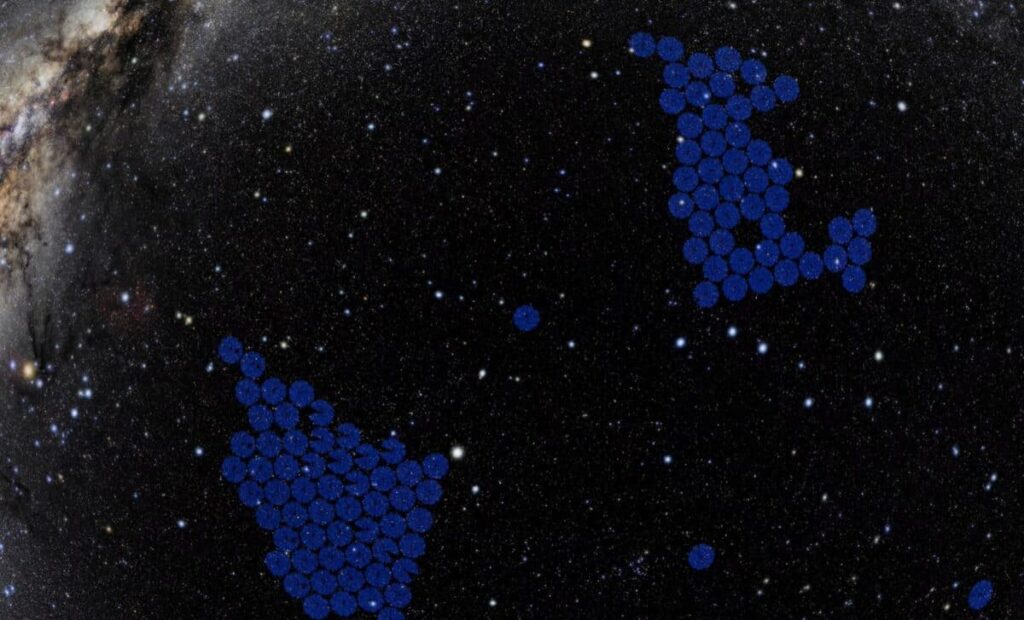
Scientists using the Dark Energy Spectroscopic Instrument have finished a five-year sky survey, producing a cosmic map that exceeds its original targets and raises new questions about the force driving the universe’s expansion.
The Dark Energy Spectroscopic Instrument, known as DESI, has completed its initial five-year survey, delivering the most detailed three-dimensional map of the universe ever assembled. Mounted on the 4-meter Nicholas U. Mayall Telescope at Kitt Peak National Observatory in Arizona, the instrument catalogued the positions of more than 47 million galaxies and quasars, 13 million more than the project originally planned to observe, along with 20 million stars. The dataset now represents cosmological measurements for six times as many objects as all previous surveys combined.
The completion marks a significant milestone in the broader effort to understand dark energy, the poorly understood force thought to be accelerating the universe’s expansion. Researchers have been tracking how galaxies clustered in the past compared to the present in order to trace that influence across roughly 11 billion years of cosmic history. Full analysis of the five-year dataset is expected to yield the first comprehensive dark energy results in 2027.
How DESI Built the Map
The instrument works by capturing light through the tips of 5,000 optical fibers, each repositioned by a miniature robotic arm as the telescope sweeps across successive areas of sky. Each fiber collects light from an individual galaxy and feeds it to a spectrograph, which separates the light into its constituent wavelengths. From those spectra, researchers calculate each galaxy’s distance from Earth, allowing them to construct a vast three-dimensional structure.
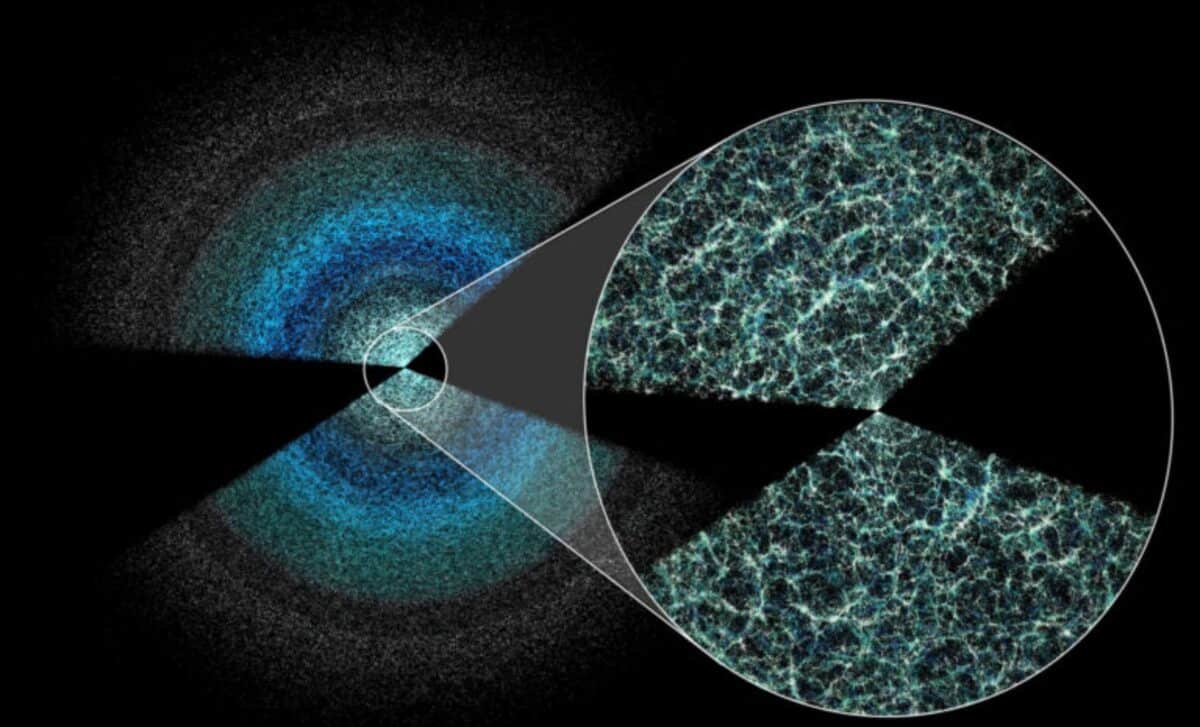 DESI’s 5,000-fiber array maps 47 million galaxies in 3D, charting the universe’s large-scale web of filaments and voids ©Claire Lamman
According to DESI co-project scientist David Schlegel of Lawrence Berkeley National Laboratory, the survey outperformed expectations through a combination of steady technical improvements and minimal downtime. “All of us know a lot more about robots and motors than we did 10 years ago,” Schlegel said. “The amount of downtime is very close to zero.” The collaboration’s director, Michael Levi, also a scientist at Berkeley Lab, described the instrument’s performance as better than anticipated and noted the pace at which the team executed the survey as “phenomenal.”
The finished map visualizes the large-scale structure of the universe, dense filaments where galaxies and clusters have gathered under gravity, separated by vast, relatively empty voids. Each point in the map represents a single galaxy.
Dark Energy Results and What Comes Next
DESI was designed to test whether dark energy behaves as a fixed cosmological constant, an idea embedded in Albert Einstein’s general theory of relativity. Earlier data from the instrument’s first three years suggested that the rate of cosmic acceleration may have shifted over time, an indication that dark energy could be something more variable than a constant. The statistical significance of that result remains low enough that it may not survive further scrutiny, but it has prompted theorists to explore alternative frameworks.
Cosmologist Bhuvnesh Jain of the University of Pennsylvania noted that DESI’s interim findings generated considerable interest. “It rules out our simplest physical pictures of dark energy and says that maybe we shouldn’t deploy Occam’s razor too prematurely,” he said.
Schlegel estimates that it will likely take around a year before the team can determine what the completed map reveals about dark energy. In the meantime, DESI continues to collect data in more observationally difficult regions of the sky, including areas lower in the southern sky, with the goal of adding more than 15 million additional galaxies to the dataset.
According to Dr. Stephanie Juneau, NSF’s NOIRLab representative for the project, the survey reflects contributions from a wide range of specialists, instrument builders, software engineers, technicians, observatory staff, and a large number of early-career researchers. “Ultimately, we are doing this for all humanity, to better understand our Universe and its eventual fate,” she said. “After finding hints that dark energy might deviate from a constant, potentially altering that fate, this moment feels like sitting on the edge of my seat as we analyze the new map.” The collaboration plans to publish several additional papers later this year, drawing on the first three years of data, while the full five-year dataset enters the processing pipeline.