
Back in 1999, when I was working as an air traffic controller at Fort Worth Center, one of my
co-workers ended up on Coast to Coast AM with Art Bell.
He had submitted audio of unusual aerial activity over the Dallas-Fort Worth area, something people now refer to as UAPs (unidentified anomalous/aerial phenomena). I remember listening to the show and laughing as Bell treated the recording as if it were a leak from a secret government source.
He even said they were using a fake name to protect the controller’s identity—until my co-worker interrupted and told him, “That’s actually my real name.”
Being an air traffic controller was a fascinating job. Most of us held secret clearances, but even then, I only encountered classified information twice in 26 years: once after 9/11, while helping coordinate combat air patrols after the attacks, and once in connection with a specific UAP event I can’t discuss.
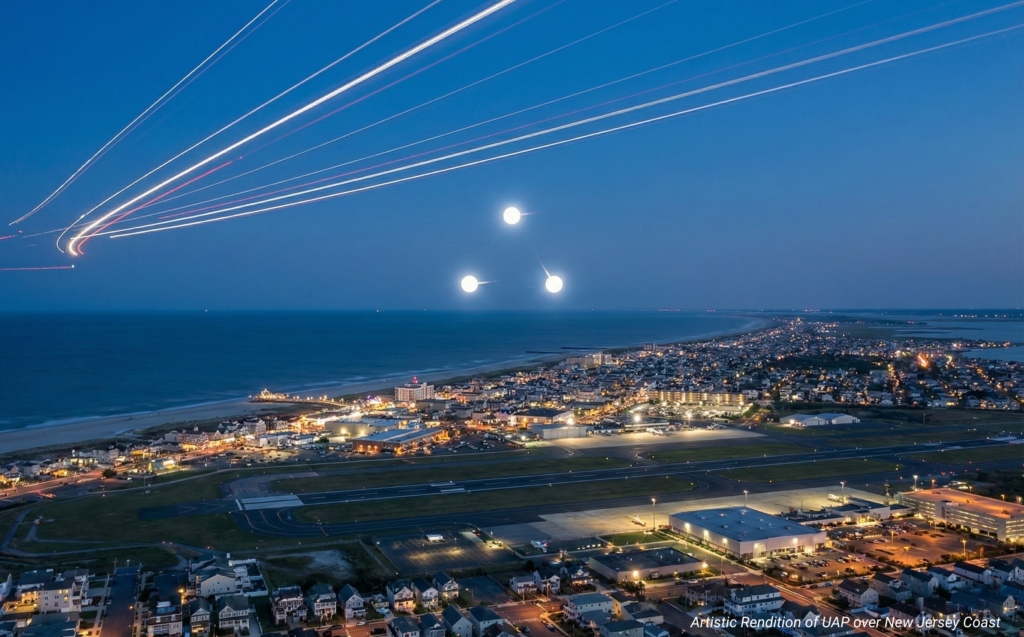
Lights Over Arkansas
A year earlier in 1998, I was flying from Texas to Arkansas with my flight instructor, a lifelong
friend, to take my instrument check ride. We finished late and headed home after dark. Somewhere along the route, five bright lights appeared between our 12 and one-30 o’clock positions, maybe a mile away at our altitude.
I radioed the controller to ask about nearby traffic. He said the closest aircraft was a 727 40
miles ahead. I told him we had five aircraft right in front of us, evenly spaced. For a second, I
thought they might be military helicopters. Then my instructor and I looked back—and they were gone.
They didn’t blink out like lights switching off. It was as if they turned or sped away at an
incredible rate. Years later, when I saw a video of the Phoenix Lights, I couldn’t shake the
feeling that what we saw that night looked eerily similar.
Five years later, I told that story over lunch with some old high school friends. My instructor was there, sitting right beside me. I finished the story and turned to him for confirmation. He
hesitated and said, “I don’t know what you’re talking about.”
![Image of a UAP captured by a U.S. Navy pilot in the cockpit of a fighter jet [Credit: U.S. Navy]](https://www.ufofeed.com/wp-content/uploads/2026/04/7201780.jpg) Image of a UAP captured by a U.S. Navy pilot in the cockpit of a fighter jet [Credit: U.S. Navy]
Image of a UAP captured by a U.S. Navy pilot in the cockpit of a fighter jet [Credit: U.S. Navy]
I couldn’t believe it. I started to wonder if I’d imagined the whole thing. Then, decades later, he called me out of nowhere and said, “Do you remember those lights we saw over Arkansas?” When I reminded him how he’d denied it before, he laughed softly.
“I just didn’t want to talk about it back then,” he said.
What struck me through the years wasn’t the classified work—it was how little we weren’t told.
The FAA never ordered us to stay silent about unusual radar returns, UFO or UAP reports, and
activities. More than a few controllers shared recordings or data with reporters.
One thing I can say with certainty is that controllers hate unknowns in their airspace. It goes against the heart of what we do. If I know about it, I can control it or at least steer the aircraft I am responsible for around it.
I often watched with incredulity as controllers complained about these unknown aircraft or whatever, not with awe and wonder but with frustration and anger at the possible safety hazard they present.
Most people remember early February 2023, when a Chinese surveillance balloon crossed the continental U.S. before being shot down off the coast of South Carolina.
We had raw radar and tracked it carefully. But one afternoon over Montana it behaved unlike any balloon I have ever seen. It was drifting southeast at about 45 knots. Then, suddenly, it reversed course and accelerated sharply to the northeast. Within seconds, the radar showed it moving over 700 knots before disappearing entirely.
My best guess? The computers dropped the target because they weren’t programmed to follow anything faster than an SR-71. Since the balloon was being tracked with raw radar and did not have a transponder, when the radar updated, the primary radar target on the next update was too far the last one to be the same object, so it stopped tracking it.
Pilot Lounge Conversations
For years, pilots avoided sharing strange stories for fear of losing their medical certificates or
being labeled unstable, delusional, or psychotic if they reported a UFO sighting. But that’s
changing.
![An unmanned aerial system is observed during Naval exercises off the U.S. East Coast in early 2022. The object in this image was first classified as an unidentified anomalous phenomena before being reclassified as a UAS based on additional information and data from other UAP sightings. [Credit: Department of Defense]](https://www.ufofeed.com/wp-content/uploads/2026/04/220517NXX9990001.jpg) An unmanned aerial system is observed during Naval exercises off the U.S. East Coast in early 2022. The object in this image was first classified as an unidentified anomalous phenomena before being reclassified as a UAS based on additional information and data from other UAP sightings. [Credit: Department of Defense]
An unmanned aerial system is observed during Naval exercises off the U.S. East Coast in early 2022. The object in this image was first classified as an unidentified anomalous phenomena before being reclassified as a UAS based on additional information and data from other UAP sightings. [Credit: Department of Defense]
Now, working as a professional pilot, I spend hours in lounges across the country trading
stories. When the conversation lags, I love to ask about UAP or other strange things that they
have seen or experienced while flying. At first, people are cautious. But once I mention that I
retired from the FAA as an air traffic supervisor and that I took UAP reports almost weekly, they open up and the stories start rolling.
The more people talk, the more the stigma fades, replaced by genuine curiosity and professional concern. I am not sure exactly what it was about changing the name of these events from UFO to UAP, but it seems that has made it more acceptable to talk about these experiences.
So kudos to whomever relabeled them and removed the stigma about bringing up these events.
New Era of Openness
Ever since the Navy released videos of UAPs tracked by their aircraft cameras, it feels like
something has shifted. It seems suddenly OK to report objects that are unexplainable given our current understanding of science and our universe.
Some of these encounters are surely experimental technology, many from our own military. But others—like the “cube in sphere” objects reported by Navy pilots off the East Coast—don’t fit any known category. These translucent spheres, each with a faint cube suspended inside, reportedly flew in tight formation with Navy fighters, even splitting squadrons mid-flight.
Encounters like that are hard to shrug off.
Why I’m Writing This
I believe pilots and controllers are in a unique position to help us understand what’s happening
above us. For much of my career, it felt taboo to talk about these things. Now, it feels important.
Are we alone in the universe? I doubt it. The idea that life exists only here feels far too small for such a vast and creative cosmos. Whether what we’re seeing is human technology or
something entirely different, the truth matters—not just for science, but for who we are as a
species.
As humanity prepares to return to the moon through NASA’s Artemis program, I think about the last time we stood there.
It was December 1972, during Apollo 17, when Gene Cernan became the last human to walk on the lunar surface. It’s been more than 50 years since we left. The same curiosity that once carried us that far is the same curiosity that keeps our eyes turned skyward even now.
Closing Thought
We’re finally going back to the moon—half a century after Cernan brushed lunar dust
from his boots for the last time.
As we take those steps outward again, I hope we also find the courage to look inward, to face the mysteries that drift above our heads and linger in our memories. Because the search for truth—out there or here at home—has always been what makes us human.