

The universe may have seven dimensions, according to a new study

mystery

Express newspaper
18/04/2026 20:59
A new theory in physics suggests that our universe may not consist of just the four dimensions we know – length, width, height and time – but seven dimensions in total.
According to some physicists, in addition to these four dimensions, there are three more “hidden” ones, folded so densely that they cannot be directly perceived. This idea, although it sounds like science fiction, is being seen as a possible way to solve one of the biggest problems of modern physics.
The problem of black holes and the “information paradox”
The theory is related to a decades-old unresolved issue: what happens to information when a black hole disappears.
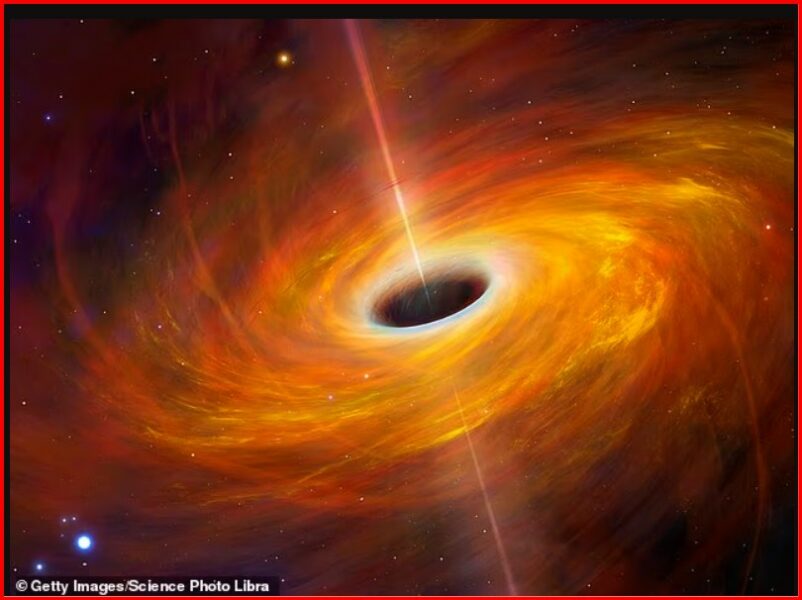
In the 70s, Stephen Hawking showed that black holes are not completely “black,” but emit radiation and gradually evaporate. This creates a conflict with the basic law of quantum mechanics, according to which information cannot be destroyed – a problem known as the “information paradox.”
A group of researchers claims to have found a solution, but only if the idea of a seven-dimensional universe is accepted.
“Imagine a book burning in a fire,” explains one of the study’s authors, Richard Pinčák from the Slovak Academy of Sciences. “The book is destroyed, but in principle it can be reconstructed from the ash, smoke and heat. The information is not lost, it is simply scattered.”
Seven dimensions and the “torsion” of space-time
In Einstein’s theory of relativity, space-time is seen as a four-dimensional structure that is bent and distorted by gravity. But according to this new theory, there are three additional dimensions, compressed to such a small scale that they are unnoticeable.
“We have four known dimensions and three other very small ones, wrapped within them,” says Pinčák.
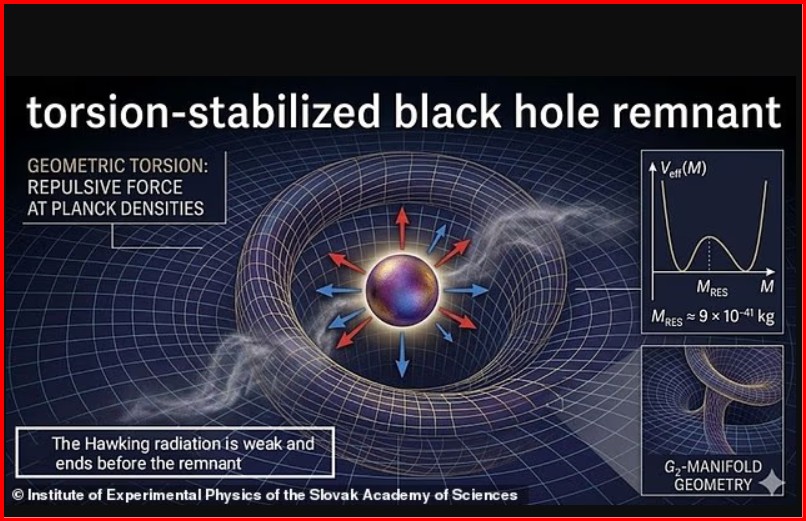
These hidden dimensions would create a new physical effect called “torsion” – a kind of warping of space-time. This effect, according to researchers, could be the key to understanding the fate of black holes.
What happens when a black hole “dies”?
According to the proposed model, when a black hole evaporates to its minimum size, its seven dimensions begin to “entangle” in a kind of knot.
This knot creates a force that prevents the black hole from completely disappearing, leaving behind an extremely small remnant – about 10 billion times smaller than an electron.
However, this remnant still preserves the information that the black hole has absorbed, thus resolving the paradox: information is never lost, because the object does not completely disappear.
Possible consequences for modern physics
Researchers think this theory could also help explain other unsolved phenomena, including the Higgs mechanism – the so-called “God particle”, which gives mass to other particles.
Also, these remnants of black holes may also make up dark matter, which makes up about 27% of the universe.
If the theory is correct, then special particles called “Kaluza–Klein” should exist, but they are so heavy that they cannot currently be detected with existing technology, including the Large Hadron Collider (LHC).
Still a distant hypothesis
Some possible signs of these dimensions could be sought in the cosmic background radiation or in the ancient gravitational waves of the universe, but the necessary instruments do not yet exist.
For now, the idea of a seven-dimensional universe remains an intriguing theory – an ambitious attempt to piece together the greatest mysteries of modern physics. /GazetaExpress/