
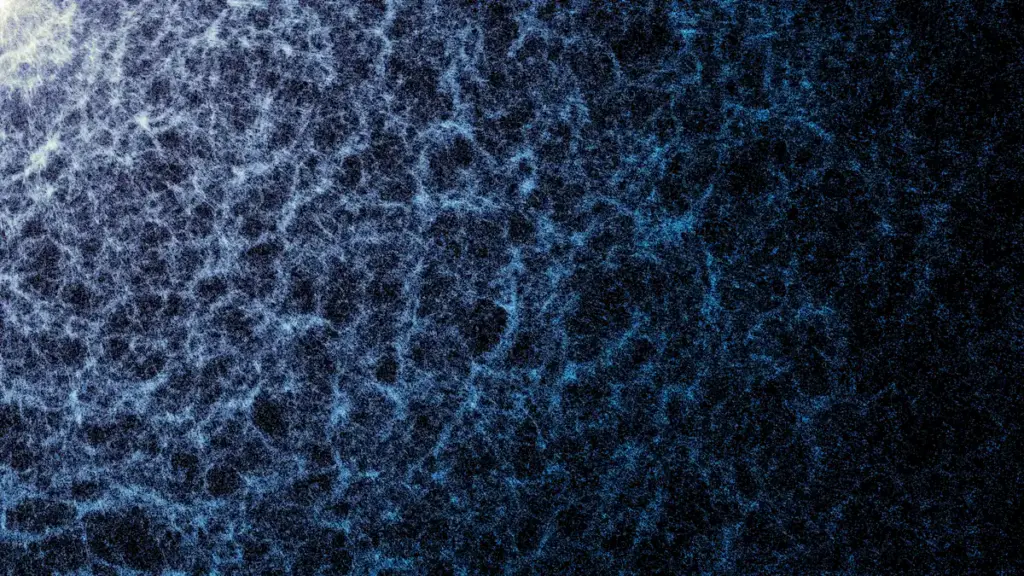
 This is just a small portion of the DESI map, revealing the large-scale structure of the universe. Each dot represents a galaxy. Credit: DESI Collaboration and DESI Member Institutions/DOE/KPNO/NOIRLab/NSF/AURA/R. Proctor (image); M. Zamani/NSF NOIRLab (image processing)
From a mountaintop in Arizona, an army of robotic eyes has spent the last five years staring into the universe’s deep past. They captured ancient light that began its journey across the cosmos up to 11 billion years ago.
On Tuesday, April 14, scientists completed the primary mission of the Dark Energy Spectroscopic Instrument (DESI) ahead of schedule. The team successfully built the largest, highest-resolution 3D map of the cosmos ever constructed.
The completed map charts over 47 million galaxies and quasars — the ultra-bright cores of distant galaxies powered by supermassive black holes. It also includes 20 million stars right here in our own Milky Way.
This staggering dataset represents a sixfold increase over all previous galactic measurements combined. With this much sophisticated data at hand, astronomers are bracing for a revolution in the field.
By tracking how galaxies cluster across different epochs of time, DESI has found tantalizing evidence that dark energy is weakening. If the final data confirms this, scientists will have to completely rewrite the standard model of cosmology.
“Ultimately, we are doing this for all humanity, to better understand our Universe and its eventual fate,” Stéphanie Juneau, an associate astronomer at the National Science Foundation’s NOIRLab, said in a statement.
Flying through the largest ever 3D map of the Universe, created by the now-completed five-year Dark Energy Spectroscopic Instrument (DESI) survey. Every dot represents a galaxy. The large-scale structure of the Universe is revealed in the way that galaxies and galaxy clusters clump together to form the strands of the cosmic web. The strands are separated by immense voids, creating a vast foam-like structure. Credit: DESI Collaboration and DESI Member Institutions/DOE/KPNO/NOIRLab/NSF/AURA/R. Proctor. Image Processing: M. Zamani (NSF NOIRLab)
Reevaluating the Expanding Universe
In the late 1990s, astronomers realized the universe was not just expanding, but expanding at an accelerating rate. Some invisible force is actively pushing galaxies apart and that force seems to be growing in strength. Scientists called this placeholder concept dark energy. Today, we know it accounts for roughly 70 percent of the universe’s total matter and energy budget.
Yet, we still have no idea what it actually is.
×
Thank you! One more thing…
Please check your inbox and confirm your subscription.
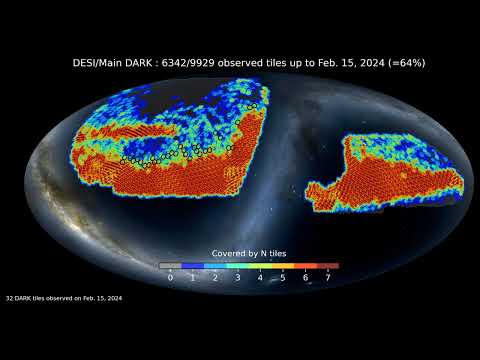
This time-lapse shows DESI’s observations accumulating to fill out the survey’s map during the “Dark-Time Survey,” which focuses on the faintest and most distant objects. Each “tile” is one telescope pointing where DESI records spectra from thousands of objects at once. The tiles overlap to add density to the map, with most areas observed multiple times. (Credit: DESI data: Anand Raichoor/DESI collaboration; Sky map: Axel Mellinger, A Color All-Sky Panorama Image of the Milky Way, Publ. Astron. Soc. Pacific 121, 1180-1187 (2009))
For all this time, the leading theory relied on Albert Einstein’s cosmological constant. Under the standard model of cosmology — technically called the Lambda Cold Dark Matter (LCDM) model — dark energy represents the static energy density of empty space. It should act as a constant, unchanging force throughout all of cosmic history.
But DESI’s early data shows the cosmological constant… isn’t constant at all. Analyzing the first few years of the survey, scientists noticed that the push of dark energy seems to fluctuate over time.
“This is a major paradigm shift. All data up to now were compatible with a standard cosmological model where the accelerated expansion of the universe was caused by a cosmological constant,” Nathalie Palanque-Delabrouille, DESI collaborator and scientist at Berkeley Lab, told science journalist Robert Lea for Space.com. “The weakening acceleration observed by DESI can no longer be explained with a cosmological constant. This could be the most interesting discovery in cosmology since that of dark energy itself.”
“After finding hints that dark energy might deviate from a [cosmological] constant, potentially altering that fate, this moment feels like sitting on the edge of my seat as we analyze the new map to see whether those hints will be confirmed. I’m also very intrigued by the many other discoveries that await in this new dataset,” Juneau added.
A 5,000-Eye Robotic Spectrograph
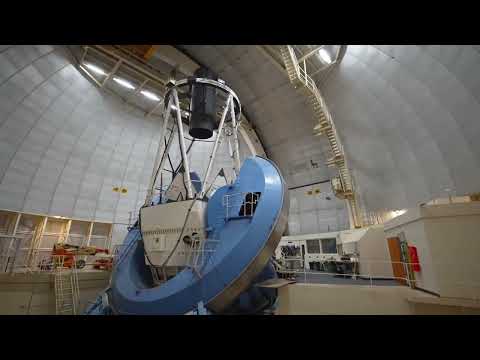
These accelerated time-lapses show how the machinery holding DESI moves the instrument into position. Credit: Marilyn Sargent/Berkeley Lab
How exactly do you map 47 million celestial objects across billions of light-years? You build the world’s most powerful multi-object survey spectrograph.
Engineers mounted DESI on the Nicholas U. Mayall 4-meter Telescope at Kitt Peak National Observatory in Arizona. The instrument relies on 5,000 individual fiber-optic sensors.
A small patch of DESI’s 5000 fiber-optic “eyes” at work. The robotic fiber positioners can be seen moving around their patrol area. The fibers themselves are back-illuminated with blue light so that their positions can be measured with the Fiber View Camera. Credit: Claire Poppett/DESI Collaboration.
During operations, robotic positioners automatically aim these tiny fiber-optic eyes at preselected galaxies. Once locked on, ten massive spectrographs split the incoming light into separate colors. This process reveals each galaxy’s exact position, its velocity, and its physical properties.
The speed of this operation is staggering. The telescope targets a new batch of 5,000 galaxies every 20 minutes. On a clear night, the observatory captures over 100,000 galaxies.
“We’ve learned about the instrument over five years, and we know its personality and behavior pretty well. That’s important because having the instrument be so efficient is why we’re here at the end of DESI’s original survey with such great data and so much science coming out,” Connie Rockosi, co-instrument scientist for DESI and a professor at UC Santa Cruz, said in a statement.
The resulting map reveals an entangled cosmic web. There’s a predictable logic to how galaxies are displaced in the universe. They clump together into massive clusters and long, luminous filaments. Vast, empty voids stretch between these glowing strands.
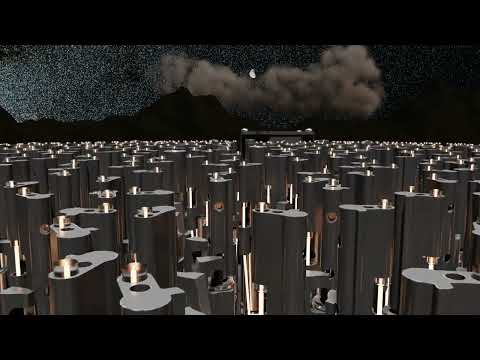
This animation shows a 3D model of DESI’s focal plane. The movement of the 5,000 robotic positioners is coordinated so that they don’t bump into one another. (Credit: David Kirkby/DESI collaboration)
Surviving Fires and Pandemics
The scale of the DESI project mirrors the vastness of the universe it studies. More than 900 researchers from over 70 institutions across 14 countries collaborated on the instrument and its data.
The U.S. Department of Energy’s Lawrence Berkeley National Laboratory led the massive international effort. When the project began its main scientific survey in May 2021, the team aimed to map 34 million galaxies. They beat that goal by over 13 million objects.
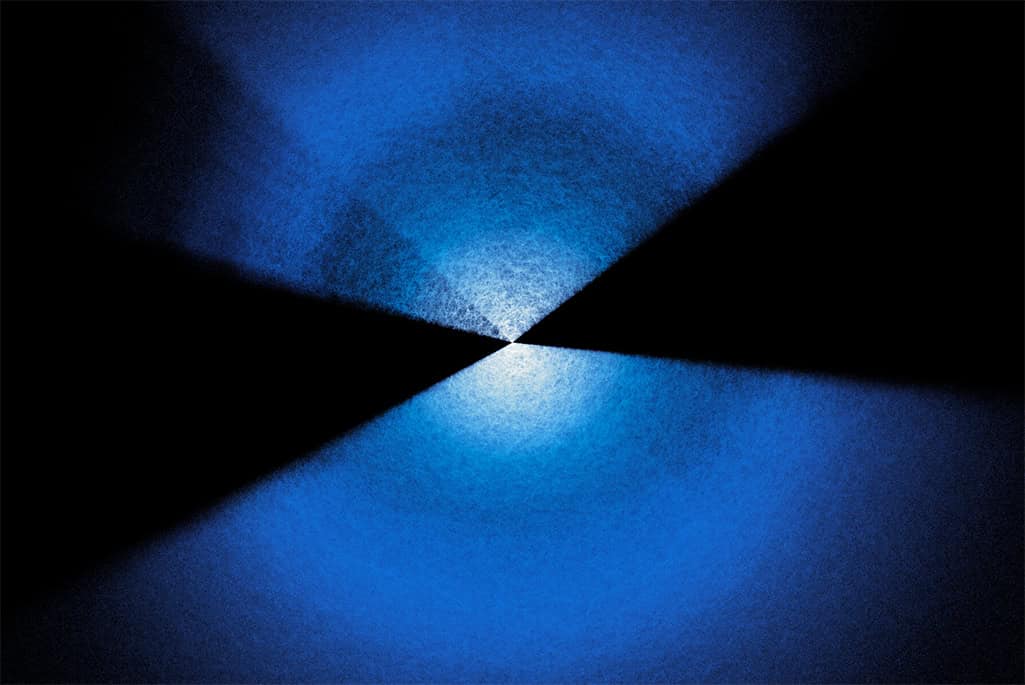 Researchers use DESI’s huge 3D map to study dark energy. Earth is at the center of this map, and every point is a galaxy. Credit: DESI collaboration and KPNO/NOIRLab/NSF/AURA/R. Proctor.
This achievement did not come easily.
“Our ability to complete the survey in five years was challenged more than once. Everyone on the operations team worked incredibly hard to keep the survey progressing with high efficiency. And I think rightly so, we are all very proud that we actually achieved this goal,” Klaus Honscheid, lead scientist of DESI instrument operations, told Space.com.
The team kept the telescope running through the height of a global pandemic. They also survived the devastating Contreras fire, a massive wildfire that swept directly through the Kitt Peak observatory in 2022 and threatened to destroy the entire facility.
Peering Deeper into the Cosmic Web
With the primary five-year mission complete, the team will now hunker down to process the massive mountain of data. The astronomical community expects the first definitive papers on dark energy from the full five-year set to drop throughout 2027.
But the telescope isn’t shutting down.
Scientists will keep DESI scanning the heavens through at least 2028. The extension will grow the cosmic map by another 20 percent. The survey will expand its footprint from 14,000 square degrees of the night sky to 17,000 square degrees.
During this next phase, researchers will push the instrument to its absolute limits. They plan to point the telescope at regions obscured by bright nearby stars, peer through thicker parts of Earth’s atmosphere into the southern sky, and hunt down fainter, more distant objects.
“DESI’s five-year survey has been spectacularly successful,” Michael Levi, director of DESI and a scientist at Berkeley Lab, said in a statement. “We’re going to celebrate completion of the original survey and then get started on the work of churning through the data, because we’re all curious about what new surprises are waiting for us.”
As we look toward those 2027 results, one thing is clear: the universe is a far stranger place than we ever imagined.
“We’ve built a remarkable piece of equipment that met all our expectations and then some,” Levi said. “Now we’re pushing beyond our original plan. We don’t know what we’ll find, but we think it’ll be pretty exciting.”