
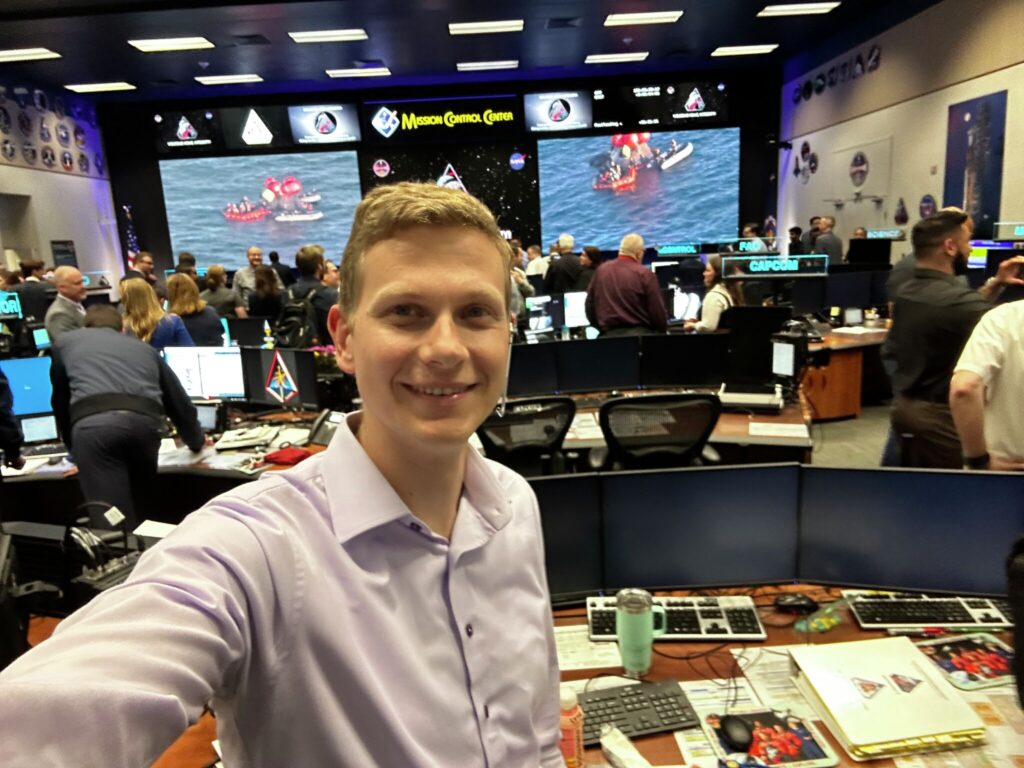
Joshua Kivijarv on April 10, 2026, watching from inside NASA Mission Control as authorities pick up the astronauts from Artemis II who splashed down on Earth after a spaceflight to the moon and back.
Courtesy of Joshua Kivijarv
GREENWICH — Joshua Kivijarv, 32 and a Greenwich native, had a hand in the recent historic Artemis II moon mission, which he said had some people in Mission Control “crying with joy over the data they got.”

Kivijarv, who now lives in Houston where he works for NASA, helped create software that tracked the inventory and location of the items onboard the Orion crew capsule, which was used to transport four astronauts around the moon and back to Earth.
Article continues below this ad
As a flight controller, Kivijarv works in the Flight Operations Directorate, the department of NASA that handles all human space flight. He helps plan flights, train astronauts and is in NASA’s Mission Control Center during flights.
He graduated from Greenwich High School and received a Bachelor of Science in mechanical engineering at Manhattan University in 2017. He then went to the University of Houston, where he received a Master of Science in aerospace engineering in 2023.
Here are 16 questions we had for him.
Article continues below this ad
Joshua Kivijarv when he was five years old in 1999, at his birthday party in the Stamford Museum and Nature Center building a rocket.
Courtesy of Maria Kivijarv
1. What first sparked your interest in space or science as a kid?
Taking stuff apart and seeing how it works, I was always fascinated by that, how the world works. When you understand how the world works, you can use that for good. Later in life, I was looking at what kind of engineering can I do that makes the biggest positive impact in the world. Space exploration is a pretty cool example because so much technology that was developed to go to the moon back in the 60s is in our pockets today and helping us in ways we couldn’t have possibly imagined.
Article continues below this ad
2. Was there a specific moment or experience that made you think, “I want to work at NASA someday?”
A chemistry teacher in college spent the whole lesson talking about the responsibilities of engineering and the consequences of engineering. We spent most of that lesson talking about the Apollo 1 fire in 1967 (which started during a launch test killed the crew members inside), where Gene Kranz, a NASA flight director, made a speech to his flight controllers called “Tough and Competent”. He got all of his flight controllers together and said ‘You have to be better. In fact, you have to be perfect. So to walk into Mission Control, you must be perfect. You must be prepared, and you must be tough and competent”. You could feel the responsibility of mission control coming out of that speech.
Joshua Kivijarv (left), his mother, Maria Kivijarv (front center), and Joshua’s father (back center) and brother (right) pose for a photo at Manhattan University in 2013.
Courtesy of Maria Kivijarv
3. How did your time in school help shape that path to working at NASA?
Article continues below this ad
Senior year at Greenwich High School, I finally got to take physics. Physics is not incredibly complicated stuff but you still are looking at formulas that explain the workings of the universe, like you are speaking the language of the universe. I was just so in awe at learning that new language and being able to explain with math the behavior of the world around me. I studied mechanical engineering in undergrad. Physics was sort of scratching the surface. Engineering school was the deep dive, like fluid mechanics, solid mechanics, materials. I was a kid in the candy store getting to look at the classes I was going to take.
4. What is your favorite piece of space media?
The movie “October Sky.” I still periodically watch that movie. I identify with it. This teenager decided he just had to understand how this thing works. It was almost an existential crisis that he understood how this works and launch a rocket and then he went and made it happen.
5. What is your favorite memory connected to space?
Article continues below this ad
I remember when SpaceX was still trying to land rockets and they had not pulled it off yet. I was watching every attempt. I was watching live when they pulled it off for the first time and I remember losing my mind. I was at my wife’s parents house watching the livestream and I just yelled out.
Joshua Kivijarv (head of the table) when he was five years old in 1999, at his birthday party in the Stamford Museum and Nature Center. He and his friends are building rockets.
Courtesy of Maria Kivijarv
6. What’s your favorite discovery connected to space?
Some of my favorite space discoveries are astronauts figuring out random stuff about how things work in space while they’re on the International Space Station. There’s this one astronaut named Donald Pettit who is just a mad scientist. There’s no other way to put it. He’ll just find stuff on the space station and start doing experiments with it. Those little human moments are just so cool to me.
Article continues below this ad
7. What’s something about working at NASA that would surprise people who only see it from the outside?
It is astonishing how much planning and training goes into flight. If you just took the amount of time spent in flight and compared it to the amount of time spent planning and training it is astonishing.
8. What’s a typical day on the job?
Coming into work, sometimes there’s stuff on my calendar already, like it’s a packed day and I know what I’m doing. Other days, I walk in and I check my email and the first thing I’m doing is figuring out what program needs my attention today. Is it the astronauts currently in low Earth orbit, our ambitions for landing on the moon, the next Starliner mission? There’s a lot to juggle.
Article continues below this ad
9. What missions did you work on beforehand and how did that prepare you for Artemis II?
I work the space station, I work Artemis, we fly the Boeing CST-100 Starliner. I was working on the further out Artemis missions and looking at some of the forward thinking stuff of how do we make sure we’re set up well to stay. The interesting thing about working those further out missions is at some point you look at it and you’re like, I’m working out all this cool, conceptual stuff, but at some point it needs to become a reality. So I need to bridge the gap between the crazy concepts and how do we actually make that happen.
A view of earth taken by NASA astronaut and Artemis II commander Reid Wiseman from one of the Orion spacecraft’s four main windows after completing the translunar injection burn on April 2, 2026.
Courtesy of NASA/Reid Wiseman
10. What was your specific role for the Artemis II mission?
Article continues below this ad
I was the lead for some software that we use for Artemis II that is envisioned to grow and scale with the rest of Artemis. All the stuff the crew is using. Their personal equipment, their cameras, their science equipment, spacesuits, the tracking of all that stuff in the spacecraft, we’re trying to improve that. Once we get to sustain human presence on the moon and we’ve got stuff on the surface, stuff in orbit, stuff there permanently, it’ll become a pretty monumental task to keep track of and coordinate what all we have.
11. How does Artemis II differ from past NASA missions, and why is it such a big deal?
It was our first time launching humans on a Space Launch System rocket (which propels the capsule), first time with humans in Orion (the crew capsule that houses astronauts). So a first time for the life support systems. A lot of firsts systems-wise, because we’ll need Orion for the sustained human presence. They also did quite a bit of science, like getting human eyes on the moon and the portions of the moon that we’re interested in operating on.
NASA’s Artemis II moon rocket lifts off from the Kennedy Space Center’s Launch Pad 39-B Wednesday, April 1, 2026, in Cape Canaveral, Fla. (AP Photo/John Raoux)
John Raoux/Associated Press
12. What were some of the biggest challenges your team faced in preparing for the launch?
Article continues below this ad
It’s a development program. With first of its time comes a lot of uncharted territory, so we’re building from scratch. The space station has been flying for 25 years, so people like me show up in the year 2019 and take for granted that we already have the spaceship up there and we know how to fly it and here’s exactly the processes we go through to get something to the space station and get the job done. Building a program from the ground up is challenging.
13. What was going through your mind as the mission came together and launched?
You’ve got a job to do and then afterwards, you look back and you go, “We actually just launched them into space.” At the time, I was just very hyper-focused on what was happening. And then after the fact, I was like, “Wow, I can’t believe we actually finally did this thing.”
The Artemis II crew answers questions from reporters during the first downlink event of their mission.
Courtesy of NASA
14. For readers who may not follow space exploration closely, what should they understand about the importance of Artemis II?
Article continues below this ad
We don’t want to just go and plant a flag and leave. We want people there to stay. We really are starting from square one again to make sure that we’re going with the right systems, the right processes, that we have the right people trained and the right mindset for permanent human presence. Artemis II was a huge stepping stone for us in that direction.
15. What does this mission mean for the future of space exploration, especially returning humans to the moon?
It’s an incremental step along the way. We can’t just skip right ahead to having a moon base. Artemis II gets us back in the business of flying people to the moon. Artemis II also I think puts America behind human space flight again.
Article continues below this ad
16. On a personal level, what does it mean to you to have played a role in something this historic?
There was a time really not all that long ago where I could consider my life a success if I could work on anything at all that went into space. To be in a place now where all four of the crew we just sent around the moon, I met all of them. That is mind boggling to me.