
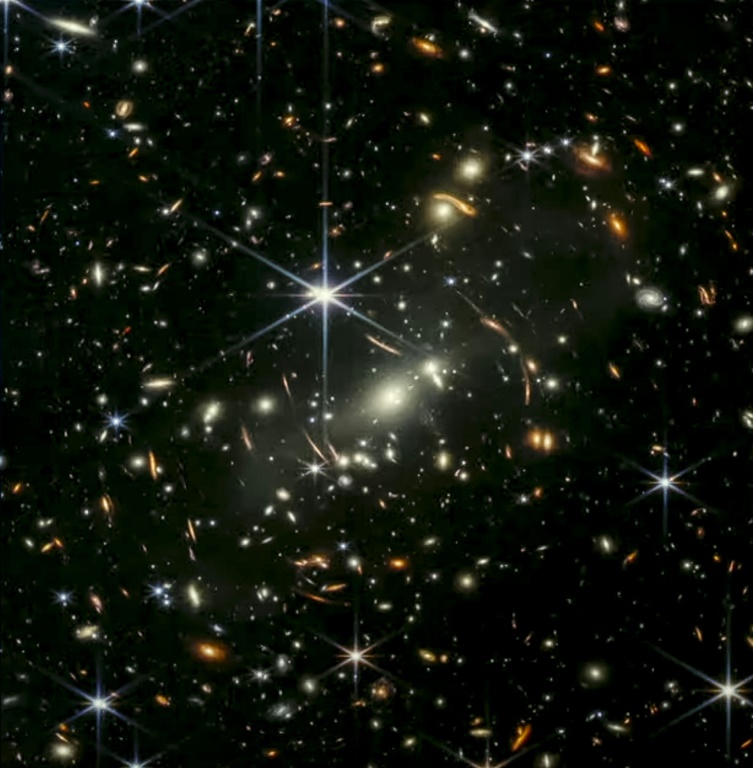
In this screen grab of a White House broadcast the first infrared image from the James Webb Space Telescope (JWST) is seen during a briefing with US President Joe Biden and National Aeronautics and Space Administration (NASA) officials in the South Court Auditorium at the White House in Washington, DC, on July 11, 2022.The JWST is the most powerful telescope launched into space and it reached its final orbit around the sun, approximately 930,000 miles from Earths orbit, in January, 2022. The technological improvements of the JWST and distance from the sun will allow scientists to see much deeper into our universe with greater detail. — © AFP/NASA
The most extensive survey of the cosmos has been conducted, producing the largest high-resolution 3D map of the universe ever made. This comes from scientists at the University of St Andrews, UK.
The map was achieved using the Dark Energy Spectroscopic Instrument (DESI) and the data took five years to collect. This has led to the most detailed 3D map of the universe.
The researchers used the newly created 3D map of the universe to explore dark energy. This is the fundamental ingredient that makes up about 70% of our universe and is driving its accelerating expansion.
By comparing how galaxies clustered in the past with their distribution today, researchers have traced dark energy’s influence over 11 billion years of cosmic history.
Looking for dark matter
The international experiment, which also involved the University of California, Berkeley brings together the expertise of more than 900 researchers.
DESI began collecting data in May 2021. The original plan was to capture light from 34 million galaxies and quasars (extremely distant yet bright objects with black holes at their cores) over the five-year sky survey. DESI instead observed more than 47 million galaxies and quasars and 20 million stars.
DESI is continuing observations and will extend its map to cover more of the sky to better study dark energy as well as dark matter and the evolution of galaxies over time.
DESI’s data also indicates that dark energy, once thought to be a “cosmological constant,” might be evolving over time. If confirmed, this would mark a major shift in how we think about our universe and its potential fate, which hinges on the balance between matter and dark energy.
Telling a unique story
Rita Tojeiro, Professor of Astronomy at the University of St Andrews says: “There is no doubt of the huge impact that DESI is having on cosmology. What is also fantastic about DESI, in addition to being a revolutionary cosmology survey, is that this new three-dimensional map is enabling world-class legacy science.”
Tojeiro adds: “Each of the 47 million galaxies and quasars that DESI observed tells a unique story. We can collect these individual stories to reveal the overarching narratives of how galaxies form and evolve through cosmic time. Because DESI is revealing the three-dimensional cosmic web in which galaxies live with unprecedented detail, we can now study how galaxies respond to cosmic structures around them in ways that have not been possible before.”
DESI has now measured data for six times as many galaxies and quasars as all previous measurements combined. The collaboration will immediately begin processing the completed dataset, with the first dark energy results from DESI’s full five-year survey expected in 2027.
DESI will continue observations until the end of 2028 and the extended map will cover parts of the sky that are more challenging to observe: areas that are closer to the plane of the Milky Way, where bright nearby stars can make it harder to see more distant objects, or further to the south, where the telescope must account for peering through more of Earth’s atmosphere.
Tojeiro adds: “I have been waiting for over 10 years for this cosmic map. Now it is here and we are lucky enough to extend it and make it even better. The level of detail is incredible, and the map is so rich with information! We will be exploring it for 10 years to come.”