
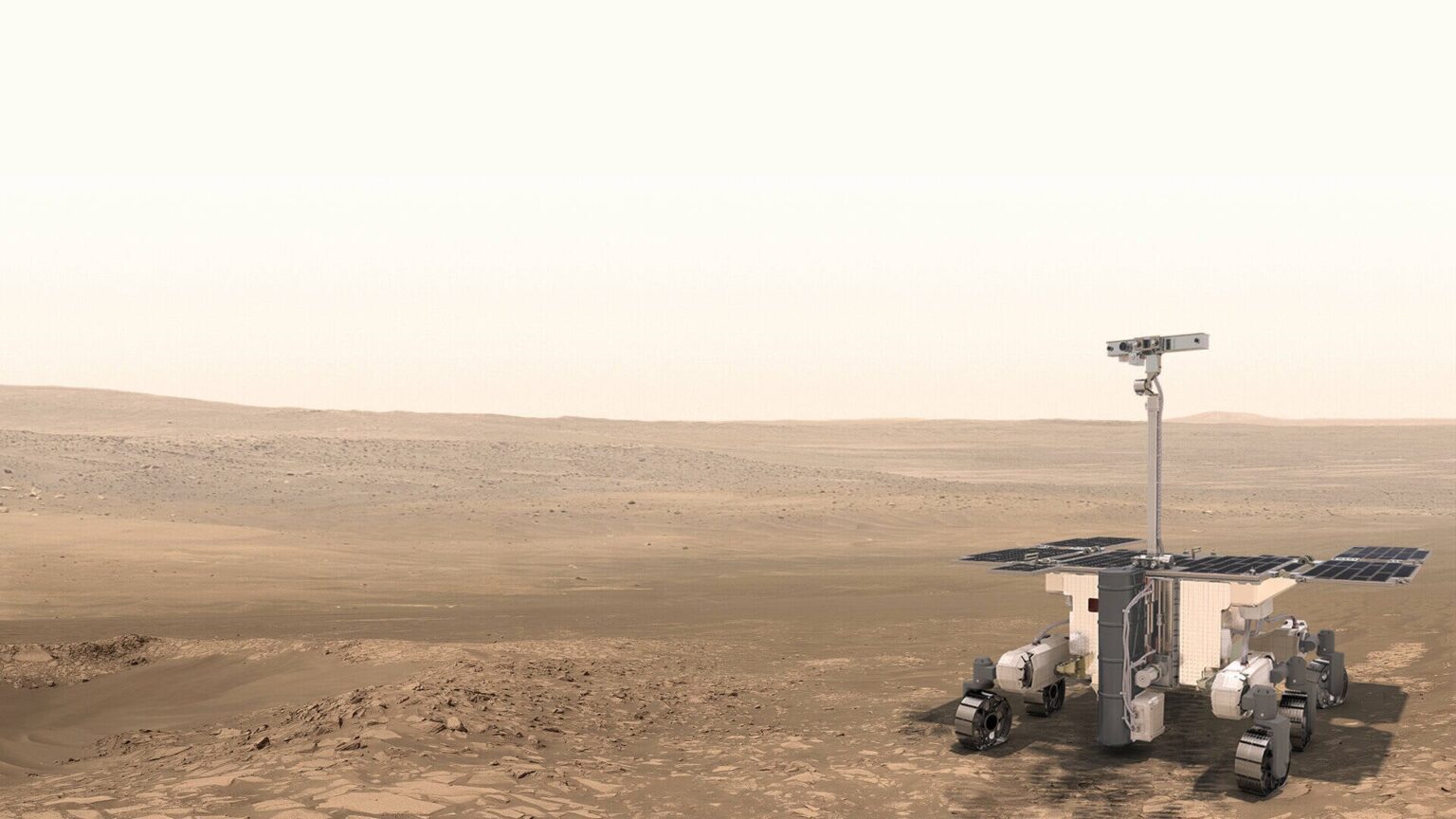
NASA is moving ahead with its contribution to the European Space Agency’s (ESA) long-delayed Rosalind Franklin Mars rover despite another attempt by the Trump administration to cut funding for the effort.
The US space agency announced that its Rosalind Franklin Support and Augmentation (ROSA) project had been approved to begin implementation. It is up to ESA to provide the rover, the spacecraft, and the lander. NASA’s contribution includes braking engines for the lander, radioisotope heater units for the rover’s internal systems, and the all-important launch services.
The plan is to launch the mission to the red planet on a SpaceX Falcon Heavy rocket from Launch Complex 39A at NASA’s Kennedy Space Center no earlier than late 2028.
The rover spent years in storage after its 2022 launch was canceled. Russia had been due to launch the mission and provide other elements, including the lander, but its invasion of Ukraine ended that plan, leaving the rover complete but without a way to get from Earth to Mars.
The six-wheeled rover will be able to drill up to a depth of two meters below Mars’s surface in search of evidence of past life on the planet.
A launch planned for 2020 was previously postponed after problems cropped up during testing.
Assuming nothing causes a delay this time, the mission to Mars will mark the end of more than 25 years in limbo for the rover. The project was conceived in 2001 and NASA came on board in 2009 after inevitable delays. In 2012, NASA confirmed it was dropping out due to budget constraints. Russia then stepped in, but when a launch again appeared possible, the country invaded Ukraine, ending that partnership.
In 2024, NASA and ESA struck a deal to get the Rosalind Franklin rover to Mars, but the NASA side of the equation has faced repeated attempts by the Trump administration to cut the contribution. The most recent proposal was made while the Artemis II crew was on their mission around the Moon.
However, the proposed cuts could be rejected or reversed by lawmakers, as happened last year.
NASA’s approval for ROSA to begin implementation means that the rover, called “snakebit” by one agency insider, might finally get a shot at rolling around the plains of Mars. ®