
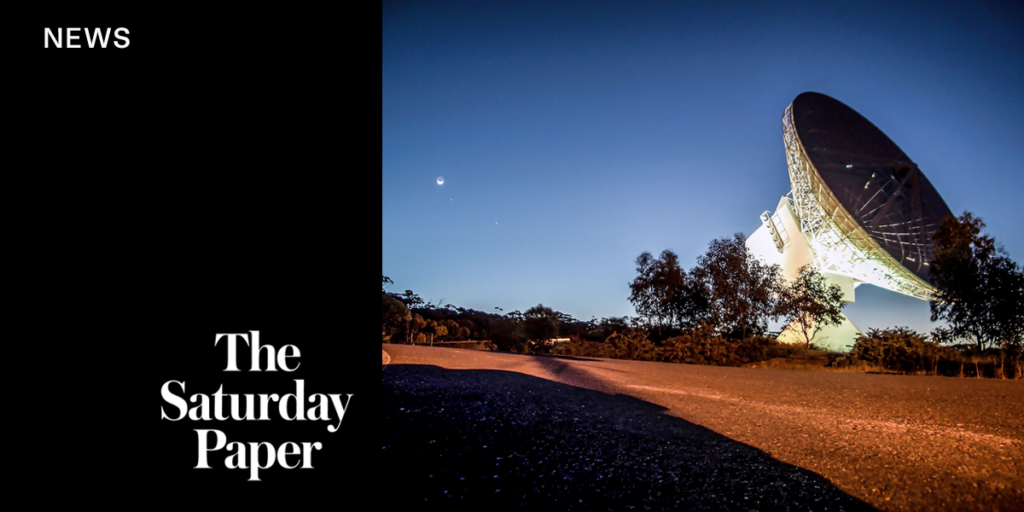
When it comes to space, Australia has long been seen – and seen itself – as a support act who, with telescopes and technology, makes the bigger nations and space agencies look good as they undertake headline-grabbing missions to the moon, Mars and beyond.
Australia has done very well in that role. As every schoolchild learns, the images of astronaut Neil Armstrong setting foot on the dusty lunar surface on July 21, 1969, were beamed around the world via two Australian radio telescopes: Murriyang at Parkes and the long-departed Honeysuckle Creek telescope near Canberra.
The Canberra Deep Space Communication Complex – a partnership between NASA and the CSIRO – is the only telescope able to make the regular interstellar telephone call to the Voyager 1 and Voyager 2 spacecraft. Japan’s Hayabusa2 mission to collect material from the asteroid Ryugu delivered its samples via a capsule in the Australian outback. Australia’s role in enabling communications with the astronauts on this month’s Artemis II mission was also loudly trumpeted by those involved, including the Australian National University and the CSIRO.
Australia is blessed with an abundance of space-friendly resources: prime geographic position in the southern hemisphere for launch, landing and observation; world-leading technological know-how in many space-related fields; world-leading astronomy and astrophysics research; and world-class telescopes.
“From both the astronomy and the space industry perspective, we’re kind of a big deal,” says Rami Mandow, an astrophysicist and PhD candidate at Macquarie University. “I just wish more people knew about it.”
Australia has its own space agency – set up as a specialist division of the federal Department of Industry, Science and Resources by the Turnbull government. Then minister for Education and Training Simon Birmingham announced the Australian Space Agency (ASA) with much fanfare at the International Astronautical Congress in Adelaide in 2017. “This agency will be the anchor for our domestic coordination and the front door for our international engagement with so many of you across the world’s space industries,” he said.
Eight years later, even people within the space sector are questioning whether the ASA is fulfilling – or even has the funds and political support to fulfil – the many hopes and dreams that were pinned to it.
“One of the reasons that the US space industry is so healthy is because the civil space agency invests a lot of money into the commercial space sector, and the public–private partnerships are quite built into the fabric of the agency,” says political scientist Dr Kathryn Robison from the United States Studies Centre and the Australasian Centre for Space Governance. “The hope was that the Australian Space Agency would do that, but it just has never had the amount of budget that it needs to effectively serve as an investor or a customer.”
The agency has administered more than $171 million in grants to 92 projects over the eight years of its operation. In the 2023/24 federal budget, though, the government committed $34.2 million over three years to the ASA – less than half of what NASA spends in a single day. It could have even less after the next federal budget.
“I’ve heard that we’re expecting cuts to the space budget,” Robison says.
“We’re operating the equipment, we’re making sure the equipment doesn’t break, but we’re not engaged in the IP development, nor are we engaging so much in the scientific exploitation.”
Those in the space sector have long wanted Australia to be a leading light in space, and we did get off to a flying start. “Australia’s had a long history in space,” says Professor Steven Freeland, an expert in space law at Western Sydney University and Bond University, and a director of the International Institute of Space Law. The joint Australian and British military project at Woomera in South Australia was launching rockets as early as 1947 and satellites from 1967. At one time, Woomera was the second-busiest rocket launching facility in the world, after NASA’s Cape Canaveral site.
Then things went quiet. “Space fell away a bit after the enthusiasm of the Apollo missions,” Freeland says. The Hawke government attempted to reanimate it in the 1980s with the Australian Space Office , which was then axed in 1996 by the incoming Howard government.
That left a gaping hole in Australia’s global presence. “International organisations or other space agencies and other nations would come to Australia and there was no one to speak to,” says Associate Professor Alice Gorman, an expert in space archaeology at Flinders University in Adelaide. “Space, before the agency, was spread over 11 different departments.”
In the meantime, the Australian commercial space industry was growing. The Space Industry Association of Australia – the peak body for the commercial sector – formed in 1992 to advance the interests of the Australian space industry. Companies such as Optus were putting their own satellites into orbit from China, the start-ups such as Gilmour Space and Southern Launch were moving into the commercial launch and rocket arena, and universities were getting research satellites into orbit.
It was becoming clear Australia needed a single point of contact for its space efforts and aspirations. So after years of lobbying by individuals and organisations, the Australian Space Agency was established to “transform and grow a globally respected Australian space industry”, according to its charter.
The charter also touts the economic benefits of investing in the space industry, and this is where ambition has faltered. “The government has really been investing a lot in what I would think of as like seed grants, or start-up grants,” says Kathryn Robison. “Space really requires a sustained and significant investment for it to be successful for an economy.”
Economic benefits can also come from investing in our sovereign capacity for satellite-based technologies, which are vital for everything from defence and internet to agriculture and disaster response. “People just don’t even realise that we’re touching space 20 to 40 times a day,” Robison says, yet Australia largely relies on other nations for those satellite-based services.
Rami Mandow says that while the big space missions attract all the attention, it’s these Earth-facing satellites that we really need to focus on. “If we could do our own versions of those, that will make us a very prosperous space-faring country.”
Professor Andrew Dempster, director of the Australian Centre for Space Engineering Research at UNSW Sydney, says the commercial space industry in Australia is in a better position now than it was before the agency launched. “You look at what’s been successful in the Australian space sector since the space agency was set up and it’s basically start-ups … that have got a little bit of help from government,” Dempster says.
In his view, though, the Australian Space Agency is also focused too much on being a regulator, which, according to its charter, includes coordinating domestic civil space sector activities, administering space activities legislation and delivering on our international obligations. These responsibilities, he argues, should fall elsewhere, with the agency more “proactive in developing what space assets Australia needs, running missions, creating an environment where space start-ups can get going, all that sort of thing”.
The agency’s regulatory focus has created a tension where companies get support and encouragement from the agency to do space activities, then run into the barrier of the agency’s costly and complex oversight.
“The agency on the promotion side has signed many MOUs [memorandums of understanding] with various countries,” says Freeland. “But the reality is that, with some, it is complex and difficult to translate those arrangements into tangible joint space endeavours. ”
Australia is still acting like a service provider, not a key player, says Professor Simon Driver , an astronomer with the International Centre for Radio Astronomy Research at the University of Western Australia. “We’re operating the equipment, we’re making sure the equipment doesn’t break, but we’re not engaged in the IP development, nor are we engaging so much in the scientific exploitation,” he says.
For all the criticisms, Mandow says Australia is in a better place because of the existence of the Australian Space Agency. But it has a lot further to go – especially in supporting research, which it currently doesn’t do – to really make an impact. “We have the capacity, we have brilliant engineers, we’re going to have a very healthy industry, but it’s a race, he says. “The sooner we can be making contributions from both the industry side and the research side and work together, the better.”
This article was first published in the print edition of The Saturday Paper on
April 18, 2026 as “Lost in space”.
For almost a decade, The Saturday Paper has published Australia’s leading writers and thinkers.
We have pursued stories that are ignored elsewhere, covering them with sensitivity and depth.
We have done this on refugee policy, on government integrity, on robo-debt, on aged care,
on climate change, on the pandemic.
All our journalism is fiercely independent. It relies on the support of readers.
By subscribing to The Saturday Paper, you are ensuring that we can continue to produce essential,
issue-defining coverage, to dig out stories that take time, to doggedly hold to account
politicians and the political class.
There are very few titles that have the freedom and the space to produce journalism like this.
In a country with a concentration of media ownership unlike anything else in the world,
it is vitally important. Your subscription helps make it possible.
Send this article to a friend for free.
Share this subscriber exclusive article with a friend or family member using share credits.

Used 1 of … credits
use share credits to share this article with friend or family.
You’ve shared all of your credits for this month. They will refresh on May 1. If you would like to share more, you can buy a gift subscription for a friend.
SHARE WITH A FRIEND
? CREDITS REMAIN
SHARE WITH A SUBSCRIBER
UNLIMITED
Loading…
Science
The search for dark matter
Atticus Bastow
In an underground laboratory in the goldfields of Victoria, the search for evidence of dark matter connects with cutting-edge research in the mountains of Italy.