
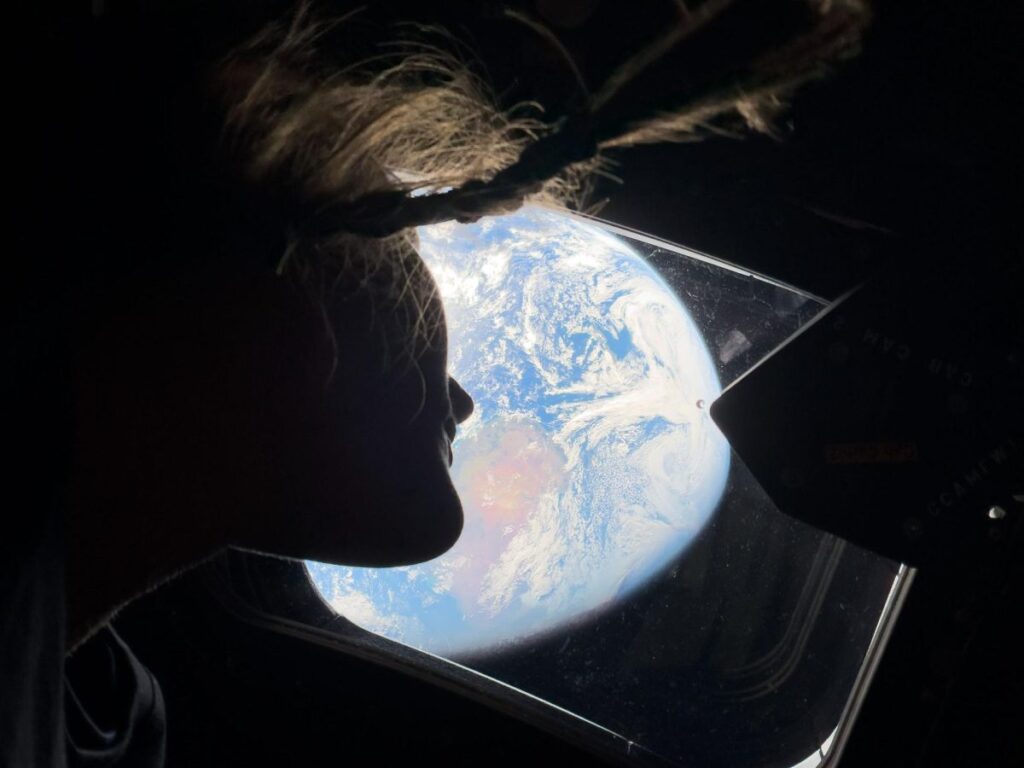
 NASA astronaut Christina Koch views Earth from above – an opportunity she earned by working hard, and caring enough to try in the first place. (Credit: NASA)
The recent, historic NASA moon mission was piloted by four astronauts. And one plush.
Known to the Artemis II crew as “Rise,” the soft, smiling, globe-shaped mascot served primarily as an indicator that the team aboard the Orion spacecraft – which consisted of NASA astronauts Reid Wiseman, Victor Glover and Christina Koch, as well as Canadian Space Agency astronaut Jeremy Hansen – was experiencing zero gravity.
But he quickly became a fixture beyond his purpose. In video transmissions to Earth, his rotund happiness was often present, spinning in the foreground with the help of one of his crewmates.
Rise wasn’t a necessary addition – at least, not in the scientific sense. Something less whimsical surely could have served the same function. But that toy’s inclusion in the mission, and in the crew’s communications, represents in its way what is so compelling about science and exploration in general, and the Artemis II crew specifically: It’s all about openness.
Openness to dreaming of going to space. Openness to putting in years of study and work to make it so. Openness to learning new things, and being wrong about things, along the way. Openness to wondering, and questioning, and yes, maybe even to being silly sometimes.
The crew’s openness drew us in because it’s something we so desperately need here on Earth.
It’s no secret that we are living through a period of not only regression and violence, but extreme upheaval as well. When looking out at the world, and how the bad actors in charge are shifting and twisting and bombing reality into something that is at once depressingly old and alarmingly uncertain… it can feel as though there’s nothing to hold onto for balance.
This recent space expedition captured the world’s attention not just because it was an unprecedented and otherworldly sight – but also, because it was real, and fun, and hopeful, and full of wonder and heart.
But you don’t get to join the crew that flies to the moon with a plush packed beside you by accident, or by being unaffected, or inert. You don’t get to experience the vastness of space firsthand, or the sight of Earth as a distant crescent, without thinking and feeling and acting beyond yourself.
You don’t become the first woman and the first Black man to visit the moon – as Koch and Glover were, respectively – by being passive. You have to give enough of a damn to rise above the obstacles put in place by a sexist, racist society that’s growing more so by the day. And, you have to work for people who embody that cherished openness to others, who will light the path to the rocket that launches you into the stars.
In order for the seemingly unreachable to come into your grasp, you have to open your heart enough to care – and then, you have to try.
If you want to do something as miraculous-sounding as exploring the cosmos – or, to shift back to earthly concerns, building bridges between people divided by chasms – you can. Humans have now performed both miracles, right before our very eyes.
But you have to have a mind that is curious enough to ask questions, outwardly and inwardly… a mind so dedicated to knowing more that it will sit atop an explosion, for the sake of being tossed through the atmosphere, just to see what lies beyond. And, you need to have a heart big enough and open wide enough to care – enough to transmit love and joy as well as data from space to Ground Control, enough to place the names of lost loves upon the moon, enough to adore all of the children looking up from Earth below… and even the plush orbs among us.
And then, you have to actually reach up, and out. ◼️
 Here’s to Rise, the Artemis II crew’s smallest member – and what he, too, asks us to recall. (Credit: Instagram)