
Back to Article List
This bright, breakout comet has cracked naked-eye magnitude and should be easy to spot with binoculars or a smartphone before dawn.
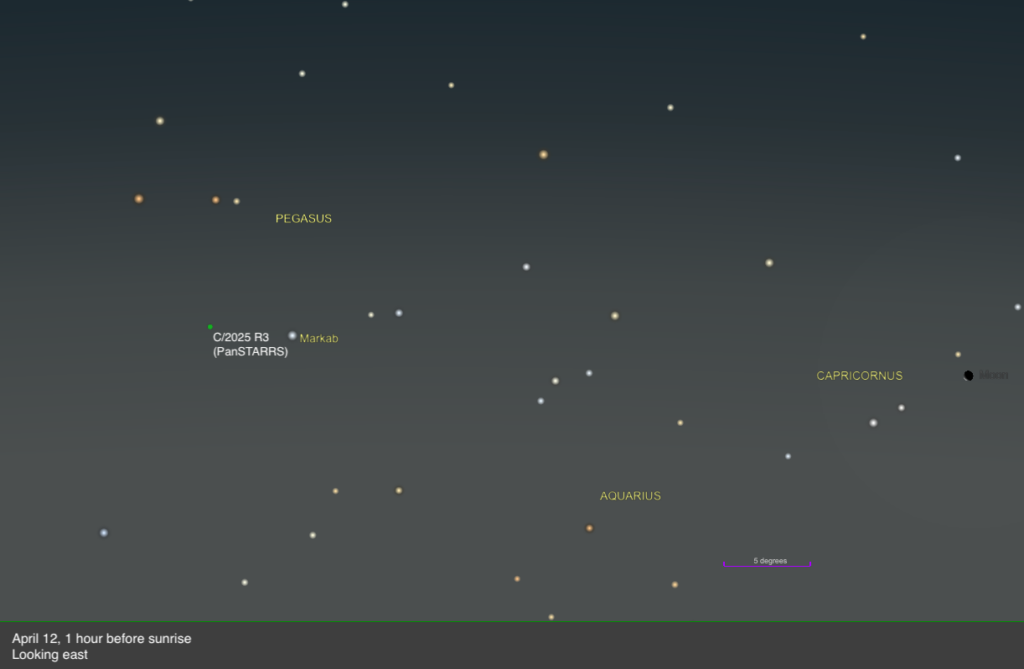
Look for the brightening Comet C/2025 R3 (PanSTARRS) in the hour before dawn, now skimming through the Great Square of Pegasus. Credit: Alison Klesman (via TheSkyX)
Looking for a sky event this week? Check out our full Sky This Week column.
April 11: Comet Tempel 2 in Scutum
While Comets Wierzchoś and Tempel 2 are faint, there’s a breakout star in the early-morning sky that’s cracked naked-eye visibility: Comet C/2025 R3 (PanSTARRS). Recently recorded at mid-5th magnitude, although this interplanetary fuzzball is technically within reach of naked eyes, your best bet will be to view it with binoculars or a small scope — or capture it with a several-second exposure using your smartphone.
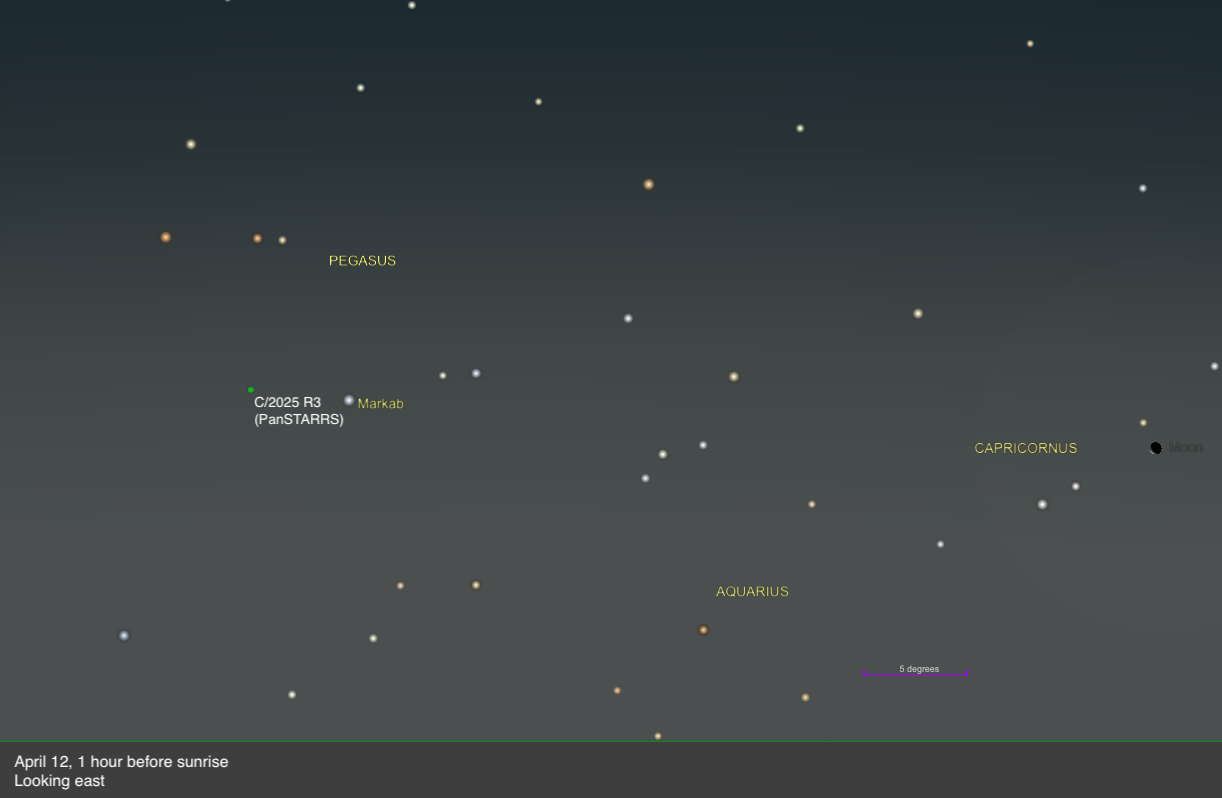
This one is for early risers, though — currently flying through Pegasus the Winged Horse, the best time to look for PanSTARRS is about an hour before sunrise, when it’s reached nearly 20° high in the east, inside the Great Square of Pegasus. Today the comet is near magnitude 2.5 Markab, Pegasus’ alpha star. As the Great Square rises, Markab makes up the point farthest right as the southwesternmost point of the Square. This morning, the comet is just 5.3° northeast of this star, rendering both visible in the same binocular field of view and offering a great signpost to find it.
Astronomers expect — and hope — that this comet might reach up to 4th magnitude this month, but it is also sinking quickly toward the horizon day by day, making it more challenging to catch. About a week from now, the comet will rise just an hour before the Sun, reaching ready visibility only 30 minutes or so before sunrise, as the sky is growing quite bright. Keep following it as long as you can!
Sunrise: 6:26 A.M.
Sunset: 7:36 P.M.
Moonrise: 4:00 A.M.
Moonset: 2:24 P.M.
Moon Phase: Waning crescent (23%)
*Times for sunrise, sunset, moonrise, and moonset are given in local time from 40° N 90° W. The Moon’s illumination is given at 10 P.M. local time from the same location.