
Innovations in industrial science: assembly facility and vehicle integration tooling, new fin-like strakes, and friction stir welding
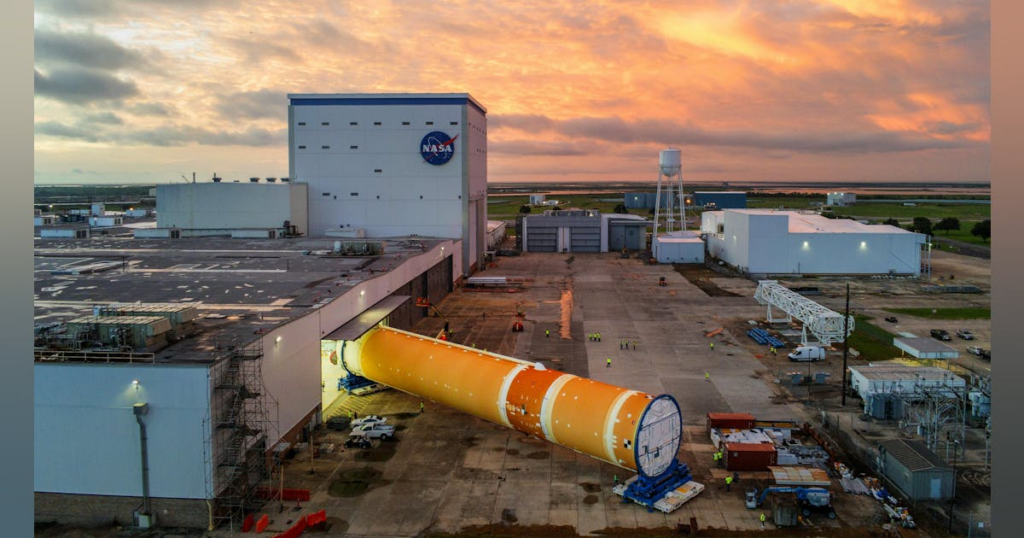
This core stage and future Artemis mission stages are being built at the Michoud Assembly Facility, which includes the largest friction stir welding tool in world. It is used to join the aluminum-lithium tank sections with stronger, lighter joints. The facility can build several core stages simultaneously with the large welding machines. There, the core stage is outfitted with avionics, thermal protection systems, propulsion systems, and other internal hardware. After the structure is fully assembled, the four engines are added.
SLS construction took a big engineering step forward inside the Vehicle Assembly Building (VAB) at NASA’s Kennedy Space Center in Florida, where the pieces built at Michoud were put together. The VAB’s High Bay 2 is tall enough to facilitate the vertical integration of the SLS core stage inside the facility.
The enormous building can suspend the fully assembled SLS 225 feet in the air to complete work before it is stacked on the mobile launcher. Technicians have 360-degree tip to tail access to the core stage, and the vertical capability allows them to do parallel processing from top to bottom, which is a much more efficient way to build core stages.
Michigan-based Futuramic Tool and Engineering led the design and build of the Core Stage Vertical Integration Center tool, which holds the core stage in a vertical position. High Bay 2 tooling was originally scheduled to begin with Artemis III, but the team was able to complete it earlier, effectively doubling the usable manufacturing space with the VAB. It also frees up space at Michoud for future SLS core stages.
After the Artemis I launch in 2022, Boeing and NASA evaluated post-flight data and discovered the SLS rocket experienced higher-than-expected vibrations near the solid rocket booster attachment points. The vibration was determined to have been caused by unsteady airflow in the gap between the core stage and the two solid rocket boosters. After wind tunnel testing and computations fluid dynamics simulations, the team added four strakes (thin, fin-like metal structures) to the core stage to reduce vibrations by steadying the airflow.
The stage also integrates modern digital engineering practices, including model-based design and simulation, to validate performance before physical production.
NASA’s SLS rocket, powered by a Boeing-built core stage, is the only super-heavy lift rocket ever built for deep space. It integrates legacy propulsion (Space Shuttle–derived RS-25 engines) with modern digital engineering and advanced welding processes. The heritage engines also saved time and cost in developing the next generation. Model-based design, digital twins, and tighter tolerance control across massive assemblies were a major step forward in designing large, safety-critical structures. The stage also integrates modern digital engineering practices, including model-based design and simulation, to validate performance before physical production. The extensive pre-flight testing shows a strong eye for safety, as well as the structural design simulations and testing with terabytes of data done before anything was ever built.