
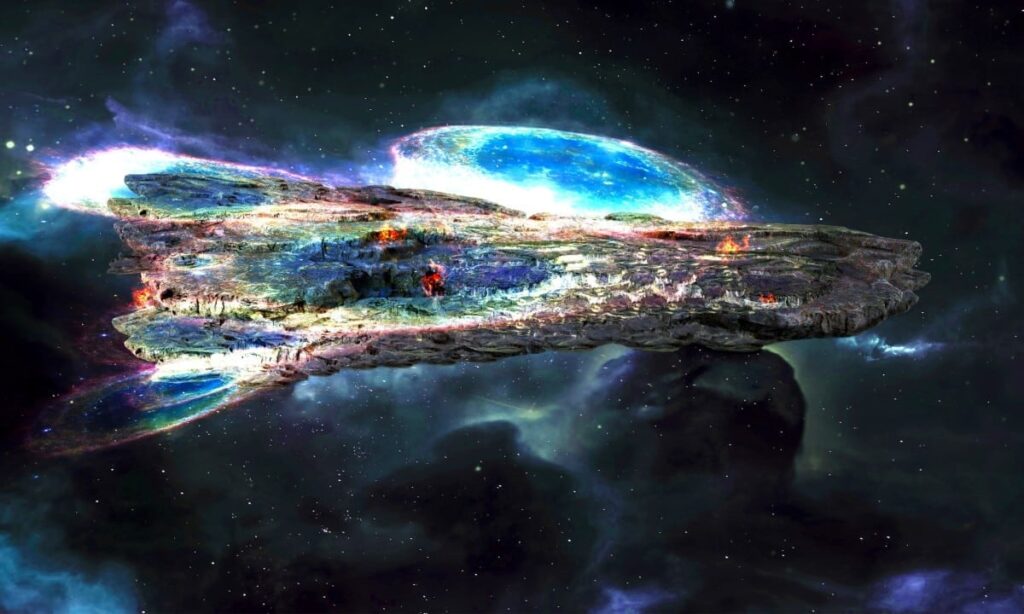
Photo: Imagens 3D do cometa 3I ATLAS – Photo: jhonny marcell oportus/ shutterstock.com
The exploration of the cosmos reached an unprecedented level in October 2025, with the Chinese probe Tianwen-1, in full operation in the orbit of Marte, managing to obtain high-resolution images of comet 3I/ATLAS. Este remarkable feat marks the first time that an object of interstellar origin has been imaged from the orbit of another planet, representing a monumental advance for planetary science and modern astronomy.
The historical record was made at a considerable distance of approximately 30 million kilometers from the celestial body. The operation required highly precise orbital maneuvers and detailed planning by Administração Espacial Nacional of China (CNSA), demonstrating the advanced technical capacity of the country’s space program. The images captured are of invaluable value to the global scientific community, which now has crucial data to further study the composition and trajectory of objects that visit our Sistema Solar from other stars.
The passage of comet 3I/ATLAS close to Planeta Vermelho generated an international mobilization. Diversas space agencies repurposed their instruments to collect as much information as possible, turning the event into a collaborative effort. Essa cooperation was essential to cross-reference data from different sources and obtain a more complete understanding of the nature of this rare and fascinating cosmic visitor.
Visitor profile from another solar system
Comet 3I/ATLAS is the third object with a confirmed origin outside our Sistema Solar to be detected, following in the footsteps of ‘Oumuamua, observed in 2017, and 2I/Borisov, identified in 2019. passage through our system. With an estimated diameter of 5.6 kilometers and moving at an impressive speed of 58 kilometers per second, its analysis offers a unique opportunity to study materials that were formed in the protoplanetary disk of another star. Esses objects function as true cosmic time capsules, carrying primordial information about their systems of origin and providing valuable clues about how other planetary systems form and evolve in Via Láctea. The scientific interest is immense, as they can reveal the chemical and physical diversity of other corners of the galaxy, allowing scientists to compare the “recipe” of other systems with our own.
The technology behind the unprecedented capture
The HiRIC (High Resolution Imaging Camera) high-resolution camera, one of the main instruments aboard the Tianwen-1 orbiter, was the centerpiece for the success of this observation. Originalmente designed with the aim of mapping the surface of Marte with an exceptional level of detail, the Chinese mission engineering team demonstrated great versatility in adapting its use. The camera was reconfigured to track a small, extremely faint, fast-moving target against the dark background of deep space, a task it was not initially designed for.
[[MVG_PROTECTED_BLOCK_0]
To overcome the challenges posed by the comet’s high speed, which could easily result in blurry images without scientific utility, the CNSA team carried out exhaustive computer simulations. The final strategy involved the use of extremely short exposure times combined with precise target tracking. Essa technique optimized light capture without compromising sharpness. The raw data was then transmitted to the control center at Pequim, where a powerful image processing system assembled the sequences, revealing the comet with unprecedented clarity for an otherworldly observation.
What the images revealed about 3I/ATLAS
The photographs released by the Chinese space agency show with great clarity the rocky and frozen core of 3I/ATLAS, the heart of the comet.
[[MVG_PROTECTED_BLOCK_0]
This nucleus is surrounded by a coma, a diffuse cloud of gas and dust that forms when the heat from Sol sublimates the ice present on the comet’s surface, releasing material into space.
The coma reached a diameter of thousands of kilometers, an indication of very intense cometary activity. The tail, formed by dust particles and ions pushed by the pressure of solar radiation, extended for around 56 thousand kilometers, positioning itself in the opposite direction to Sol.
[[MVG_PROTECTED_BLOCK_0]
Preliminary spectral analyses, based on data collected by other instruments, suggest the presence of water ice and carbon dioxide. Também signs of carbon monoxide were identified, a composition that points to a formation in an extremely cold region of its home star system.
A scientific collaboration on a planetary scale
The 3I/ATLAS observation was not an exclusive effort by China. Agência Espacial Europeia (ESA) also played an important role, using its Mars Express and ExoMars Trace Gas Orbiter probes.
This equipment was used to analyze gaseous emissions from the comet’s coma, providing a complementary perspective to the visual data obtained by Tianwen-1.
NASA also actively participated, directing Mars Reconnaissance Orbiter (MRO) to capture images with its powerful HiRISE instrument. On the surface, rovers like Perseverance tried, albeit with great technical difficulty, to detect the comet from the Martian soil.
Context of the mission Tianwen-1 on Marte
Launched in July 2020, the Tianwen-1 mission is a milestone for the Chinese space program, consolidating the country as a power in interplanetary exploration. The probe successfully entered the orbit of Marte in February 2021, consisting of an orbiter, a lander and the Zhurong rover.
In May 2021, the Zhurong rover landed on the vast plain of Utopia Planitia. Durante its mission of approximately one Earth year on the surface, the vehicle collected geological data, analyzed the composition of the soil and atmosphere and sent back detailed images of the terrain, expanding knowledge about the geological history of Marte.
Meticulous planning for a historical record
The Tianwen-1 mission team began planning to observe the comet in September 2025, as soon as orbital predictions became accurate enough to guarantee the success of the endeavor. The complex calculations took into account the high relative speed between the probe and the comet, in addition to the low luminosity of the object.
The entire process was designed to ensure that the probe was in the correct orbital position and that its instruments were properly calibrated at the exact moment of passage. The complexity of the maneuver reinforces the China’s ability to carry out highly technically difficult space operations autonomously.
Next steps for the Chinese space program
The successful observation of 3I/ATLAS serves as an important validation of the technologies and methods that will be used in future deep space exploration missions by China. The experience gained strengthens the Sistema Solar exploration program for smaller bodies, such as asteroids and other comets, which is one of CNSA’s main focuses for the next decade.