
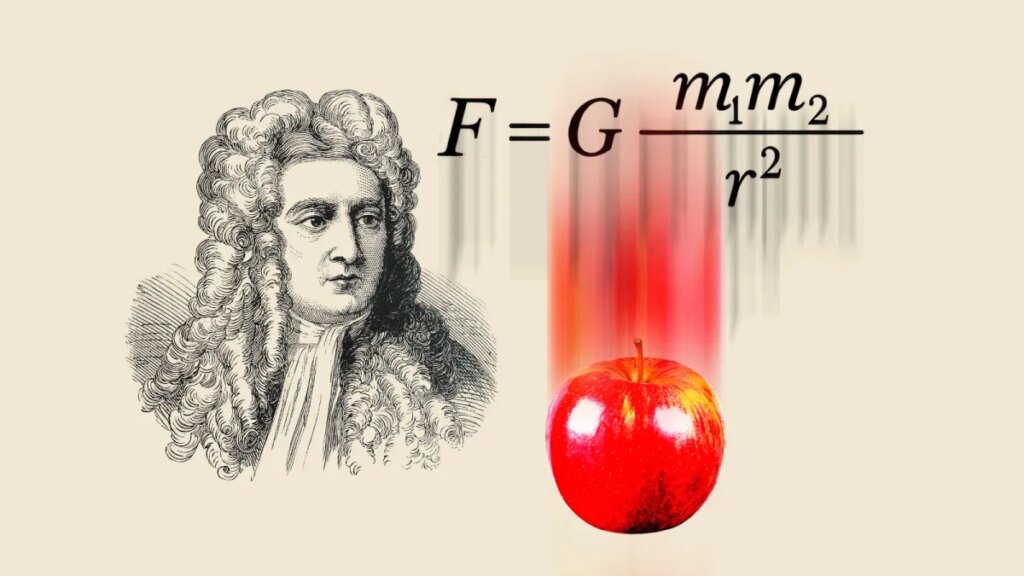
The latest effort to measure the strength of gravity has ended much as it began: with the force that holds the universe together still eluding scientists.
For ten years, a team led by Stephan Schlamminger of the National Institute of Standards and Technology (NIST) in the United States sought to measure the value of the gravitational constant, a property known as “big G”.
In essence, it is the number that tells you how strongly objects attract one another. Every time you drop your keys, weigh yourself or watch the moon circle the Earth, gravity is at work — and big G describes its strength. It governs both the fall of an apple and the motion of galaxies.
Yet, after more than two centuries of measurement attempts, scientists are still arguing over its exact value. Unlike other fundamental constants, which are known to many decimal places, big G refuses to settle down. Different experiments have consistently returned slightly different answers.
It is a “humbling” reminder, Schlamminger says, that there are still some very basic things we do not know.
 Stephan Schlammingerjennifer lauren lee/nist
He and his colleagues set out to repeat an earlier experiment conducted at the International Bureau of Weights and Measures in France. They asked whether it would give the same result in different hands. If it did, confidence in the result would grow. If not, the mystery would deepen.
The apparatus is a refined version of a set-up devised by Henry Cavendish, the English scientist, in 1798. It relies on a torsion balance: roughly speaking, a thin wire from which a small set of weights is suspended. When nearby masses pull on the weights through gravity, the wire rotates by a minuscule amount.

In the NIST version, precisely machined metal cylinders were arranged to attract the suspended weights.
The twist in the wire was invisible to the eye but measurable with sensitive instruments. From that twist, the gravitational force, and big G, could be inferred.
During the decade his team spent tweaking the apparatus for accuracy, Schlamminger took a precaution: he was blinded to the results his experiments were producing. One of the hazards in precision science is knowing what answer you “ought” to get. Researchers, without meaning to, may be tempted to stop refining their methods once their results look plausible.
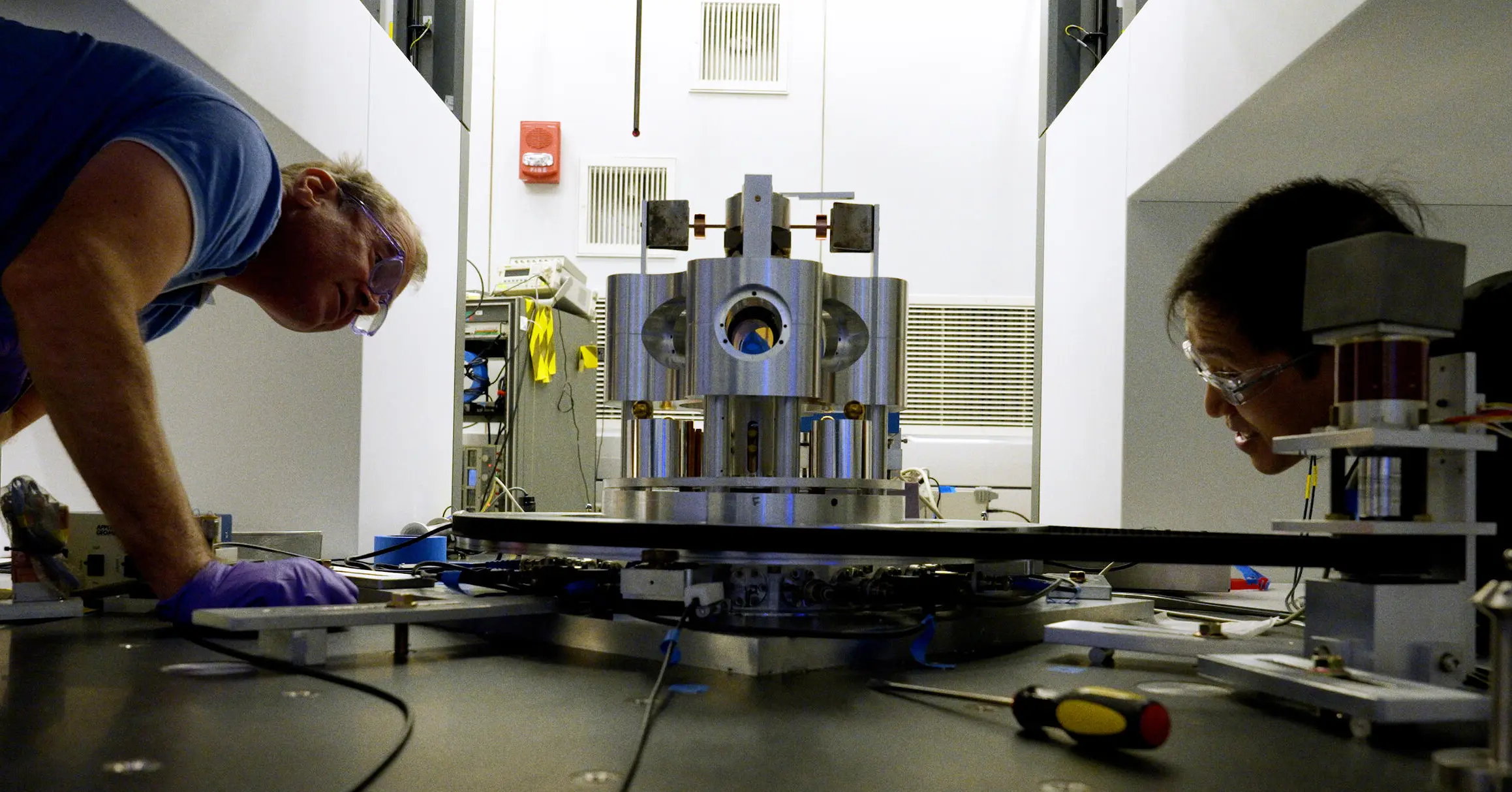 Schlamminger, left, and Vincent Lee, a fellow scientist, examine the torsion balance
To avoid this, a colleague added a small, unknown figure to key measurements. The value of this figure was sealed in an envelope. For years Schlamminger analysed data that he knew was out by a certain margin, without knowing by how much. Only at the end, on a conference stage, was the envelope opened and the true number revealed.
His final value for big G was 6.67387 × 10⁻¹¹ cubic metres per kilogram per second squared. The units reflect how gravity works: the force depends on mass, distance and how that force translates into motion.
This differed from the earlier French measurement by about 0.02 per cent. In many settings, that would be negligible. Here, it is too much. Big G remains the least well known of the constants that underpin physics.
Daily Briefing newsletter
Get our top stories and exclusive analysis sent straight to your inbox every morning.
Sign up with one click
Why does this matter? One answer is that, in practical terms, it does not. Astronomers often deal in combinations such as big G multiplied by the mass of the Earth or the sun, values that can be determined very precisely by observing the motion of these bodies. Big G on its own rarely features in engineering or technology.
But the disagreement between experiments may hint at something deeper. The failure to pin down big G could reflect the difficulty of the measurements: almost any “noise” in the lab — the vibration of a passing lorry, say, or static electricity on a lab coat — can easily swamp the tiny gravitational signal force between two relatively small objects.
Or the inconsistency could be a tantalising sign that something is missing from our ideas of how the universe works. “That’s a very exciting, if remote, possibility,” Schlamminger says.
The Standard Model, the best framework physics has for describing nature, accounts for three of the four fundamental forces: electromagnetism, and the strong and weak nuclear forces. For now, it does not explain gravity, by far the weakest of the quartet. If a theory eventually emerges to fill that gap, a reliable value for big G would provide something to test it against.
For now, though, Schlamminger seems unperturbed. There is, he suggests, something invigorating about the lingering uncertainty. In an age of often dizzying scientific advances, big G is a reminder that fundamental truths remain unknown.
Schlamminger said there is still “terra incognita” out there, unknown territory waiting to be mapped.