
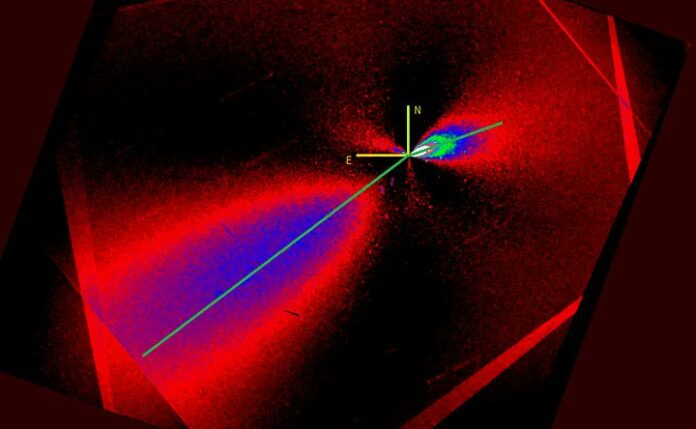
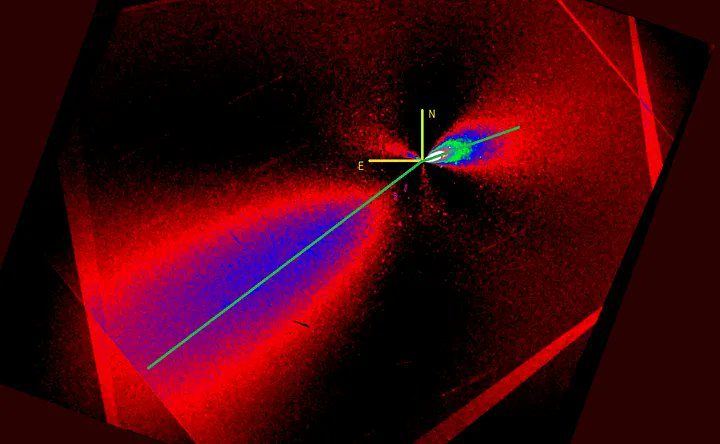
 Processed Hubble image of interstellar object 3I/ATLAS highlighting a persistent sunward anti-tail and a secondary jet, with orientation markers overlaid to show the object’s geometry and the anti-correlated jet structure observed across multiple epochs.
An unexpected brightness swap between twin jets suggests order, not decay, as scientists track a repeating rhythm from an interstellar visitor.
The latest frames do not quiet the story. They sharpen it.
[USA HERALD] – On December 12 and again on December 27, NASA’s Hubble Space Telescope captured high-resolution images of interstellar object 3I/ATLAS that reveal a stable, double-jet structure behaving in a way few expected to see persist this far past perihelion. Across the two observations, the jets do something striking: as one brightens, the other fades. The swap is clean, repeatable, and geometrically consistent. This is not random outgassing. It is anti-correlation.
I examined the raw morphology and brightness distribution, paying particular attention to orientation and persistence. The dominant feature remains a sunward anti-tail—something already observed earlier in the year. What is new, and what demands attention, is the continued presence and behavior of a secondary jet that does not dissipate or wander. Instead, it returns. Structured. Coherent. Aligned. The two jets trade dominance as though governed by a shared mechanism rather than independent bursts.
Previous articleTrump Pushes Automakers Toward Tiny Cars As Affordability Crisis DeepensNext articleNew Image Reveals Persistent Energy Asymmetry Around Interstellar Object 3I/ATLAS 
With over 20 years of experience in the legal and insurance sectors, Samuel applies his profound legal acumen to investigate and accurately report on the facts.