
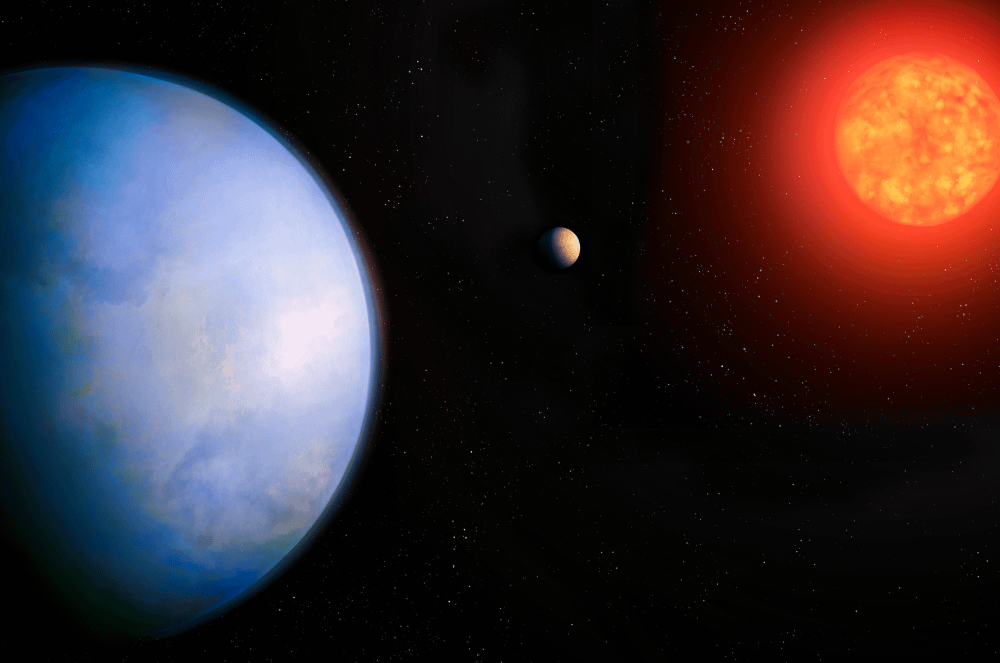
Astronomers announce discovery of a “Super-Earth” in the habitable zone of a red dwarf star just 22 light years away
by ChiefLeef22
Astronomers announce discovery of a “Super-Earth” in the habitable zone of a red dwarf star just 22 light years away
by ChiefLeef22
26 Comments
https://www.psu.edu/news/research/story/newly-discovered-super-earth-offers-prime-target-search-alien-life
>A massive exoplanet discovered orbiting a nearby dwarf star is well positioned for next-generation telescopes to search for signs of life
>The discovery of a possible “super-Earth” less than 20 light-years from our own planet is offering scientists new hope in the hunt for other worlds that could harbor life, according to an international team including researchers from Penn State. They dubbed the exoplanet, named GJ 251 c, a “super-Earth” as data suggest it is almost four times as massive as the Earth and likely to be rocky planet.
Super Earth you say? 👀

“Just 22 light years away” I know that in the space it’s a pudle jump but it always gets me that someone is referring to this huge distance with a word “just”.
My wife is asking if we can send all GOP goals to this place?!
say RIP to the joints whoever decides to colonize that ball of rock.
“Just” (pretty cool discovery though!)
Just 22 light years away
“Just”
Basically next door, not that we can ever travel even a single light year away.
I always wonder with the possibly habitable planets that differ greatly in size – won’t the gravity on them be either absolutely crushing or way too weak? Or can life, as it does in our deep oceans for example (I know that in this case it’s pressure and not gravity but I digress), evolve to adapt to whatever gravity it evolves in?
Can’t wait to be disappointed by this one too
So cool! Arent red dwarfs alot less…warm tho? Maybe im thinking of something else. But is there a real habitable space around those stars? Would it be super close? Would that planet have an atmosphere?
Well what are we waiting for? Let’s go check it out
aka the Human Habitable Zone. Our idea of habitable zones now is naive, the moons of our own gas giants will prove
3 weeks later: Scientists have confirmed the planet is most likely not Earth-like and uninhabitable….
‘just’ 22 light years away… just a ~120 trillion mile hop, skip and jump.
Could you imagine, this is where octopus come from
…just 2,081 × 10^14 Km away.
Just tell us already you’ve found life beyond earth this constant edging is awful
>Earth like planet discovered
>Look inside
>The ground gives you cancer or smth
“just” doing A LOT of work in that title
To be clear, the fastest thing we have would take like 30k+ years to get there
For context, if we could travel at Voyager 1’s speed of 61,200km/hr to get there, it would take a mere 390,000 years.
Just a day trip, let’s go!
Only 22 light years away. We can make that by next Tuesday.
Only 22 ly 😂😂😂