
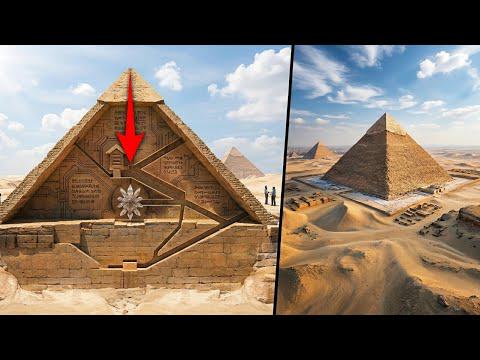
For a long time, standard history has told us that the pyramids were simply monumental tombs. But when you closely examine the internal architecture—the precision of the shafts, the usage of materials like granite and quartz, and the specific geometric dimensions—the "tomb" theory starts to face serious unyielding questions.
Many independent researchers suggest these structures were designed as complex resonant machines or ancient power plants, utilizing thermal gradients and electromagnetic conduits.
What are your honest thoughts on the alternative engineering of the Giza plateau? Do you think the mainstream narrative is missing a massive piece of ancient advanced technology?
P.S. I’ve spent weeks gathering the visual evidence and deep-diving into this architectural anomaly for a documentary-style video breakdown. If anyone wants to see the visual layout and the full breakdown of how these chambers could have functioned as conductors, I’ve uploaded it herehttps://youtu.be/Te0JzijOhUs?si=c5bmhrjU3PZ63nI0
by DarkArchive_Official
2 Comments
Technology doesnt get made in a vacuum. Where are the workshops to build the parts that would go into a generator? Even if there was just one, itd be built on technology that was around. We just dont see any technology from the archeological record that’d support a power generator in ancient Egypt.
The pyramids were tombs. Thats it.
I don’t know what the pyramids were used for, but I don’t really believe they were built as huge mausoleums for pharaohs. Correct me if I’m wrong, but I didn’t think anyone ever found mummies entombed in any pyramid