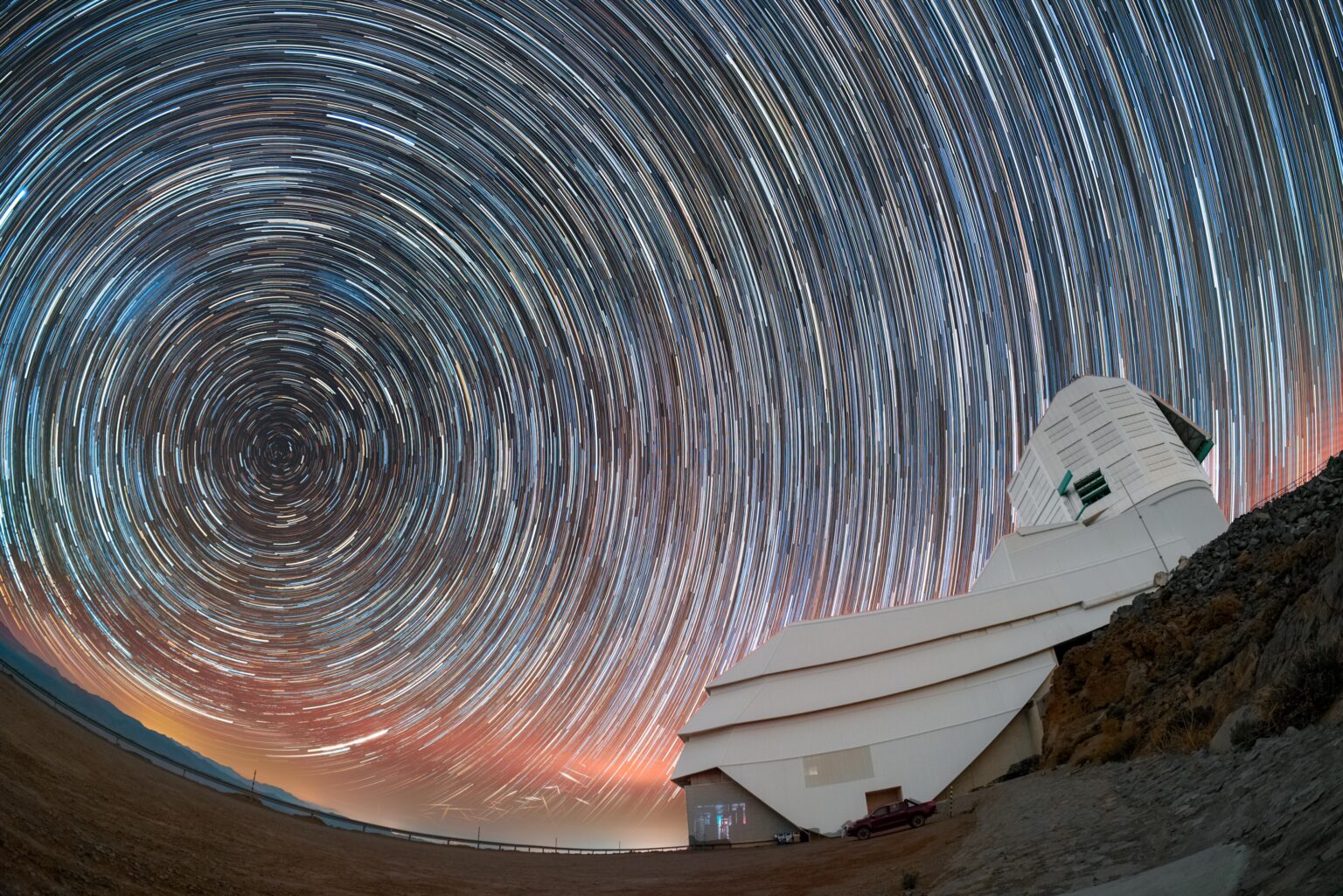
Are you dizzy yet? Mesmerizing star trails spin above Cerro Pachón, a mountain in northern Chile and home to NSF–DOE Vera C. Rubin Observatory. Rubin Observatory is jointly funded by the U.S. National Science Foundation (NSF) and the U.S. Department of Energy’s Office of Science (DOE/SC). Rubin is a joint program of NSF NOIRLab and DOE’s SLAC National Accelerator Laboratory, which cooperatively operate Rubin.
The star trails in this image suggest the multitude of colors and brightnesses of stars. This extra-long-exposure image also captures the stars’ apparent movement (as well as other moving objects, such as air traffic and satellites). At the center of the circular star trails is the southern celestial pole, residing in the dim constellation of Octans (the Octant).
By observing characteristics of stars with observatories like Rubin, scientists can gain insight into stellar evolution. Rubin is expected to observe and measure about 17 billion stars during its 10-year Legacy Survey of Space and Time (LSST). Additionally, when Rubin detects a change in a star’s brightness, it will send out an alert within minutes. This will allow astronomers to investigate both short and long-term changes in stars that are difficult to monitor without continuous survey operations. These include flickers or pulses that precede supernovae, new variable stars with multi-year periods of variation, and rare events like the merging of dense neutron stars. The dazzling night will yield dazzling discoveries.
Hernán Stockebrand, the photographer, is a DevOps Engineer with Rubin Observatory and a NOIRLab Audiovisual Ambassador.
Credit: NSF–DOE Vera C. Rubin Observatory/NOIRLab/SLAC/AURA/H. Stockebrand

1 Comment
Image from this post, text from post below the link:
[https://noirlab.edu/public/images/iotw2619a/](https://noirlab.edu/public/images/iotw2619a/)
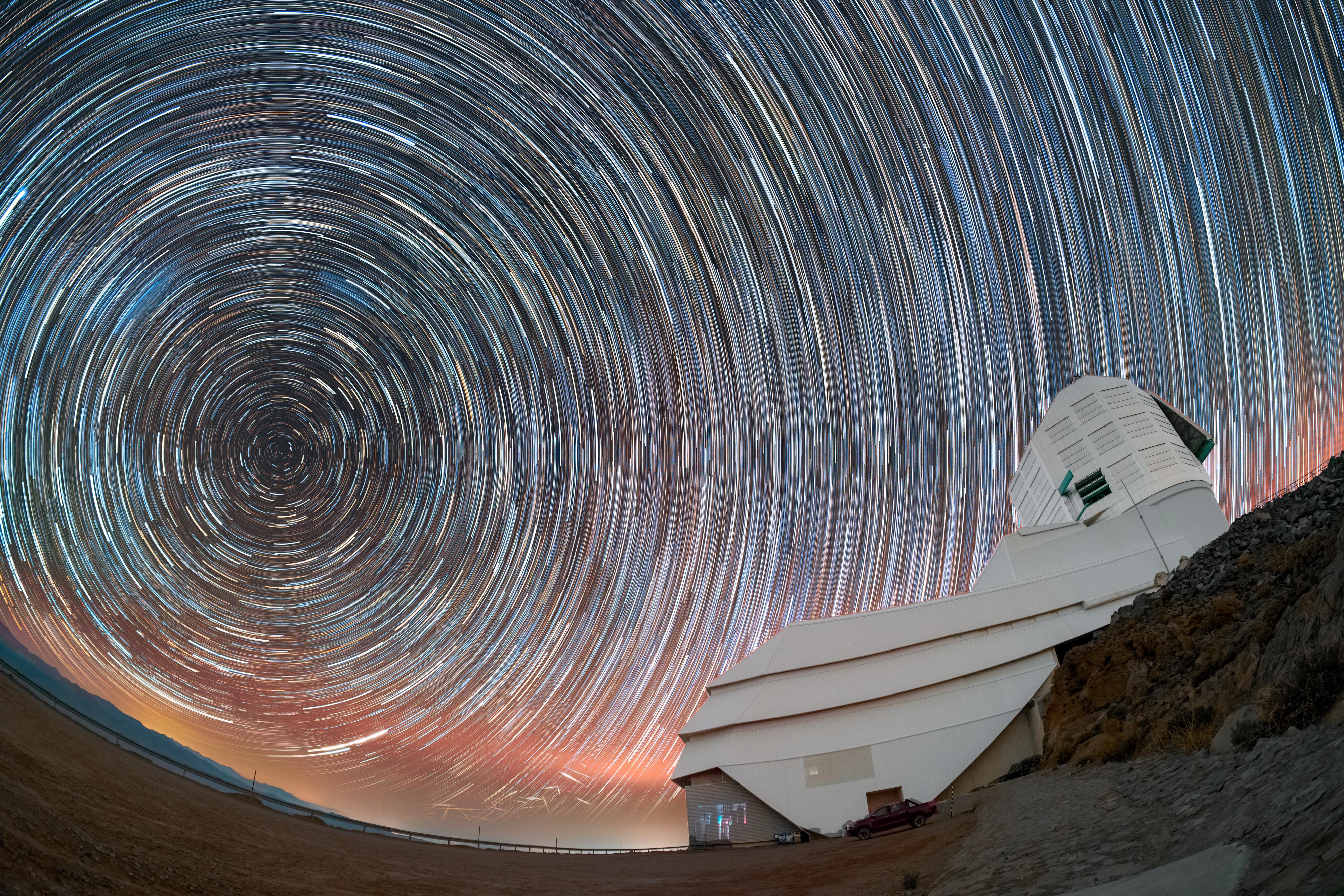
Are you dizzy yet? Mesmerizing star trails spin above Cerro Pachón, a mountain in northern Chile and home to NSF–DOE Vera C. Rubin Observatory. Rubin Observatory is jointly funded by the U.S. National Science Foundation (NSF) and the U.S. Department of Energy’s Office of Science (DOE/SC). Rubin is a joint program of NSF NOIRLab and DOE’s SLAC National Accelerator Laboratory, which cooperatively operate Rubin.
The star trails in this image suggest the multitude of colors and brightnesses of stars. This extra-long-exposure image also captures the stars’ apparent movement (as well as other moving objects, such as air traffic and satellites). At the center of the circular star trails is the southern celestial pole, residing in the dim constellation of Octans (the Octant).
By observing characteristics of stars with observatories like Rubin, scientists can gain insight into stellar evolution. Rubin is expected to observe and measure about 17 billion stars during its 10-year Legacy Survey of Space and Time (LSST). Additionally, when Rubin detects a change in a star’s brightness, it will send out an alert within minutes. This will allow astronomers to investigate both short and long-term changes in stars that are difficult to monitor without continuous survey operations. These include flickers or pulses that precede supernovae, new variable stars with multi-year periods of variation, and rare events like the merging of dense neutron stars. The dazzling night will yield dazzling discoveries.
Hernán Stockebrand, the photographer, is a DevOps Engineer with Rubin Observatory and a NOIRLab Audiovisual Ambassador.
Credit: NSF–DOE Vera C. Rubin Observatory/NOIRLab/SLAC/AURA/H. Stockebrand