
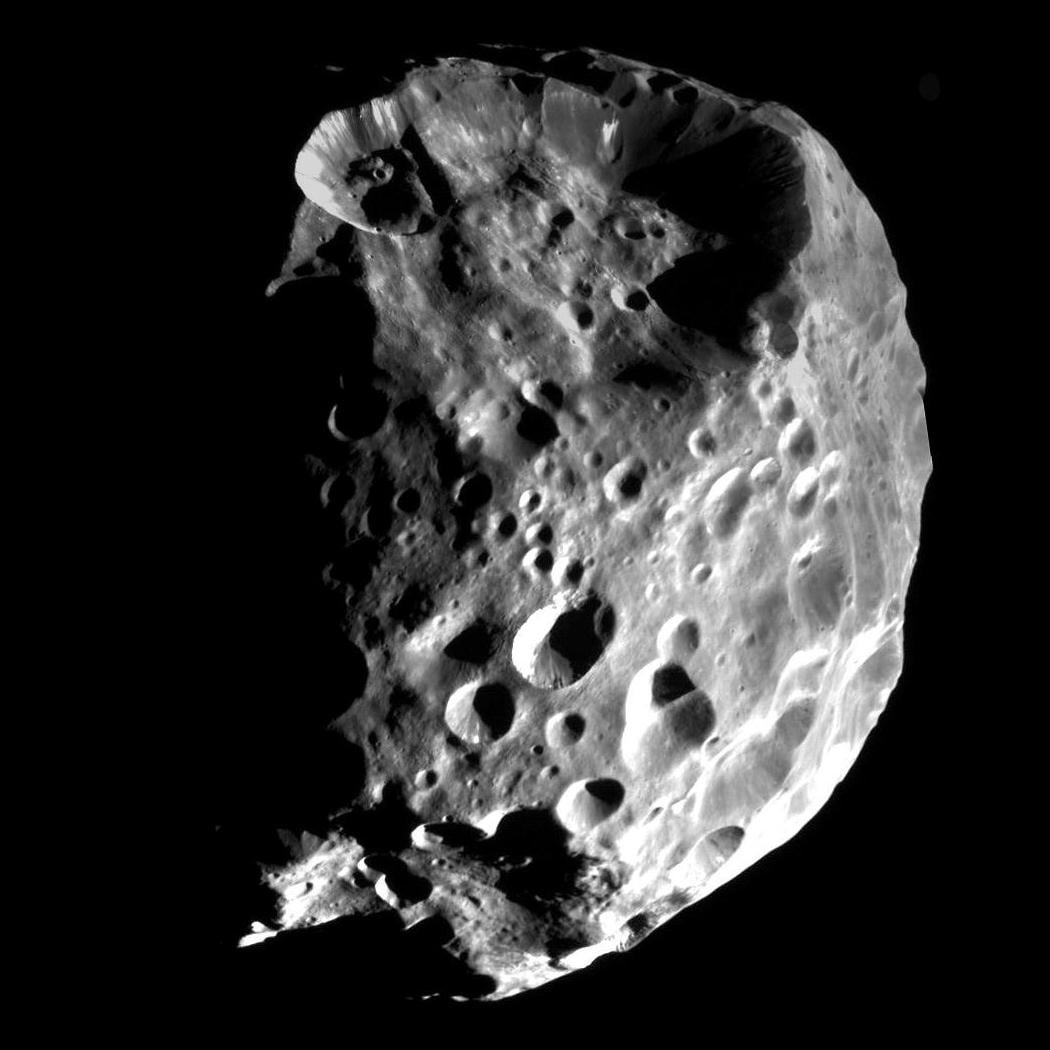
Cassini spacecraft image of the Saturn moon Phoebe as it flew past it in 2004 just before entering Saturn’s orbit (NASA, Cassini)
by Grahamthicke
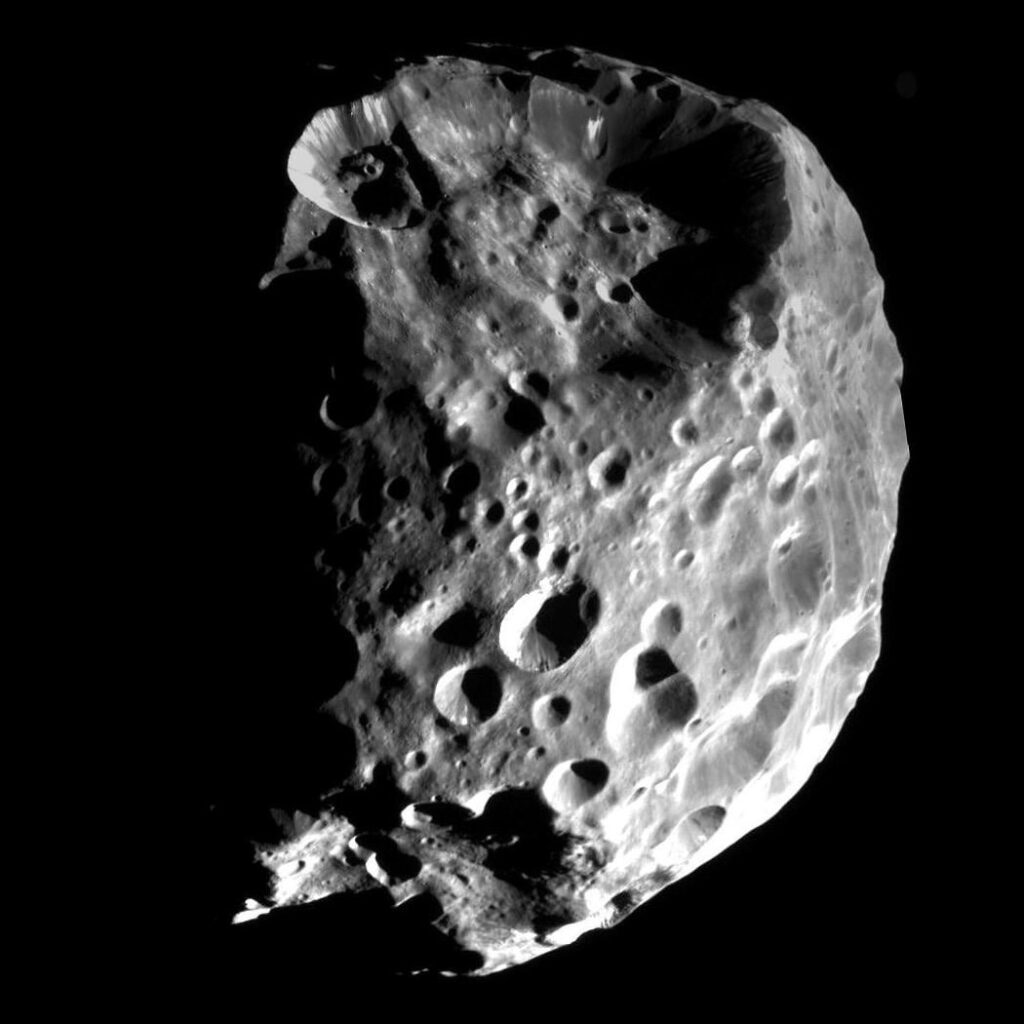
Cassini spacecraft image of the Saturn moon Phoebe as it flew past it in 2004 just before entering Saturn’s orbit (NASA, Cassini)
by Grahamthicke
3 Comments
Saturn’s moon Phoebe could have once been a comet that was captured by it’s gravity. Images from the robotic Cassini spacecraft taken when entering the neighborhood of Saturn indicate that Phoebe may have originated in the outer Solar System. Phoebe’s irregular surface, retrograde orbit, unusually dark surface, assortment of large and small craters, and low average density appear consistent with the hypothesis that Phoebe was once part of the Kuiper belt of icy comets beyond Neptune before being captured by Saturn.
Visible in the above image of Phoebe are craters, streaks, and layered deposits of light and dark material. The image was taken from around 30,000 kilometers out from this 200-kilometer diameter moon. Phoebe was the first target encountered upon the arrival of the [*Cassini*](https://en.wikipedia.org/wiki/Cassini%E2%80%93Huygens) spacecraft in the Saturn system in 2004, and is thus unusually well-studied for an irregular moon of its size.
Phoebe has a moderately eccentric, retrograde orbit, making it part of Saturn’s Norse group of satellites. It is the second-largest retrograde satellite in the Solar System after Triton. .
looking way more cheese than our moon i’ll tell ya what
I don’t see any protomolecule, so I’ll consider that a good thing.