
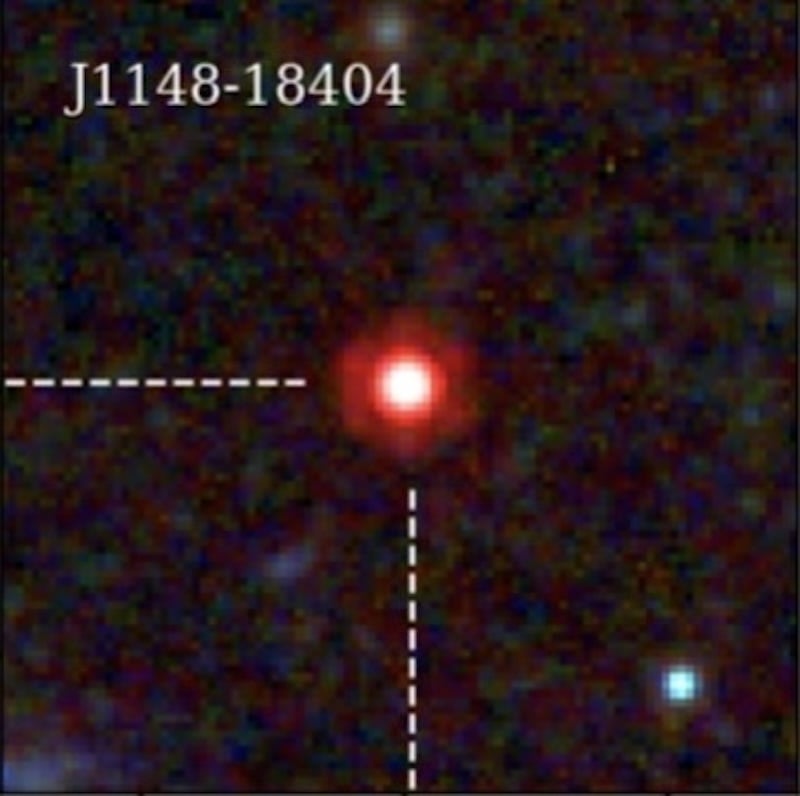
What are the little red dots? It’s the question that has quietly obsessed astronomers since the James Webb Space Telescope first opened its eyes and started revealing the early universe in unprecedented detail. Hundreds of tiny, faint, reddish objects all sitting some 12 billion light years away, meaning we see them as they existed when the universe was barely a toddler. They showed up almost immediately and nobody could agree on what they were. Now, one maverick object hiding in a decade old data archive might finally have cracked it.
The leading theory for these so called little red dots is as exotic as it sounds. Most astronomers believe they are supermassive black holes in the act of devouring enormous quantities of surrounding material but swathed so completely in dense clouds of gas that all the usual evidence is smothered.
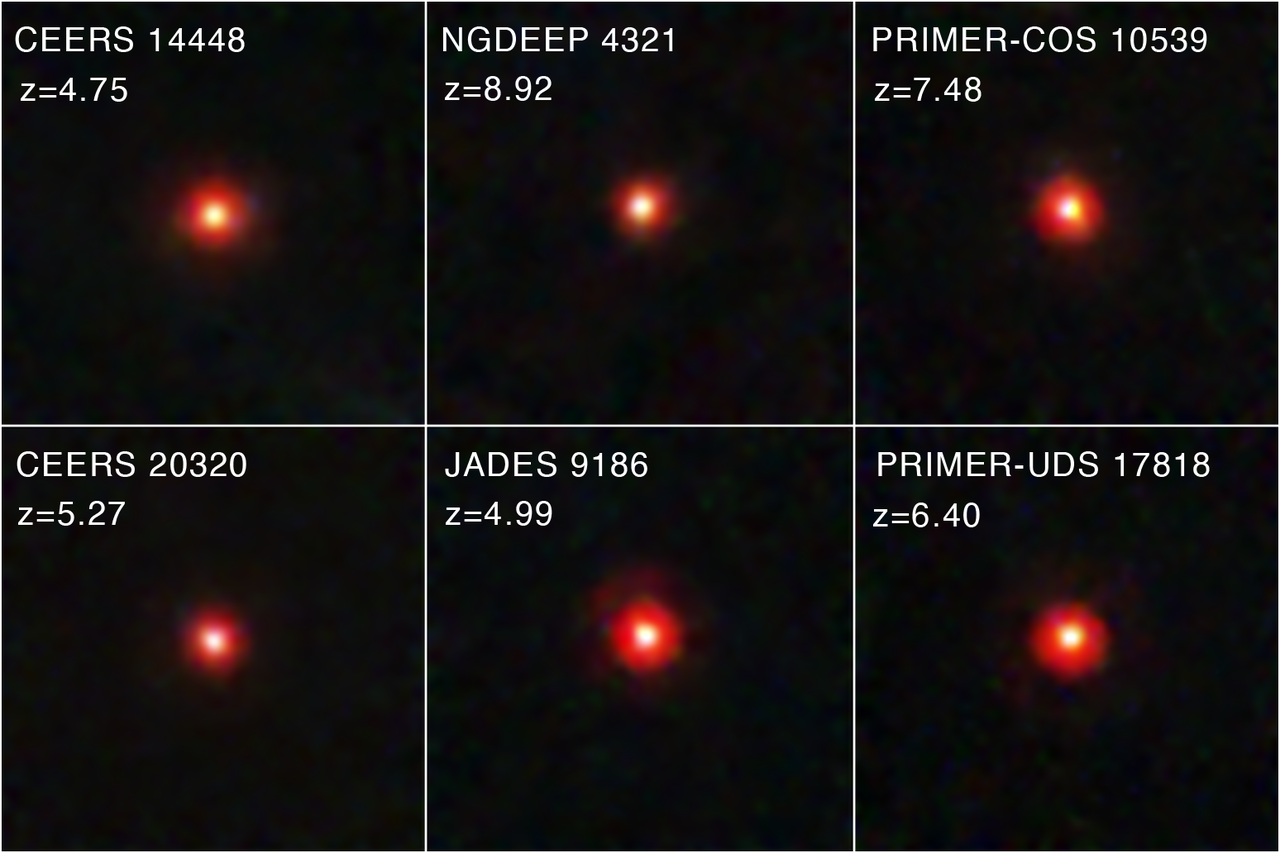 False colour images of 6 little red dots with redshift given (Credit : NASA, ESA, CSA, STScI, Dale Kocevski)
A typical feeding supermassive black hole is one of the most violently luminous things in the universe, blazing with ultraviolet light and pumping out X-rays powerful enough to be detected across billions of light-years. These objects do none of that, the gas swallows everything. Scientists have taken to calling them “black hole stars,” because their spectral fingerprint looks less like a black hole and more like the surface of a star. Exotic, puzzling, and stubbornly impossible to confirm, until now.
Using NASA’s Chandra X-ray Observatory alongside fresh Webb data, a team led by Raphael Hviding at the Max Planck Institute for Astronomy has found the exception that proves the rule. Object 3DHST-AEGIS-12014 is an X-ray dot that sits 11.8 billion light years from Earth and looks, in almost every respect, exactly like a little red dot. Small, red and ancient. But this one does something no other little red dot has ever done, it glows in X-rays.
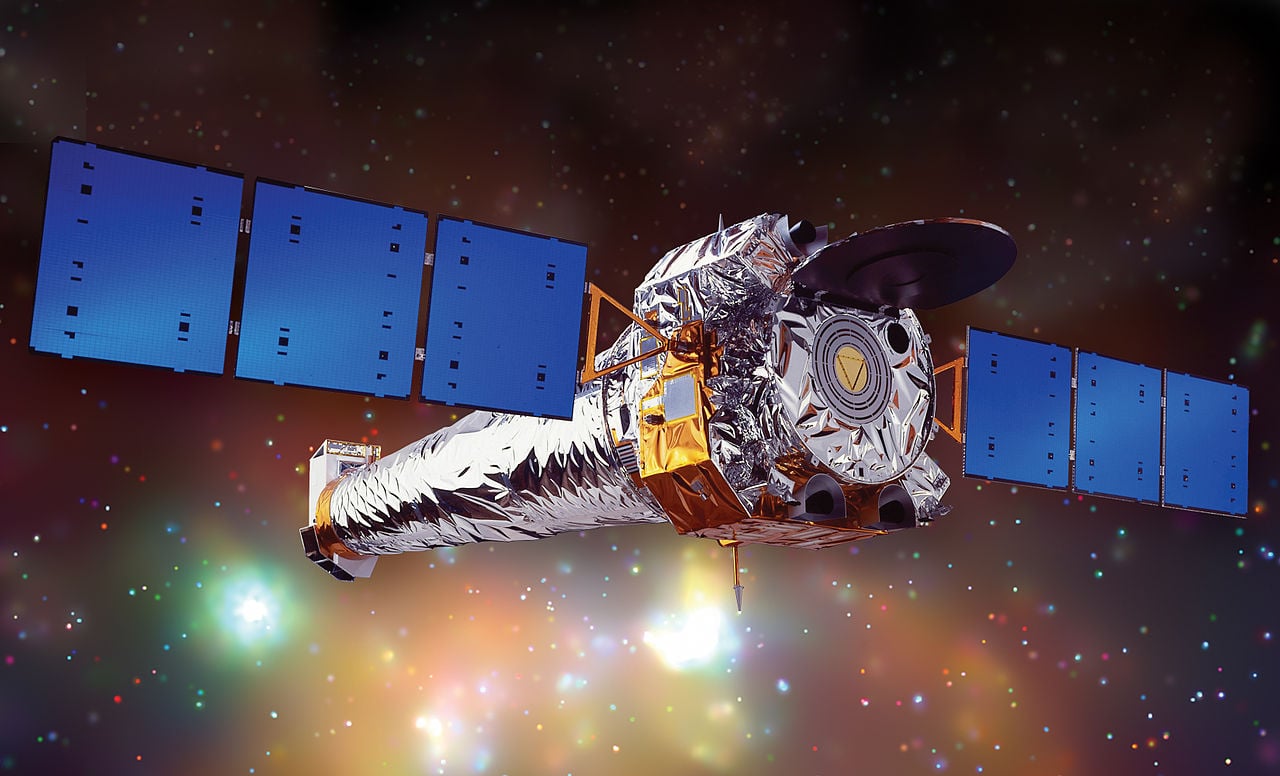 Artist impression of the Chandra X-ray observatory (Credit : NASA/CXC/NGST)
The team believes they are witnessing a transition. As the black hole consumes its surrounding gas cloud, gaps begin to appear. X-rays from the feeding black hole punch through these holes, briefly escaping into space before the cloud closes over again. The flickering X-ray signal Chandra detects is the light of a black hole breaking free of its cocoon, one patch of thinning gas at a time. Eventually, the cloud is gone entirely, the little red dot ceases to exist, and what remains is a fully exposed, conventionally luminous, growing black hole, the kind astronomers have been studying for decades.
Here’s the kicker in the story though. The Chandra data that revealed all of this had been sitting in an archive for over ten years, unnoticed and unremarkable and the X-ray dot was there all along. It took Webb, pointing at the same patch of sky with fresh eyes to reveal what had been hiding in plain sight.