
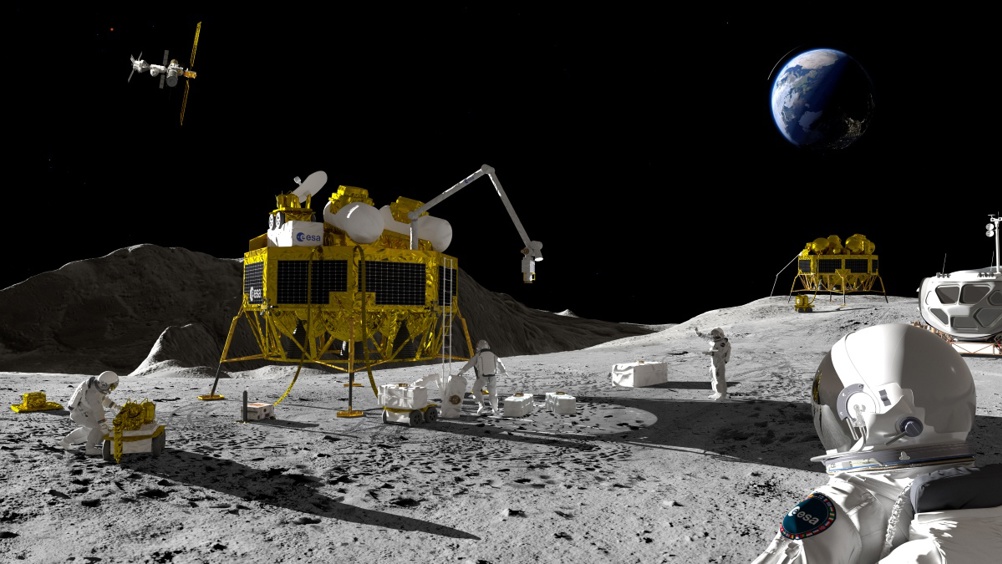
The Smart Skin for Exploration Cobots project will see a pan-European team creating a tough, multifunctional protective layer that can be deployed on different robotic arms, whether operating in orbit, on the Moon or on Mars. As well as dust and intense space radiation, robots in these environments are subjected to temperature extremes ranging from -150°C to +120°C.
“The potential for robots in space exploration is extensive,” said Christian Dalsgaard, senior consultant at the Danish Technological Institute (DTI), which is leading the project.
“They can help with everything from resource extraction on the Moon to on-orbit satellite servicing and active debris removal. But this requires the robots to be extremely robust and capable of operating autonomously – or safely in collaboration with humans.”
At the core of the smart skin system is a 3D-printed scaffold that serves as the base for four key functions: a thermal and dust-protective layer; flexible power and data cabling; collision sensors; and features that enhance human-machine interaction. According to Tamás Bárczy, CEO at consortium partner Admatis, the smart skin could enable robotics developers to use more off off-the-shelf parts, lowering the barriers to entry for participation in the space economy.
“Applying an advanced protection system could lead to building robotic arms from commercially available components,” said Bárczy.
“This can create a cost-effective way of providing new solutions for customers in many space domains – from deep space missions, through in-orbit servicing to Moon colonisation.”
Alongside DTI and Hungary’s Admatis, the two-year, €1.65m project will also feature contributions from Poland’s PIAP Space and Luxembourg’s Redwire Space Europe, both of whom are already involved in robotics projects with ESA. While the project’s goal is to test solutions in space-like conditions, the research could also have wider applications, according to the consortium.
“We see strong potential for the technology eventually to find applications in companies where robots are exposed to extreme conditions,” said Dalsgaard.
“Think of metal foundries, where dirt and extreme heat challenge equipment performance. The technology we are developing could potentially extend the service life of critical equipment and reduce maintenance costs.”