
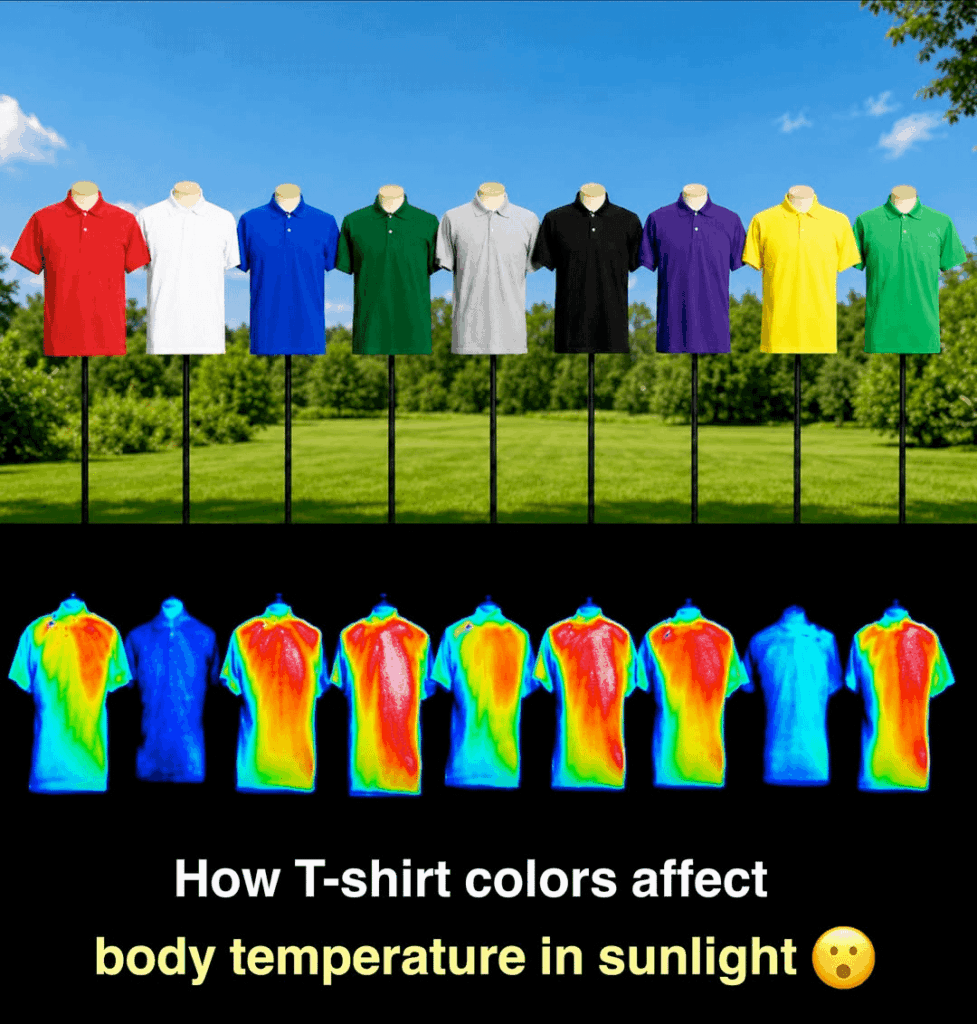
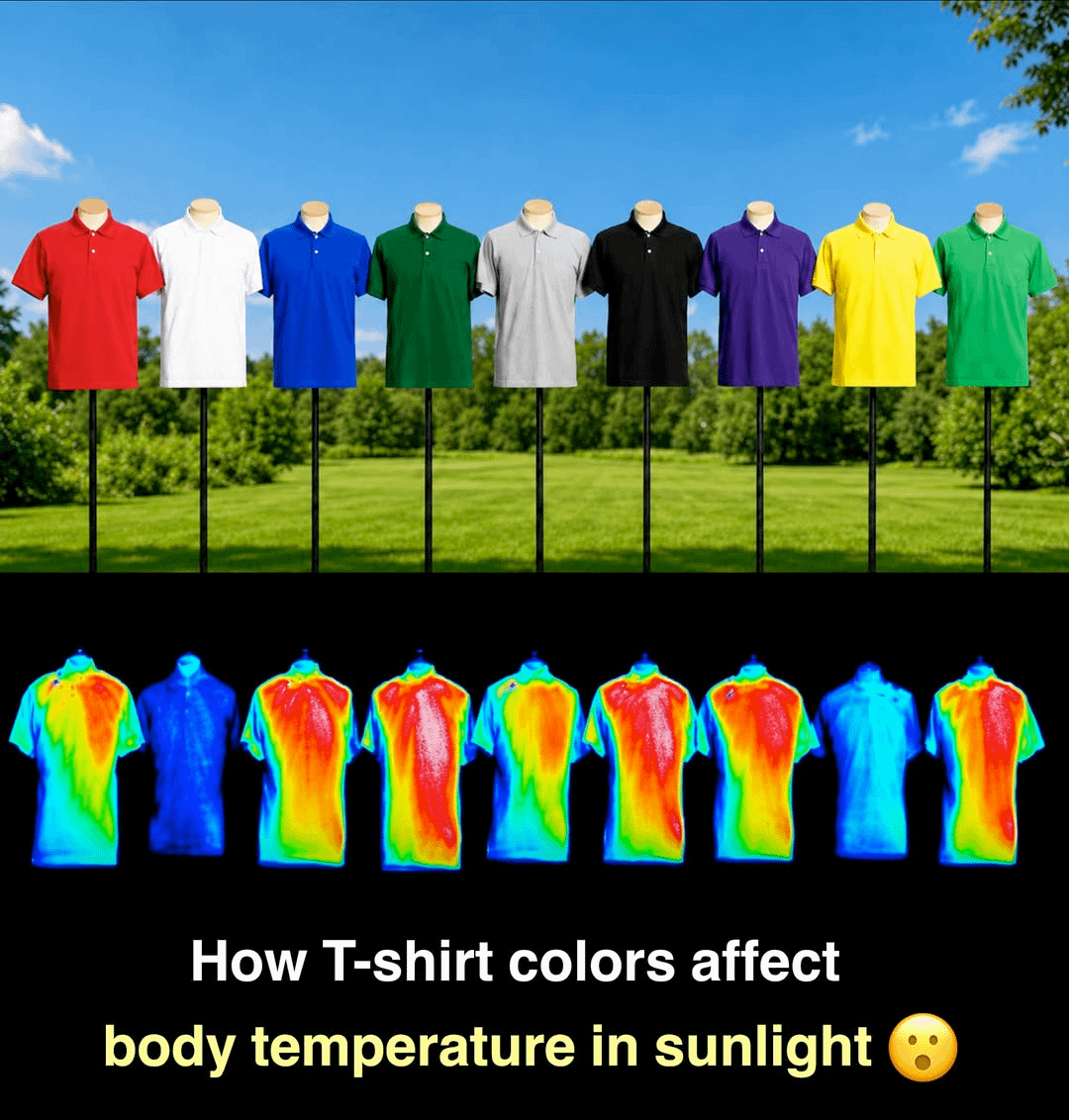
In daylight, dark colors (like black, navy, red) absorb more sunlight and get hotter, showing up in bright red and yellow tones on the thermal image.
At night, the black surface emits more infrared, hence cooling faster and blending with the background in infrared/thermal vision.
The formula for infrared heat radiation is based on the Stefan-Boltzmann Law, which states that power radiated is (P = epsilon * sigma * A * T^4). A black object has an emissivity (epsilon) near 1.0 (perfect emitter), while a white object has a lower emissivity (often 0.7–0.9), meaning black objects emit more infrared energy than white objects at the same temperature
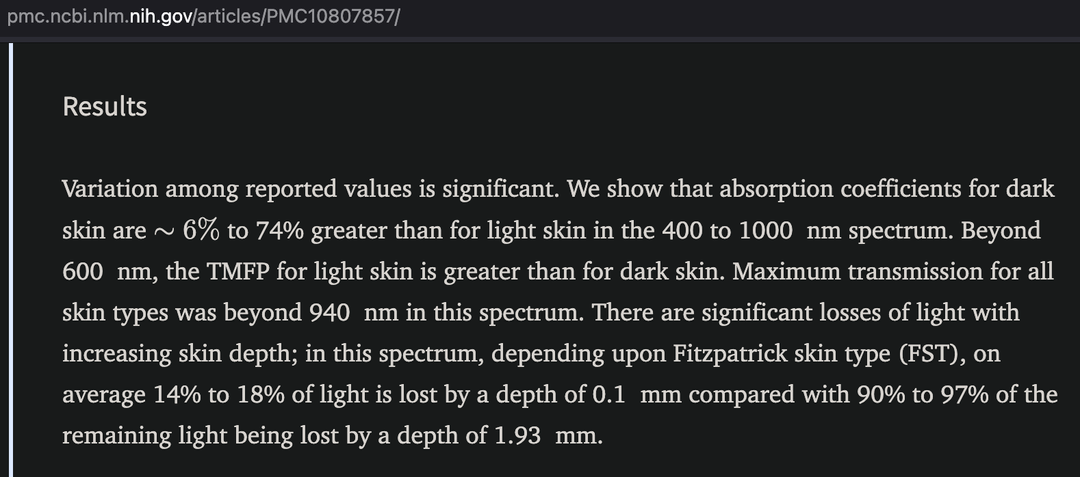
Effect of skin color on optical properties and the implications for medical optical technologies: a review
"Variation among reported values is significant. We show that absorption coefficients for dark skin are∼6% to 74% greater than for light skin in the 400 to 1000 nm spectrum. Beyond 600 nm, the TMFP for light skin is greater than for dark skin. Maximum transmission for all skin types was beyond 940 nm in this spectrum. There are significant losses of light with increasing skin depth; in this spectrum, depending upon Fitzpatrick skin type (FST), on average 14% to 18% of light is lost by a depth of 0.1 mm compared with 90% to 97% of the remaining light being lost by a depth of 1.93 mm."
by fried-raptor
1 Comment
Slink back to the shadows with your forbidden knowledge