
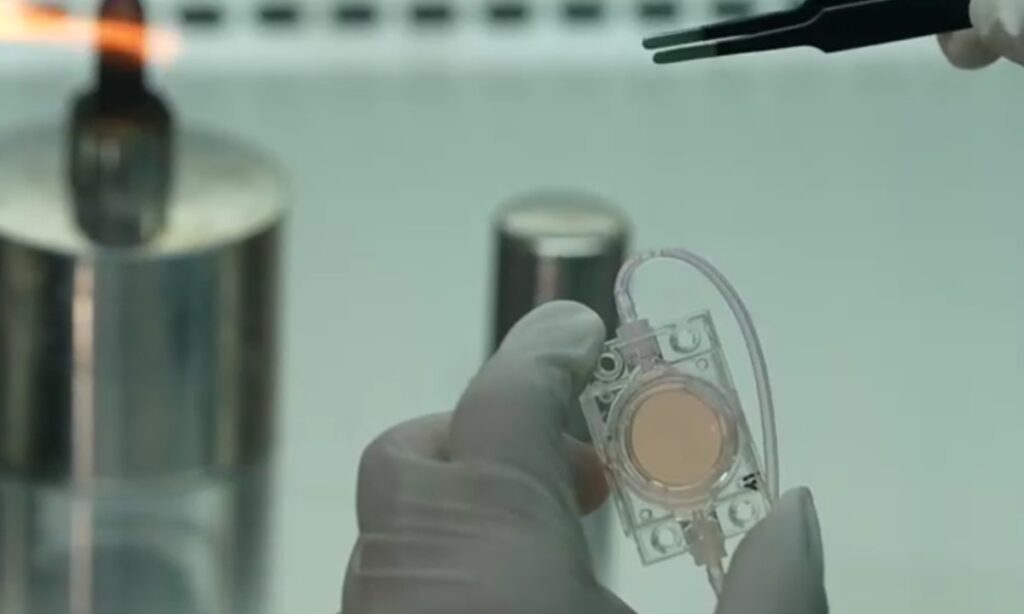
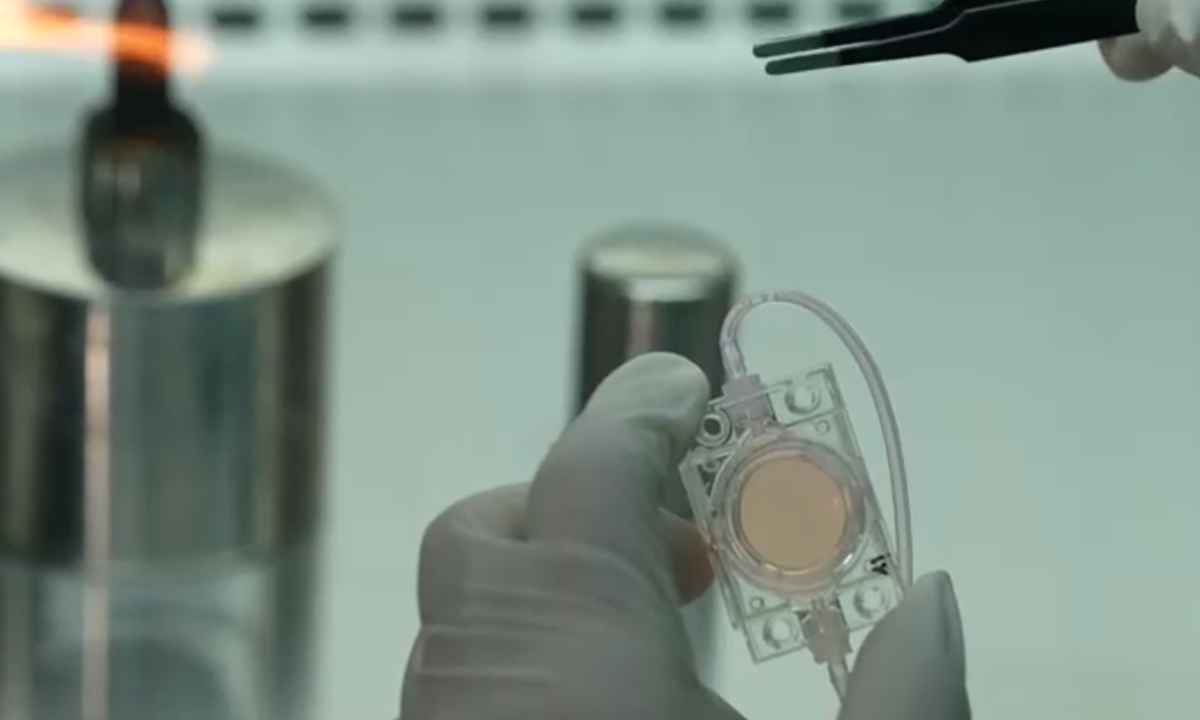
Photo: Screenshot of the video footage introducing the ‘artificial embryos’ space experiment
China on Monday successfully launched the Tianzhou-10 cargo spacecraft from the Wenchang Space Launch Site, carrying not only supplies for the Chinese space station, but also an unprecedented study on the development of “artificial embryos” in space. The mission marks the world’s first attempt to investigate how embryo-like structures develop under real microgravity and cosmic radiation conditions, the Global Times learned from the Technology and Engineering Center for Space Utilization, under the Chinese Academy of Sciences (CAS) on Tuesday.
Representing the space application system of the China Manned Space Program, the center revealed that Tianzhou-10 ferried 67 scientific items weighing more than 768 kilograms to support 41 space science experiments. These projects span life sciences, biotechnology, microgravity physics, astronomy, and Earth science. Among them, the embryo experiment has drawn particular attention.
China’s space scientists have designed what they describe as a complete “space embryo research system,” covering multiple stages of vertebrate development — from zebrafish embryos to mouse embryos, and now stem-cell-derived “artificial embryos,” according to a statement the center provided to the Global Times on Tuesday.
The goal is to understand how gravity shapes life itself, per the CAS center.
Yu Leqian, the artificial embryo project’s manager, explained to media that real human embryos are extremely difficult to obtain for large-scale scientific research. Artificial embryos offer an alternative.
“Artificial embryos are structures constructed from stem cells that closely resemble real embryos,” Yu said. “They are not true embryos and do not have the ability to develop into an individual human being, but they can help us study important questions about early human embryonic development.”
According to Yu, the embryo models used in the experiment correspond roughly to a crucial stage of human development between days 14 and 21 after fertilization.
It is an extremely important developmental window, Yu explained. “Within just a few days, the precursors of all organs begin to form. The human body axis – which side becomes the head and which becomes the tail – is also established during this period.”
“If any disturbance or abnormality occurs at this stage,” he added, “it could have profound effects on the adult body later in life.”
Yu told the Global Times on Tuesday that “in the early stages of human embryonic development, we still do not understand why, within just a few days, the embryo is able to organize itself into a structured body plan. How this process is regulated remains unclear. However, many diseases related to early development – such as deformities and congenital heart disease are closely associated with this critical developmental period.”
“That is why we are sending these artificial embryos into space – to observe what happens at the very beginning, when the body’s foundation is being built and its biological blueprint is being drawn. We want to understand what kinds of effects may occur in this process, and whether those effects are significant. The findings could help guide our future research,” Yu explained.
Also, life on Earth evolved over billions of years under constant gravity. But no one truly knows how mammalian embryonic development responds under near zero-gravity conditions. The Chinese space station provides something Earth cannot fully reproduce: long-term microgravity combined with authentic cosmic radiation.
During the mission, the artificial embryos will develop for five days aboard the station under the supervision of taikonauts. Automated systems will replace nutrient solutions daily to ensure stable growth conditions, according to Yu.
After the experiment concludes, the samples will be frozen in orbit and later returned to Earth for detailed laboratory analysis.
The implications extend far beyond basic biology. As humanity moves toward the possibility of long-term space habitation – and perhaps even permanent settlements on the Moon or Mars – scientists must confront a fundamental challenge: Can human life continue across generations in space?
This Tianzhou-10 experiment is designed as an early step toward answering that question. “This is really our first attempt to answer the most basic question: does space have an effect at all?” Yu said. “Once we understand what the effects are, we can begin trying to intervene – perhaps through technologies that reduce or counteract those effects.”
“This is our first attempt to answer whether humans can survive and reproduce in space. I hope the answer will be yes,” Yu said.