
On 15 May, NASA’s Psyche spacecraft will pass within 2,800 miles of the Martian surface. It will be travelling at more than 12,300 mph. Mars’s gravitational pull will then reshape its trajectory, pushing it toward one of the solar system’s strangest objects.
The target is the asteroid Psyche, a metal-rich body in the main asteroid belt. Scientists believe it is the exposed core of a failed protoplanet. The spacecraft won’t reach it until late 2029. For now, Mars is doing the heavy lifting.
Why Mars, and Why Now
Psyche launched in October 2023. It relies on solar-electric propulsion, burning xenon gas at low thrust to build speed over months. The Mars flyby is, therefore, a propellant-saving measure, letting gravity do the work rather than the engines. Mission planners also fired the spacecraft’s thrusters for 12 hours on 23 February to fine-tune the approach.
“We are now exactly on target for the flyby,” said Sarah Bairstow, Psyche’s mission planning lead at NASA’s Jet Propulsion Laboratory. “We’ve programmed the flight computer with everything that the spacecraft will do throughout May.”
Mars Seen From the Wrong Side
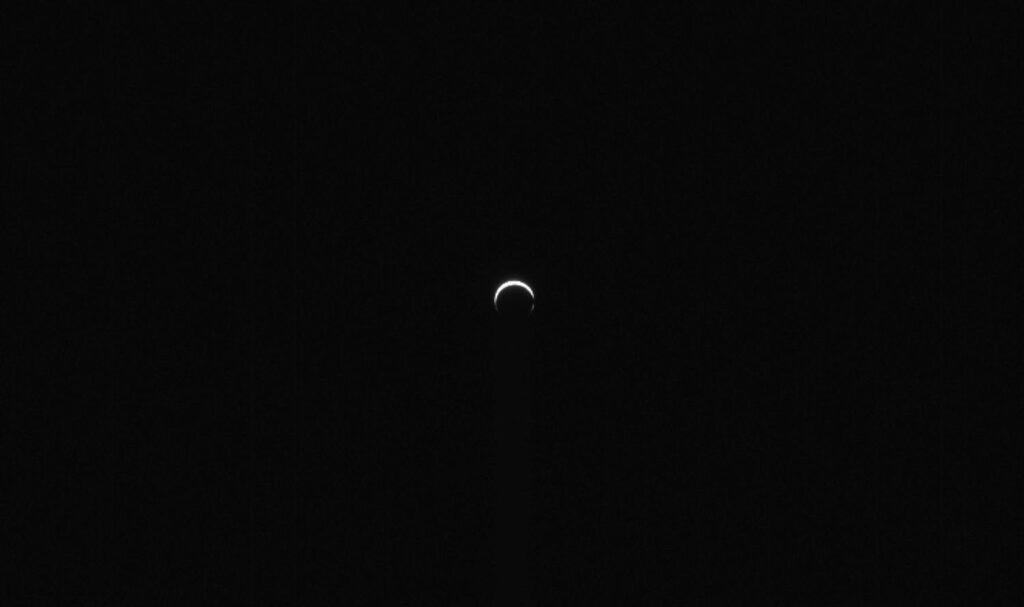
The view from Psyche will be unfamiliar. Because the spacecraft approaches from the night side, Mars currently looks like a thin crescent. That geometry is deliberate. It gives the imaging team a range of lighting conditions across the encounter.
Jim Bell, the imager instrument lead at Arizona State University, said the geometry offered rare versatility. “The thin crescent on approach and the nearly ‘full Mars’ view after we fly past create opportunities for both great calibration observations as well as just plain beautiful photos.”
Raw images of a distant Mars have already appeared on the mission’s website. A processed time-lapse will follow in the coming weeks.
Science on the Way Through
The team plans to capture thousands of images and run observations across multiple instruments. The magnetometer should detect Mars redirecting solar wind particles. Meanwhile, the gamma-ray and neutron spectrometer will track cosmic ray flux changes during closest approach. There may also be a chance to detect a faint dust torus around Mars, shed by the moons Phobos and Deimos.
All of this, however, serves a purpose beyond scientific curiosity. Every technique the team practises here will be essential in 2029. That is when Psyche settles into orbit and the real mission begins.
 Published by Kerry Harrison
Kerry’s been writing professionally for over 14 years, after graduating with a First Class Honours Degree in Multimedia Journalism from Canterbury Christ Church University. She joined Orbital Today in 2022. She covers everything from UK launch updates to how the wider space ecosystem is evolving. She enjoys digging into the detail and explaining complex topics in a way that feels straightforward. Before writing about space, Kerry spent years working with cybersecurity companies. She’s written a lot about threat intelligence, data protection, and how cyber and space are increasingly overlapping, whether that’s satellite security or national defence. With a strong background in tech writing, she’s used to making tricky, technical subjects more approachable. That mix of innovation, complexity, and real-world impact is what keeps her interested in the space sector.