
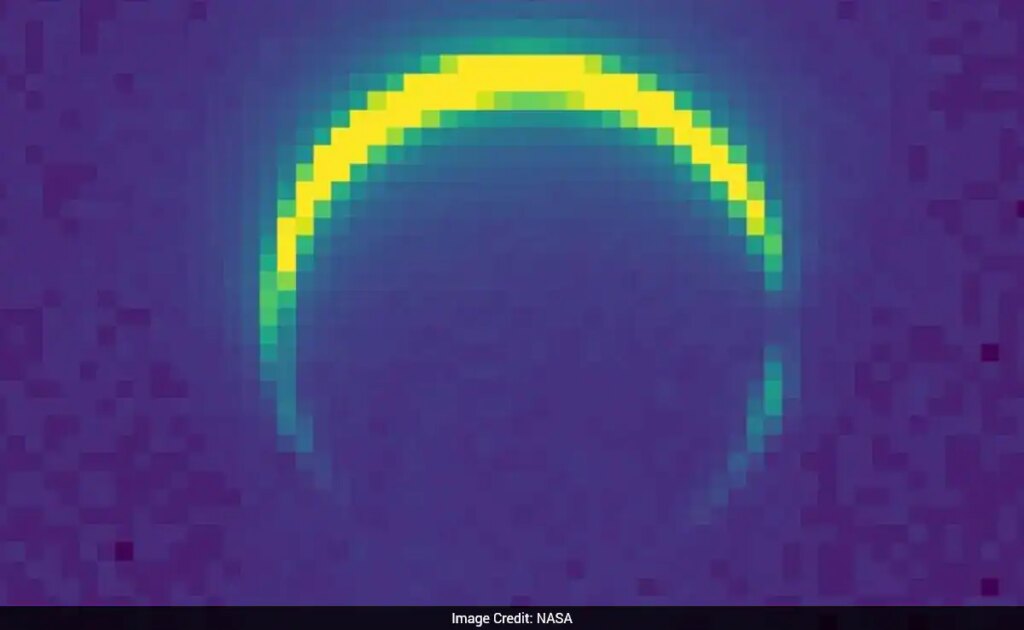
A new image captured by a spacecraft traveling through deep space shows Mars as a thin crescent, offering a rare and unusual view of the Red Planet. The image was taken as the spacecraft moves closer for a planned flyby that will help it continue its long journey toward a distant asteroid, reported NASA. The spacecraft, named NASA’s Psyche spacecraft, is set to pass close to Mars on Friday, May 15. It will fly about 2,800 miles (4,500 kilometers) above the planet’s surface while moving at a speed of around 12,333 mph (19,848 kph). During this pass, Mars is being used to help change the spacecraft’s path and increase its speed using the planet’s gravity.
Launched on October 13, 2023, the Psyche spacecraft is on a mission to reach the metal-rich asteroid also named Psyche. It uses a solar-electric propulsion system powered by xenon gas, slowly gaining speed over time as it travels through space.
Mission planners are using the Mars flyby to reduce fuel use by letting the planet’s gravity assist the spacecraft instead of relying only on its engines.
During the close approach, the spacecraft’s multispectral imager is expected to capture thousands of observations of Mars. These images will help scientists prepare for future operations when the spacecraft reaches the asteroid in 2029. On May 7, the mission team began receiving initial unprocessed images, including views of a starfield and a small Mars. Scientists will later adjust these images for brightness and contrast and create a time-lapse of the flyby.
Rare Crescent View Of Mars
The image released on May 3, 2026, shows Mars as a thin crescent. According to mission scientists, the spacecraft is approaching Mars from a high phase angle, meaning it sees the planet mostly from the night side with only a narrow strip of sunlight visible. A mission imaging expert, Jim Bell, explained that this viewing angle creates both a thin crescent during approach and a nearly full view after the flyby, which helps with calibration and imaging tests.
The flyby will also allow the spacecraft to test its instruments. Its magnetometer will study Mars’ magnetic field, while the gamma-ray and neutron spectrometer will measure changes in cosmic radiation during the encounter.