
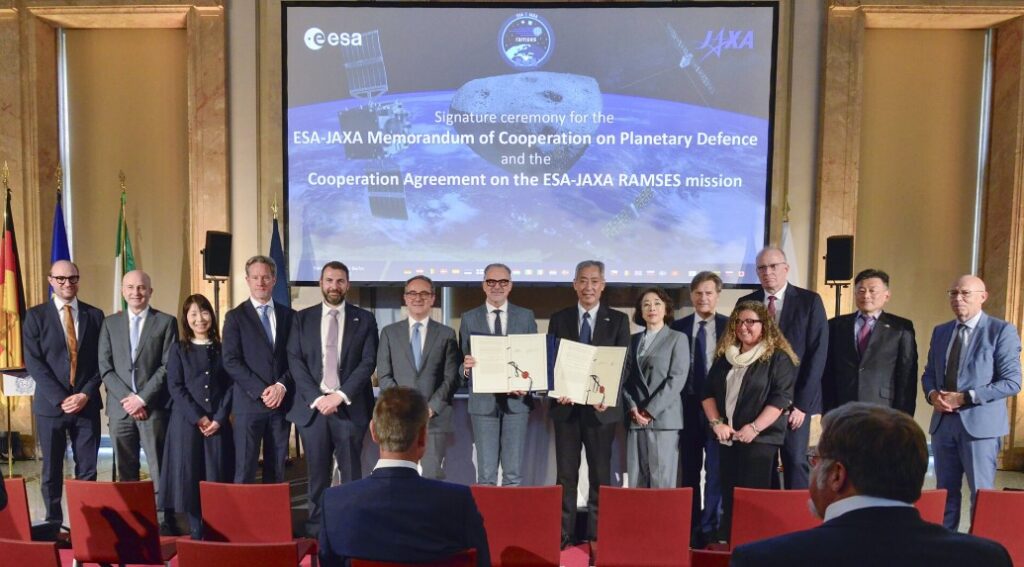
On 7th May 2026, the European Space Agency (ESA) and the Japan Aerospace Exploration Agency (JAXA) signed a Memorandum of Cooperation to deepen their work in planetary defence. They also concluded a dedicated agreement to advance the Rapid Apophis Mission for Space Safety (Ramses), which aims to study the near-Earth asteroid Apophis. The formalities took place at the Italian Embassy in Berlin, with ESA Director General Josef Aschbacher and JAXA President Hiroshi Yamakawa present alongside European and Japanese leaders. The Italian Space Agency (ASI) helped host the event because OHB Italia was chosen as the Ramses prime contractor.
This step follows a November 2024 joint commitment to broaden large-scale cooperation in planetary defence. The new agreements emphasize concrete collaboration, moving from shared intentions to mission-level work between the two agencies. The partnership rests on established trust, technical skill, and a shared goal of protecting the planet.
JAXA’s president highlighted the value of international teamwork in space. He noted that ESA and JAXA’s collaboration aims to push international efforts forward in planetary defence, with support from ESA’s member states, including Italy. The exchanges stress that cooperation remains essential in a complex space environment.
Planetary defence involves detecting and characterising near-Earth objects, tracking their paths, assessing potential impacts, and planning mitigation measures if needed. By strengthening ESA–JAXA collaboration, the two agencies commit to advancing these global efforts and sharing expertise to improve readiness.
ESA leads planetary defence through its Space Safety programme. The Near-Earth Object Coordination Centre (NEOCC) monitors threats and refines orbital predictions, while various missions develop rapid reconnaissance and deflection technologies. For instance, the Hera mission, which includes significant JAXA participation, will visit the Didymos asteroid system later this year. Hera will contribute to proving a kinetic impact method for asteroid deflection as a practical defense technique.
Ramses is the first major outcome of the new cooperation. The mission plans a 2028 launch and will rendezvous with Apophis before its rare close approach to Earth in April 2029. Apophis measures about 375 metres across and will pass roughly 32,000 kilometres above Earth, closer than many satellites in geostationary orbit. ESA will manage the spacecraft’s design, assembly, and operations, while JAXA will supply key elements such as lightweight solar arrays, an infrared camera, and the H3 rocket for launch. This collaboration builds on previous ESA–JAXA joint efforts, including Hera’s role and other shared missions like EarthCARE and BepiColombo.
More to the point, Ramses offers a unique opportunity: as Apophis nears Earth, researchers can observe a real-world interaction and test mitigation concepts in a direct, in-situ environment. At the moment, observers anticipate gathering data that could inform future planetary defence strategies. The Ramses project exemplifies how two major space agencies can combine strengths to address a global challenge.
 Published by James Hydzik
James Hydzik is a technology geek focused on the junction of engineering, writing, and coffee. He joined Orbital Today in 2020 to help make sense of the Johnson government’s decision to buy OneWeb. Since then, he has taken on interviewing and editor-in-chief roles. James learned the ropes of editing and writing with Financial Times magazines, The World Bank, PwC, and Ericsson. Thus far, interviewing New Space movers has put the biggest smile on his workaday face. The son of an Electrical Engineer, James understands the value of putting complex topics into clear language for those with a lay person’s understanding of the subject. James is a European transplant from the United States, and as ex-KA3LLL, he now holds European amateur radio licenses. His next radio project is a portable 10GHz EME (moonbounce) station, as it combines his childhood interests in antennas and space.