
Scientists have spotted a missing slice in the universe’s black hole lineup. A study published on April 1, 2026, reports a drop-off starting around 45 times the mass of our sun, hinting that certain black holes are far rarer than expected.
The finding points to a dramatic ending for some of the biggest stars. If a star blows itself apart in the right way, it can leave nothing behind, not even a black hole, and the “missing masses” become the clue. How do you catch an explosion that may not leave a clear smoking gun?
The forbidden mass range
Astronomers often describe black hole masses by comparing them with our sun, since the numbers are so large. New analyses of gravitational-wave data support the idea of a “pair instability” gap, including a missing band of smaller “secondary” black holes between about 44 and 116 times the mass of our sun.
In plain terms, the gap is a no-show zone in the mass distribution. What makes it especially interesting is the mismatch between partners, since the larger black hole in a merger can sometimes fall into the same mass neighborhood.
Hui Tong, a PhD candidate at Monash University’s School of Physics and Astronomy and the ARC Centre of Excellence for Gravitational Wave Discovery, said “there are no stellar-origin black holes in the forbidden zone.” He says the most likely reason is that some stars are destroyed completely before a black hole can form.
Listening to black hole mergers
Gravitational waves are tiny ripples in spacetime produced when massive objects like black holes spiral together and merge. Detectors on Earth measure them as incredibly small changes in length, closer to sensing a distant vibration than taking a photograph.
Those vibrations still carry usable details. By matching a signal’s shape to computer models, scientists can estimate the masses of the two black holes and learn how fast they were spinning.
This work leans on the fourth Gravitational-Wave Transient Catalog, built from signals recorded by the LIGO-Virgo-KAGRA detector network between May 24, 2023, and January 16, 2024. The public release added 128 new candidates and brought the total to 218, giving researchers a much larger sample to test big ideas about how stars die.
Pair instability in plain language
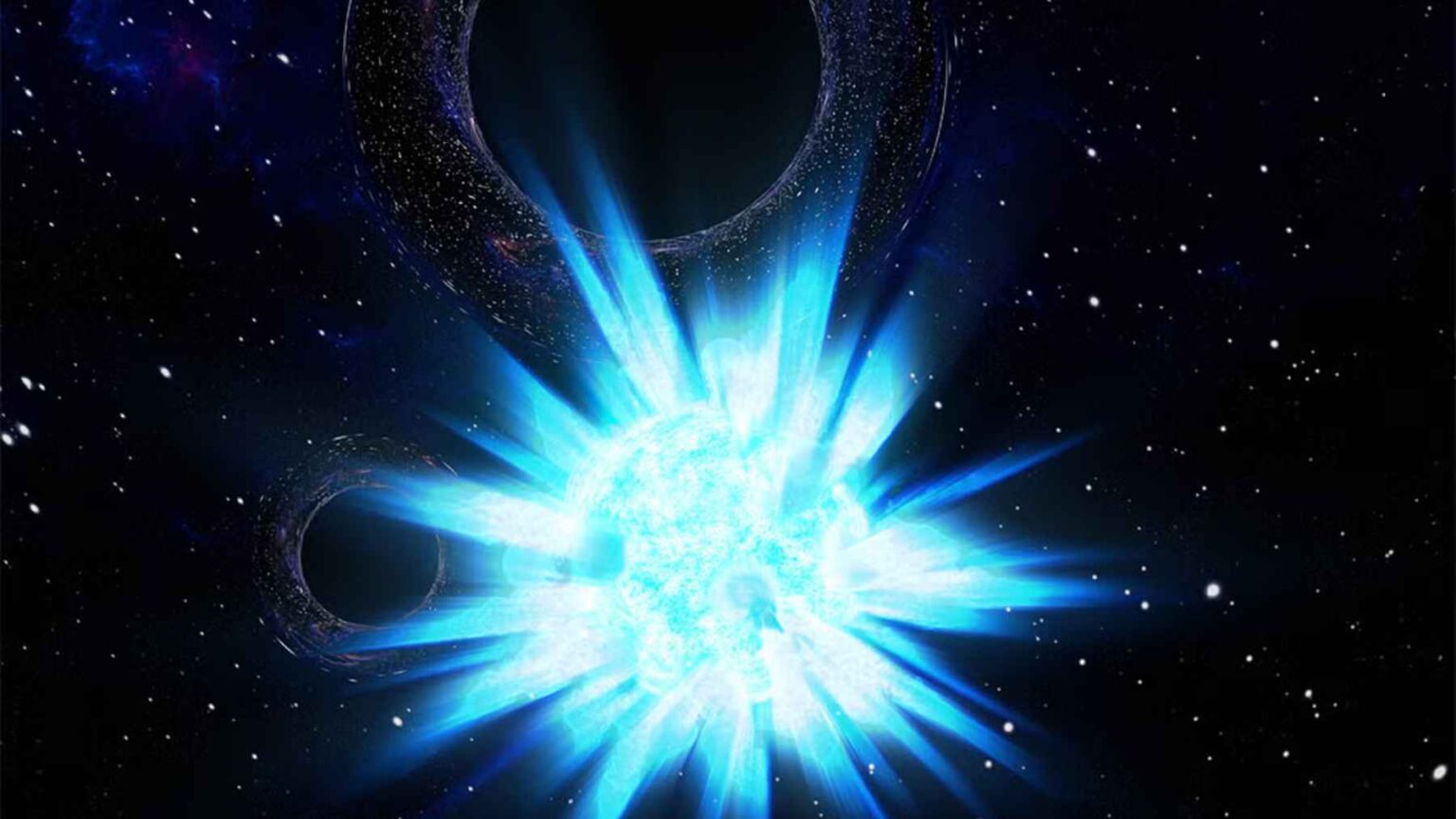
Most massive stars die with gravity winning in the end, squeezing the core until it collapses into a black hole. But in the most extreme stars, the core gets so hot that high-energy light turns into pairs of particles, electrons and positrons, which reduces the pressure holding the star up.
With less pressure, the core can contract quickly and heat up even more. That can trigger a runaway thermonuclear blast powerful enough to tear the star apart, leaving no black hole and no neutron star behind.
Scientists first proposed this chain of events in the 1960s, but it is tough to confirm with telescope images alone. One leading candidate is the unusually bright supernova 2018ibb, which researchers have followed for years to see if it matches the expected signature of this kind of blast.
A clue hidden in the smaller partner
Why obsess over the smaller partner in a black hole merger? In a pair, the heavier one is called the primary while the lighter one is the secondary, and the new result focuses attention on that lighter object.
The reason is simple but important. A gap in the secondary masses fits the idea that secondaries mostly come straight from dying stars, while some primaries may have grown larger through earlier mergers and then merged again later.
This also connects to an ongoing debate about how sharp the cutoff really is and how much model choice matters. A Sky & Telescope analysis notes that Tong’s team focused on the clearest events in the latest catalog and argues the pattern matches “second-generation” black holes, while other researchers see a gentler decline.
Why this matters beyond black holes
A mass gap might sound like a niche detail, but it is really a window into how stars recycle matter into space. Pair-instability explosions are expected to eject large amounts of heavy elements while leaving no remnant, changing how galaxies get “enriched” over time.
Those heavy elements are the same basic ingredients that later end up in rocky planets. In that sense, learning which stars leave nothing behind also helps scientists map when and where future solar systems can inherit the raw material for worlds.
There is another payoff that stays closer to the physics. Astrophysicist Maya Fishbach at the University of Toronto said “once they are born, black holes can grow via repeated mergers,” a point that lines up with the idea of repeated collisions building up the biggest objects.
What scientists will watch for next
The most obvious next step is more detections. As catalogs grow and detectors improve, researchers can check whether the gap edges stay in the same place, or whether they shift with different stellar environments and formation histories.
Some scientists are also stress-testing alternatives. Modeling work has explored whether everyday binary evolution, including mass transfer between stars, could create a similar-looking cutoff without requiring pair-instability explosions in every case.
Either way, the direction of travel is clear. As the sample grows, the “forbidden range” could become a tool for reading the hidden lives of massive stars, not just counting black holes.
The main study has been published in Nature.