
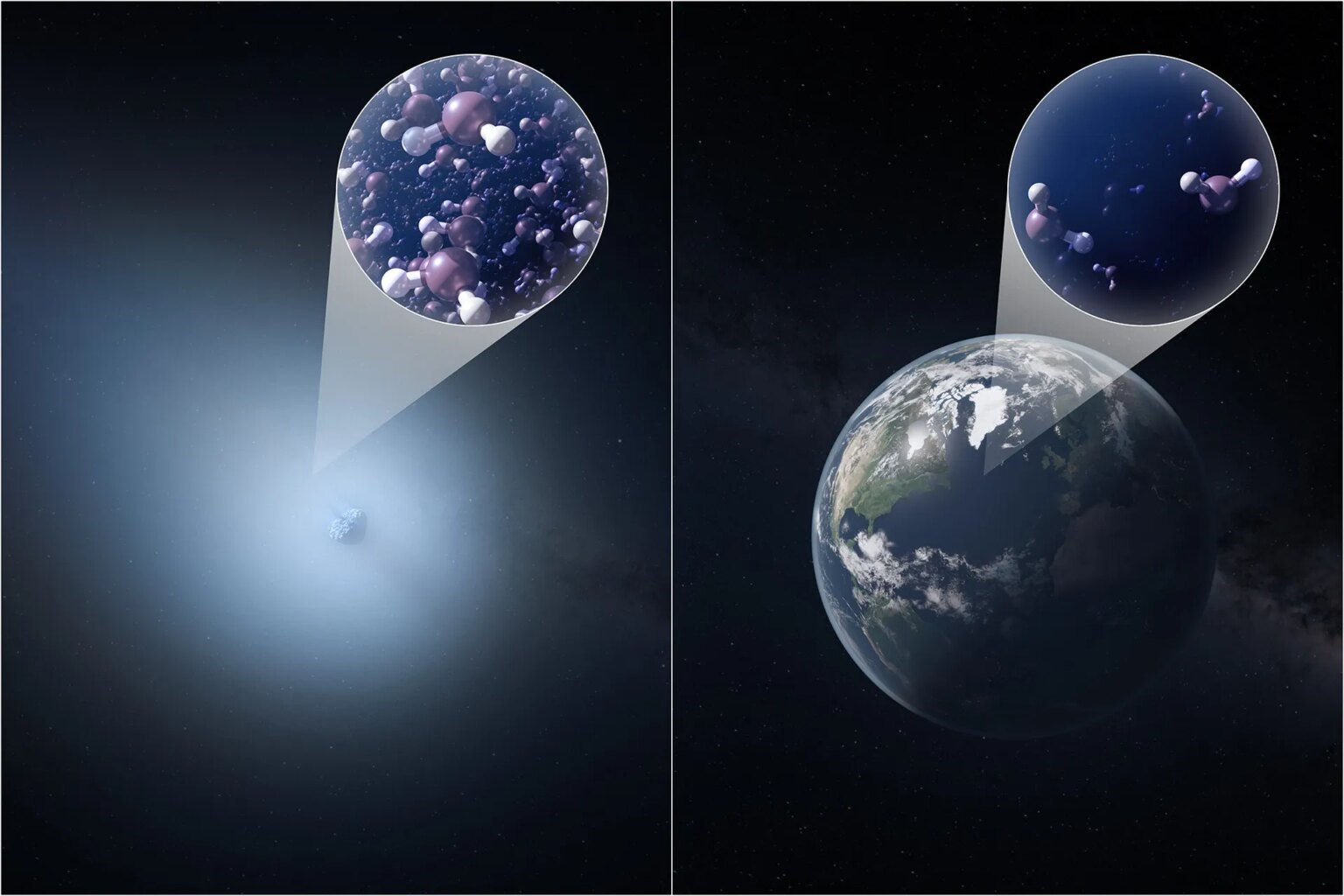
Water sampled from 3I/ATLAS (left) has 30 times the concentration of deuterated water molecules that Earth’s oceans do (right), as shown in this illustrated comparison. Credit: NSF/AUI/NSF NRAO/M. Weiss
We already knew interstellar comet 3I/ATLAS came from somewhere far beyond our solar system. Now scientists have more information on how alien that somewhere really is — a corner of the universe colder than, less irradiated than, and chemically distinct from the conditions that shaped our home.
A study published April 23 in Nature Astronomy reveals that 3I/ATLAS carries water with an extraordinary concentration of what’s known as deuterated water. The finding marks the first time scientists have ever measured deuterated water in an interstellar object — and the numbers are unlike anything we’ve seen before.
“Our new observations show that the conditions that led to the formation of our solar system are much different from how planetary systems evolved in different parts of our galaxy,” said Luis Salazar Manzano, a doctoral student at the University of Michigan and lead author, in a press release.
A frozen record
Discovered in July 2025, 3I/ATLAS is only the third known interstellar object to pass through our solar system and just the second confirmed interstellar comet, after 2I/Borisov in 2019. Its estimated age of up to 12 billion years makes it potentially the oldest interstellar visitor ever detected — likely born in the early galaxy, long before our Sun ignited. Like all comets, 3I/ATLAS is essentially a frozen time capsule housing a chemical record of the environment where it formed.
Just six days after 3I/ATLAS’s closest approach to the Sun, the team, led by Salazar Manzano, used the Atacama Large Millimeter/submillimeter Array (ALMA) in Chile to detect deuterated water in the comet’s coma. Deuterium is a heavy form of hydrogen — standard hydrogen with a neutron added to its nucleus. When water forms in extremely cold environments (below about 30 kelvin, or -406 degrees Fahrenheit [-243 degrees Celsius]), chemical reactions incorporate deuterium into water molecules. The colder the environment, the higher the deuterium concentration. That ratio gets locked into ice and preserved, making it a frozen fingerprint of a planetary system’s birth conditions.
The water deuterium-to-hydrogen (D/H) ratio the team measured on 3I/ATLAS was 40 times greater than that of Earth’s oceans, and 30 times the average value for solar system comets. The unprecedented ratio tells scientists that the comet’s home system formed in a place far colder and less irradiated than the molecular cloud that eventually became our solar system.
The water D/H ratio in 3I/ATLAS sits well above every solar system comet ever measured — Hale-Bopp, Hyakutake, Halley, 67P — and beyond what any known protostar or protoplanetary disk in our galaxy has produced.
Something’s in the water
The team presented three possible explanations for the extreme deuterium ratio in 3I/ATLAS’s water.
The first is that the ratio was established during the cold, dense stage before 3I/ATLAS’s host star formed — known as the prestellar cloud phase. The highest levels of deuterium enrichment in water are expected to occur during this phase. If the molecular cloud that gave birth to 3I/ATLAS’s host system was colder than the one that produced our Sun, that could account for the difference. Our own Sun likely formed in a clustered environment, surrounded by other massive stars whose radiation heated the surrounding gas to between 20 and 30 kelvins. Because deuterium enrichment in water occurs more strongly in environments at around 10 kelvins — typical of isolated star formation — the authors argue that 3I/ATLAS’s host star likely formed somewhere colder than our Sun’s birth environment, possibly in relative isolation without nearby massive stars warming its surroundings.
The second is that the ratio reflects what happened — or didn’t happen — inside the protoplanetary disk (the dense disk of dust and gas around a young star) after the host star formed. In our solar system, thermal processes within the protoplanetary disk gradually diluted the deuterium ratio over time. If 3I/ATLAS’s host disk did less of that thermal processing, the comet would have retained a higher D/H ratio than solar system comets carry today.
The third is that 3I/ATLAS formed unusually far from its host star, beyond what is called the CO₂ snowline — the distance at which carbon dioxide freezes. Water ice that forms at greater distances from a star tends to be more deuterium-rich, and objects that form that far out are also more likely to be ejected into interstellar space by gravitational interactions with planets.
Of the three, the authors consider the prestellar cloud explanation most likely. Because the chemical reactions that incorporate deuterium into water are so sensitive to temperature, they conclude that the environment where 3I/ATLAS’s host system was born was almost certainly colder than the molecular cloud that gave rise to our own Sun. The other two explanations are not ruled out — thermal processing in the disk, and a distant formation location could each have contributed further to the enrichment, and the paper notes that all three are consistent with the data. Regardless, the result is the same: 3I/ATLAS came from a system built under different conditions than ours.
Proving the obvious
Because most optical telescopes cannot point toward the Sun, observing a comet near perihelion is extremely difficult. But because ALMA is a radio telescope that doesn’t rely on visible light to gather data, it can do just that. The team used ALMA’s Atacama Compact Array to detect deuterated water and methanol emissions from the comet’s outgassing coma, then used modeling to infer the water production rate and constrain the D/H ratio.
Beyond rewriting what we know about 3I/ATLAS, this study demonstrates that planetary systems across the galaxy can form under radically different physical and chemical conditions than our own. As more interstellar objects are discovered — a near-certainty as next-generation observatories come online — scientists now have a proven method to chemically fingerprint their birthplaces.
As study co-leader Teresa Paneque-Carreño put it, “This is proof that whatever the conditions were that led to the creation of our solar system are not ubiquitous throughout space. That may sound obvious, but it’s one of those things that you need to prove.”