Two years from now, humanity will be sending its seventh rover to planet Mars. Called Rosalind Franklin in honor of a British chemist who specialized in the inner workings of DNA, it is Europe’s first dedicated Mars rover, and it will be tasked with looking for signs of life deeper into the planet’s crust than any other exploration instrument ever did.
We learned at the beginning of April that the spacecraft which will be tasked with sending the Franklin on its way is a SpaceX Falcon Heavy, which will lift off from Launch Complex 39A at NASA’s Kennedy Space Center in Florida no earlier than 2028. And now, we’re treated with some details on what the rover is supposed to do once it reaches its destination.
You see, like all other missions of this kind before it, the Franklin needs a rocket to launch, a spacecraft to carry it through the void, and a lander to get it to the surface. Because this is a joint European effort, these things are presently being put together by the European Space Agency (ESA) with help from Thales Alenia Space and Airbus.
What brings us here today is the landing module, which is the one that’s supposed to safely deposit the rover on the reddish surface of the planet sometime in 2030. The work of Airbus, the thing is 12-feet (3.8 meters) across and will be fully capable of sustaining atmospheric entry at a speed of 13,000 mph (21,000 kph).
To slow down, the lander will use a combination of retro rockets and parachutes, which will slow the thing down to 100 mph (152 kph), then to just seven mph (11 kph). Before entering Mars’ upper atmosphere and touching down, only six minutes would have passed.

Photo: ESA
Once it reaches the surface, the lander will open up, extending two descent ramps in a bid to give mission operators a choice on what route is best to follow in the Oxia Planum region of the planet, where it’s supposed to land.
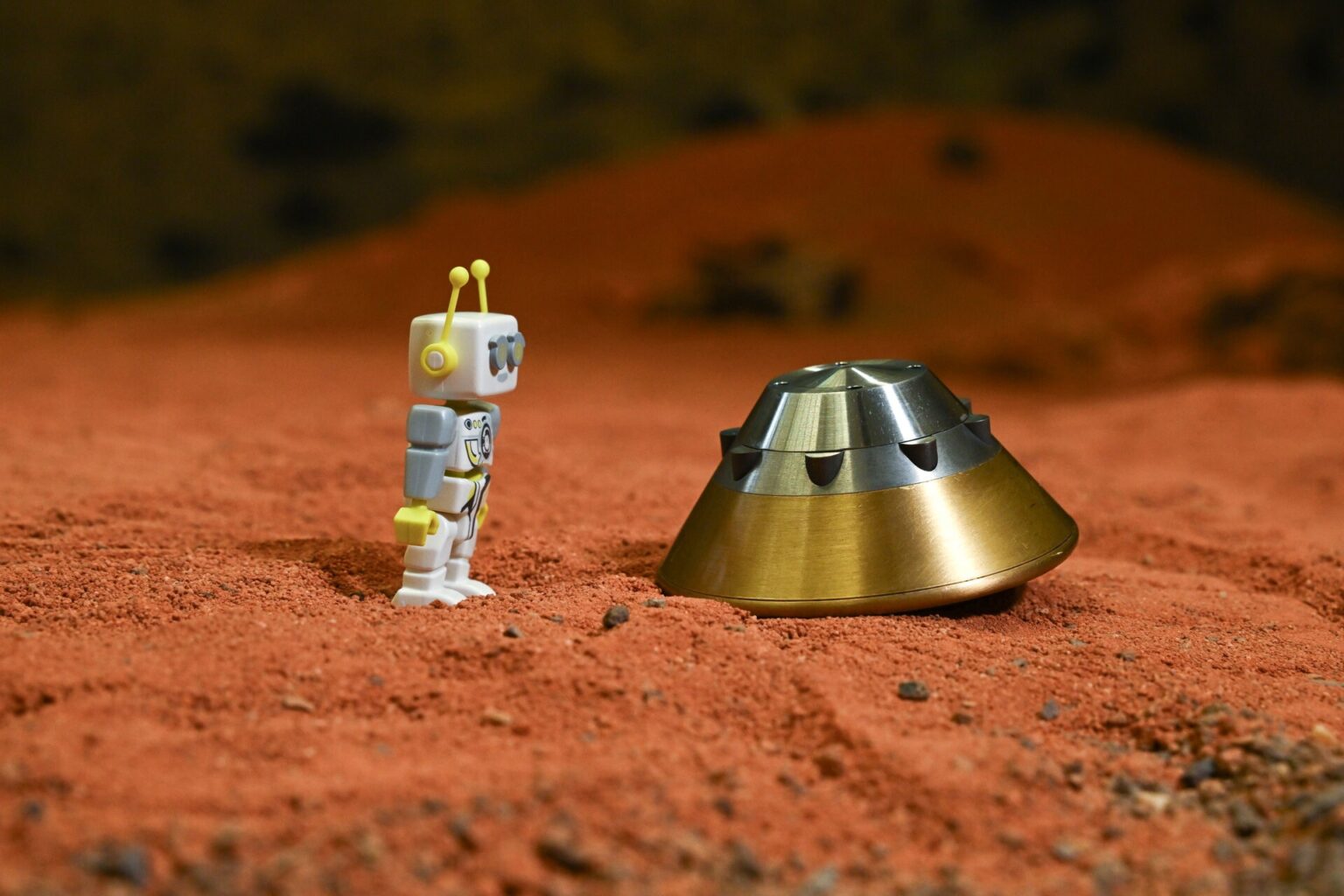
To make sure all of the above unfold successfully as described, the ESA had to test the lander somehow. Instead of going for a full-scale copy, though, the agency opted to create a miniature lander that’s just three inches (eight cm) in diameter.
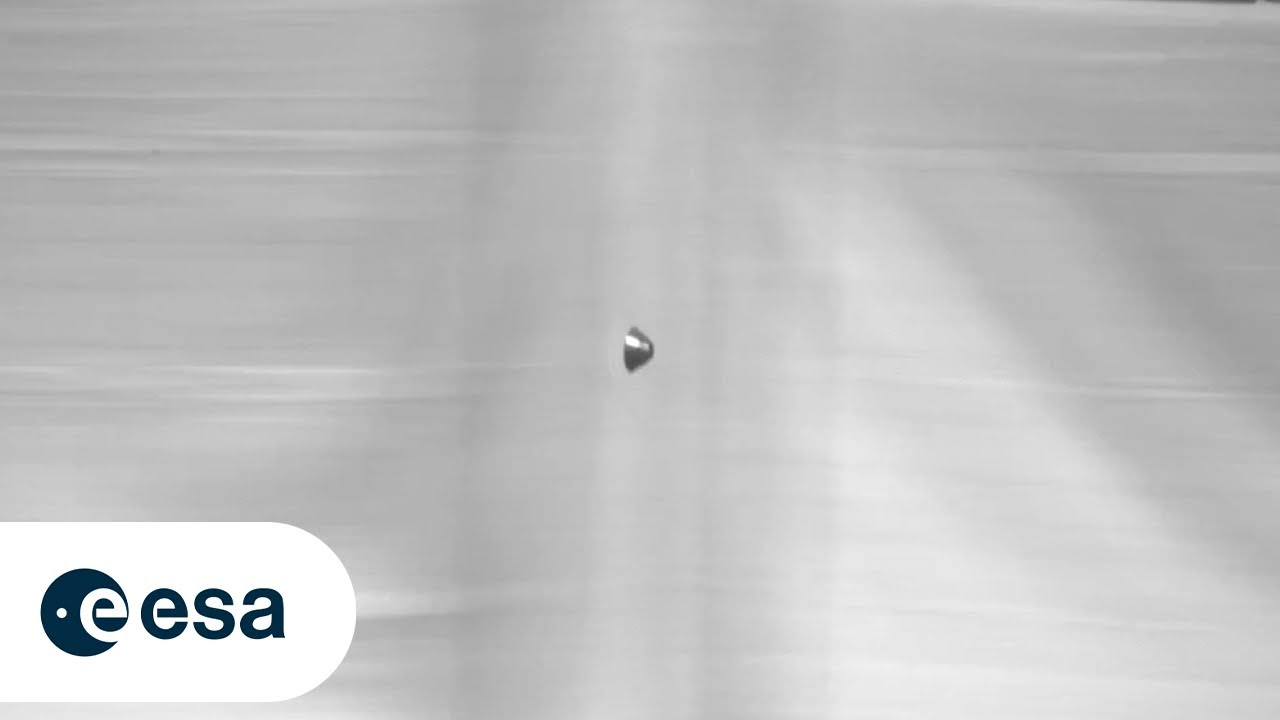
Don’t let the size, comparable to that of a minifigure, fool you, though. The small metallic capsule seen in the attached gallery and in the video below this text is packed to the teeth with sensors meant to collect data. It recently traveled at speeds of 2,672 mph (4,300 kph), and it can withstand 17,000 Gs, far beyond what most electronics can survive.
The capsule was recently fired from a smooth-bore gun in an attempt to mimic the real lander’s speed and aerodynamics. Its electronics circuits (magnetometers, accelerometers, and radar) kept tabs on what was going on for the duration of the 755-foot (230-metre) flight, which were covered in just half a second at supersonic speeds.
The ESA did this with 20 different models of the miniature capsule during a test campaign conducted at the end of last year at the French-German Research Institute of Saint-Louis (ISL) in France. The goal was to gather data on the capsule’s movement, trajectory, and stability, and on how it might behave during entry.
You can see the action in the video below, which was shot with specialized tracking cameras and has been slowed down 60 times to make things discernible.

Photo: ESA
Once the Franklin reaches the Red Planet, it will become the seventh rover on Mars, joining the five American ones (Sojourner, Spirit, Opportunity, Curiosity, and Perseverance) and the Chinese Zhurong. It will, however, be the most capable of the bunch in one key aspect.
The thing is equipped with a massive drill that will allow it to punch holes 6.6 feet (two meters) deep into the Martian soil and collect samples that have the greatest chance of containing traces of life, thanks to the protection from radiation and extreme temperatures the above soil granted them.
The Rosalind Franklin is part of the ExoMars program ran by the ESA, and it was initially supposed to fly in 2020, on board a Russian rocket. Some problems with the descent parachutes pushed the launch to 2022, but that was not met either, on account of Russia invading Ukraine and becoming the pariah of the civilized world.
Now that SpaceX has been brought on board to launch the rover, chances are the mission will indeed get going two years from now. There is no doubt in my mind that the Franklin will find irrefutable proof that Mars once had life (or perhaps that it still has).
The only question is whether the two remaining operational rovers, the Curiosity and the Perseverance, will beat it to the punch or not. Given the recently announced discoveries, that may very well be the case.