
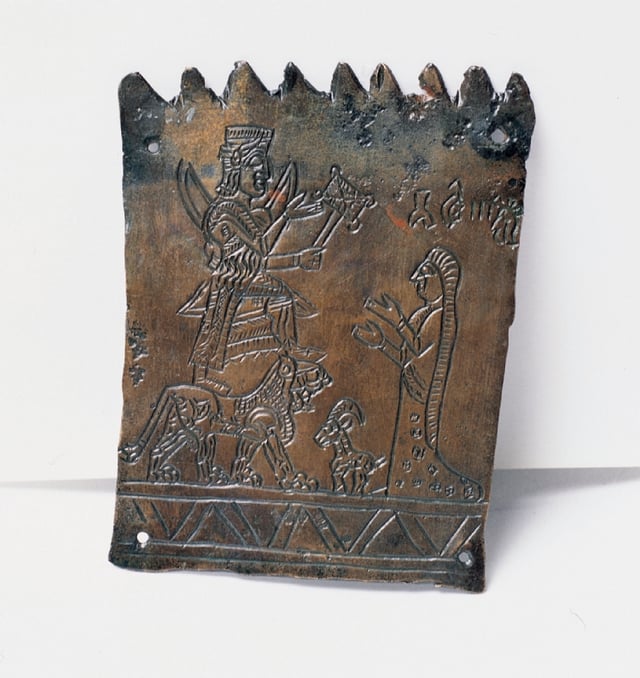
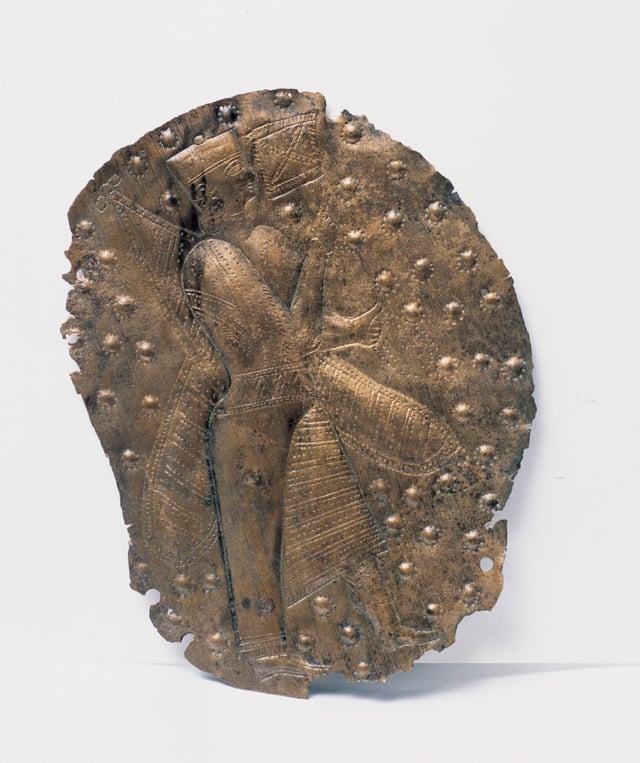
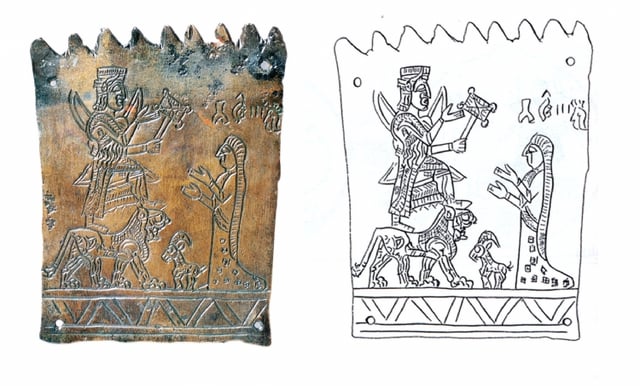
The Urartians, a powerful Iron Age civilization based around Lake Van in modern-day Turkey, were known as master metalworkers. Among their most mysterious artifacts are the bronze votive plaques, which were originally protective bronze battle belts worn by soldiers. At some point, these belts were intentionally cut into pieces and re-engraved with ritualistic and magical scenes to be left as offerings in sacred sites. Thousands of these plaques were discovered in a single hoard in the village of Giyimli, suggesting a massive, organized ritual.
The imagery on these plaques is highly specific and strange. They often depict "Horned Deities" standing on the backs of lions or bulls, holding weapons and bows. One frequent scene shows a mortal woman in a long geometric tunic standing before a deity in a prayer position, often accompanied by a sacrificial goat. While some plaques follow a formal "Palace Style," others are made in a "Folk Style" with wide-eyed human faces and surreal figures that represent local folk beliefs and protective magic. These artifacts suggest that the Urartians believed in a complex world of unseen entities and used these metallic sheets as a form of spiritual protection or communication with the divine. Today, these rare items are preserved in the Van and Elazig Museums in Turkey.
Does anyone know of other ancient cultures that converted their military armor into ritualistic talismans for protection against "unseen" forces?
by bortakci34
2 Comments
Civilizations in the future gonna be finding manga and thinking some really fucked up shit about us.
I like the atropaic symmetry of using old battle armor to make a protective amulet.
Hm, I’m trying to think of other examples of that.. “beating swords into ploughshares” doesn’t count obviously.. I know people have made various crafts from bullet shells and, idk what they’re called, the brass shells from bigger ammunition? But not specifically amulets or talismans.
I will say this, such a practice would definitely give me a sense of an amulet being stronger by association. It’s a poor analogy; but kind of like wearing your flak jacket to defend your dissertation lol
Anyway, I can’t think of another genuine example of the practice in OP, but it makes a lot of sense. I’ll bet those examples do exist.
Edit: perhaps these votive offerings were presented as thanks for the deities’ protection in battle and in the hope that this protection would continue against the forces that assail you in daily life. Or, if the soldier has fallen in battle, that the deities would look after his family, with the sacrificial animal pictured representing the soldier himself?