
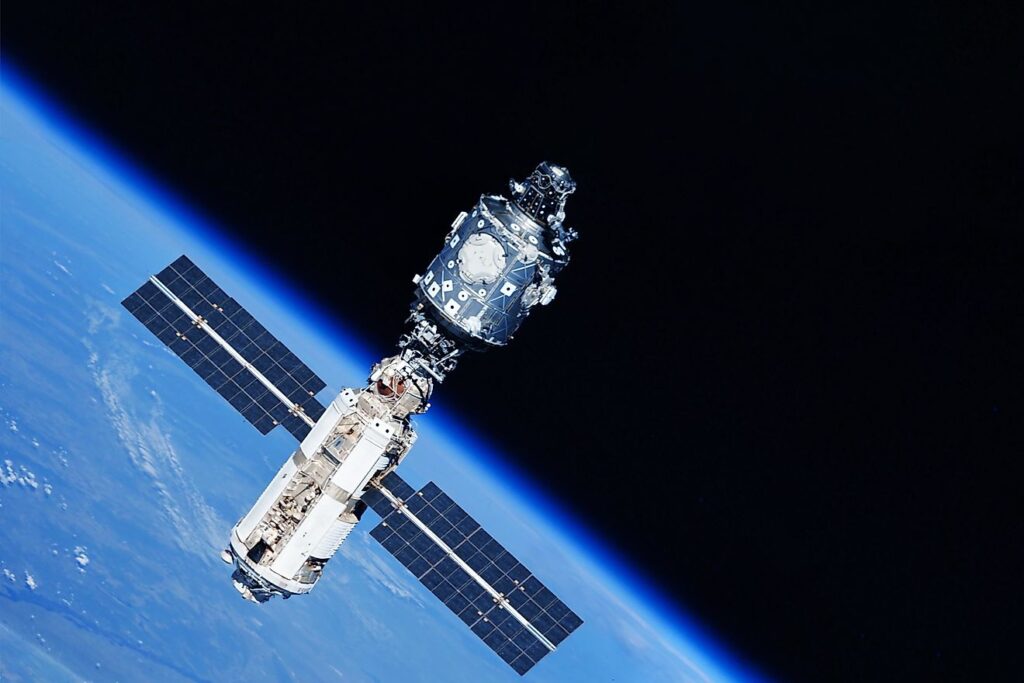
A satellite is any object that orbits another body in space. Earth’s only natural satellite is the Moon. Every other satellite around Earth, more than 14,000 of them as of early 2026, is artificial. The first one was launched in October 1957 by the Soviet Union; recent ones are reaching orbit at a rate of roughly 60 per week, almost all of them part of SpaceX’s Starlink constellation. The orbital environment around Earth has changed more in the last six years than in the previous sixty, and the trajectory of that change is what makes the satellite question worth revisiting in 2026.
The First Satellite
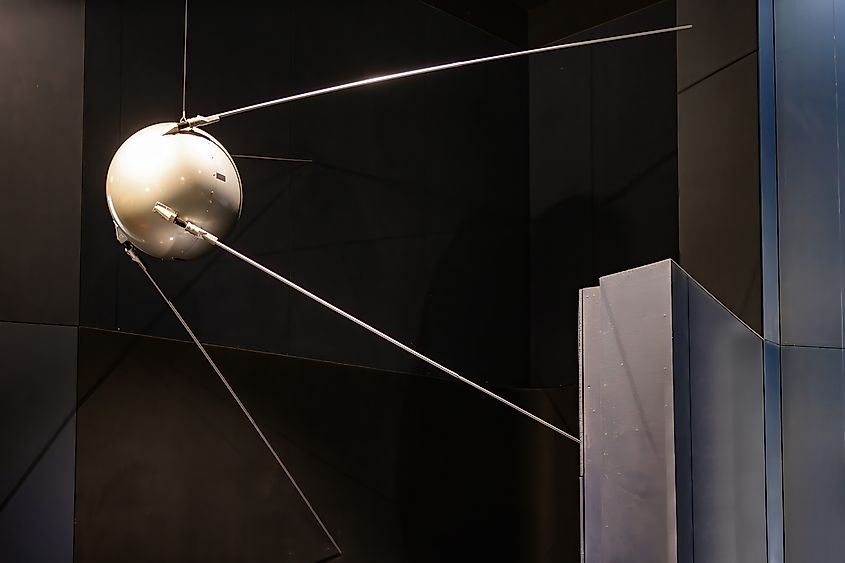 Sputnik 1, the first artificial satellite in the Science Museum, London. Editorial credit: agsaz / Shutterstock.com
The Soviet Union launched Sputnik 1 from the Baikonur Cosmodrome on October 4, 1957. It was a metal sphere with a mirror finish, 58 centimeters (23 inches) in diameter, weighing 83.6 kilograms (184 pounds). The body was built from an aluminum-magnesium-titanium alloy and equipped with four whip antennas and a small radio transmitter operating on 20.005 and 40.002 MHz. The signal was a simple repeating beep that amateur radio operators around the world could detect. Sputnik 1 transmitted for 22 days before its batteries ran out, then orbited silently for two more months before burning up on reentry on January 4, 1958.
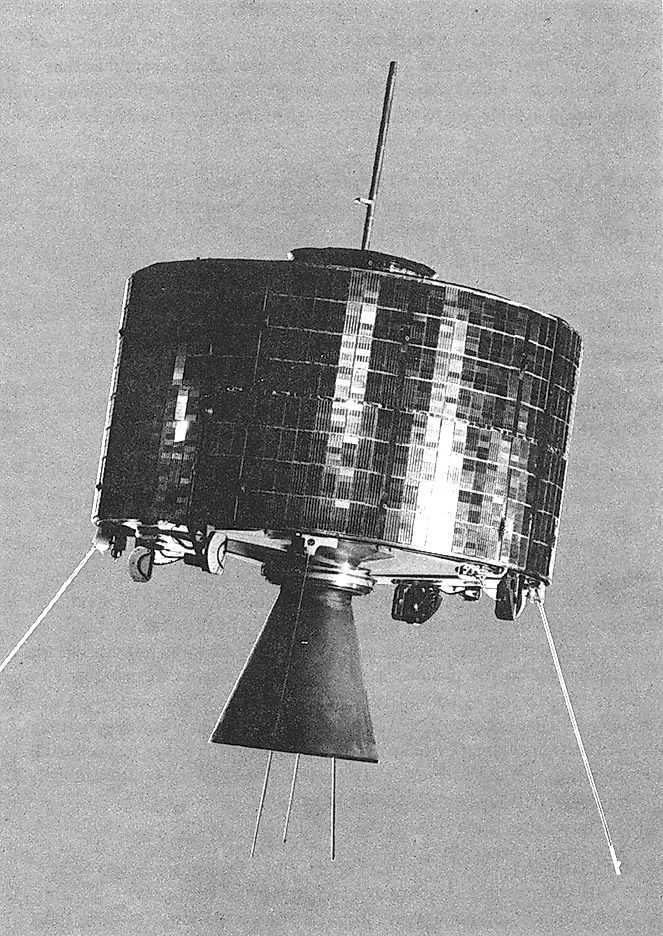 Syncom 2, the first geosynchronous satellite
The political reaction in the United States was substantial. The Eisenhower administration accelerated American satellite efforts, leading to the launch of Explorer 1 on January 31, 1958, and the establishment of NASA in July of the same year. The Cold War space race that defined the next decade had its starting line at Baikonur.
How Many Satellites Are in Orbit Today
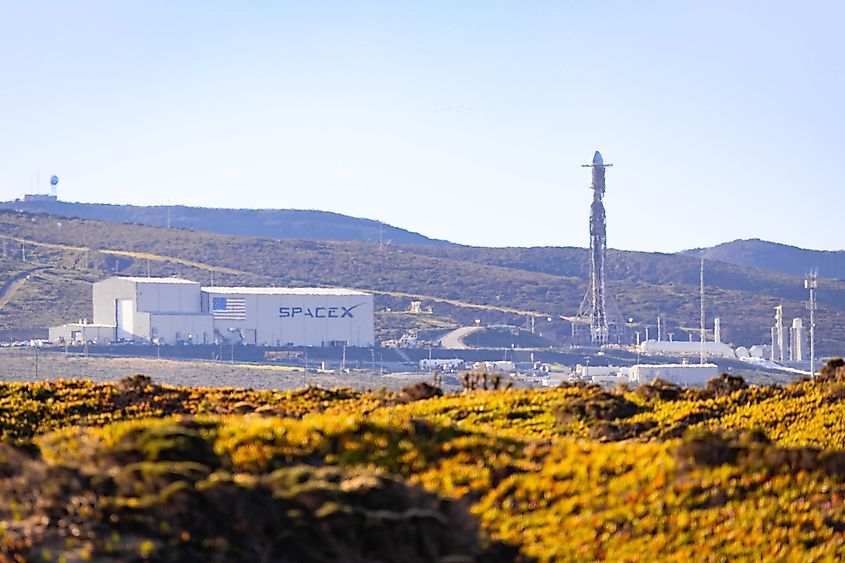 SpaceX Falcon rocket standing on launch pad preparing for liftoff at California aerospace facility. Editorial credit: Photo Spirit / Shutterstock.com
The number changes weekly, but as of early 2026, the European Space Agency and independent tracking services count approximately 14,500 active satellites in Earth orbit. Roughly 9,900 of those are SpaceX Starlink satellites. The remaining 4,600 are split among government, commercial, scientific, and military operators across all other countries combined. The United States operates the most satellites by a wide margin, almost entirely because of Starlink; without it, the US would operate around 600 active satellites, on par with China.
Add in defunct satellites still in orbit (roughly 3,000 to 4,000) and tracked debris fragments, and the total number of objects circling Earth pushes past 17,000. Counting smaller, harder-to-track debris, the figure climbs into the tens of thousands.
Where Satellites Orbit
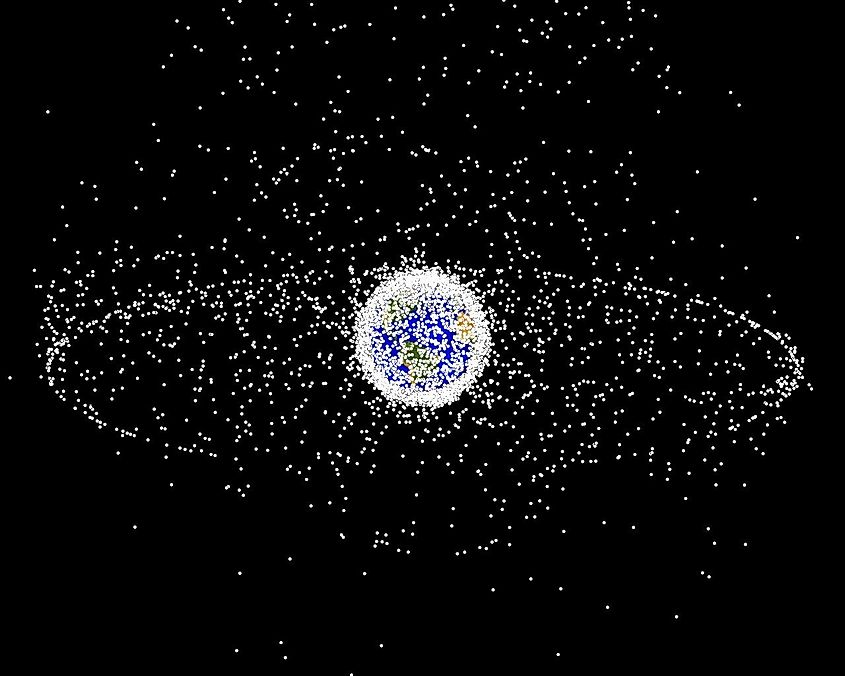 A computer-generated image from 2005 showing the distribution of mostly space debris in geocentric orbit with two areas of concentration: geostationary orbit and low Earth orbit.
Earth’s satellites are categorized by altitude. Low Earth Orbit (LEO), the band from about 160 to 2,000 kilometers up, holds around 90% of active satellites, including Starlink, the International Space Station, the Hubble Space Telescope, and most Earth-observation spacecraft. Medium Earth Orbit (MEO), between 2,000 and 35,786 kilometers, is where GPS and other global navigation satellite constellations operate. Geostationary Orbit (GEO), at exactly 35,786 kilometers above the equator, holds satellites that complete one orbit every 24 hours and appear to hover over a fixed point on Earth, which makes them useful for weather monitoring and broadcasting.
Satellites Around Other Bodies
Mars has the second-largest active satellite fleet in the Solar System after Earth. Roughly seven spacecraft are currently operating in Mars orbit: NASA’s Mars Odyssey (in orbit since 2001 and the longest-running active spacecraft at any other planet), NASA’s Mars Reconnaissance Orbiter, NASA’s MAVEN, the European Space Agency’s Mars Express, the joint ESA-Roscosmos ExoMars Trace Gas Orbiter, the United Arab Emirates’ Hope orbiter, and China’s Tianwen-1 orbiter. Several Mars orbiters from earlier missions remain in non-functional orbits around the planet.
The Moon has a small but growing fleet of active spacecraft, including NASA’s Lunar Reconnaissance Orbiter (since 2009) and CAPSTONE, China’s Queqiao-2 relay satellite, and others tied to ongoing lunar exploration programs. Jupiter currently has one active orbiter, NASA’s Juno. Mercury has no active orbiter; the joint ESA-JAXA BepiColombo mission is en route and scheduled to enter Mercury orbit later this decade. Venus has no active orbiters at present.
What Satellites Do
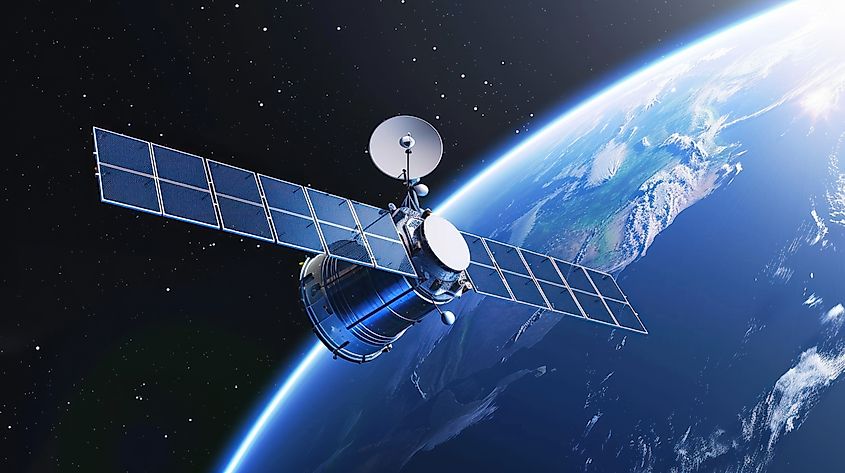 Modern Space Communications and Telecommunications Satellites.
Modern satellites support communications (the largest category by far, dominated by Starlink and other internet constellations), Earth observation, weather forecasting, navigation (GPS, Galileo, GLONASS, BeiDou), scientific research, military reconnaissance, and astronomy. The Hubble Space Telescope, in low Earth orbit since 1990, was joined in 2022 by the James Webb Space Telescope at the Earth-Sun L2 Lagrange point, about 1.5 million kilometers from Earth, well beyond the conventional satellite altitude bands.
For everyday users, the practical effects are constant. GPS navigation depends on a constellation of about 31 active satellites in MEO. Television and high-latitude telephone service depend on geostationary satellites. Real-time weather imagery, internet service in rural and maritime areas, and most of the climate-monitoring data underlying long-term forecasts all come from satellites.
The Crowding Problem
The pace of growth is the central issue facing space operators in 2026. ESA projects approximately 100,000 active satellites in Earth orbit by 2030 if planned mega-constellations (continued Starlink expansion, Amazon’s Project Kuiper at 3,200 planned satellites, China’s Qianfan at around 14,000 planned) are fully deployed. Collision risk in LEO, light pollution affecting ground-based astronomy, and atmospheric effects from frequent launches and satellite re-entries are now active research and regulatory concerns rather than theoretical ones.
The first satellite was a 184-pound metal sphere broadcasting a beep. Less than seventy years later, the orbital environment around Earth carries more spacecraft than there are people in some small countries, and the rate of change shows no sign of slowing.