
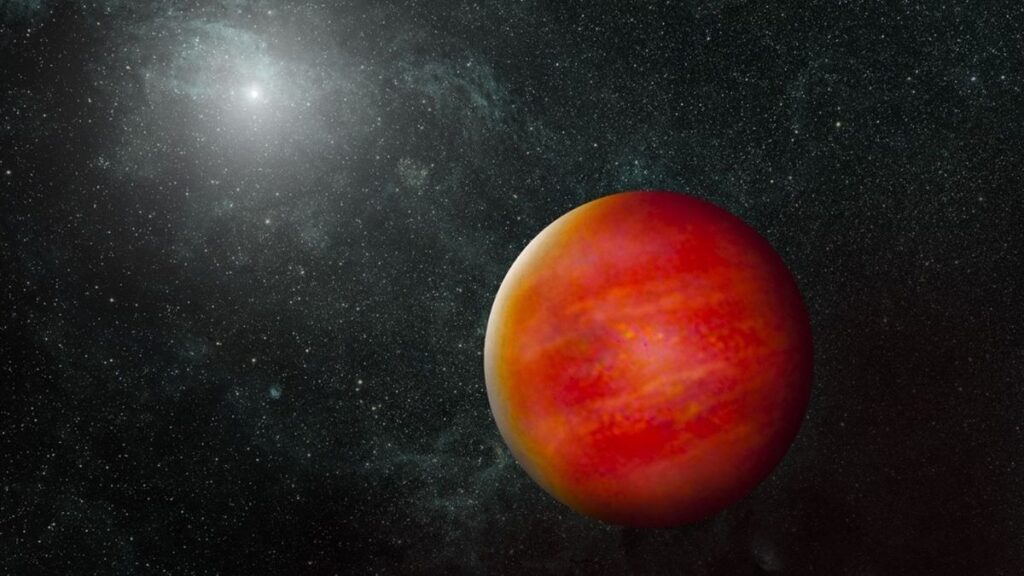
Over 2,00,000 citizen scientists have discovered more than 3,000 new brown dwarfs, doubling the total number of these mysterious objects known to science, in what is being called one of the biggest citizen science achievements in astronomy.
These amateur astronauts spent years scrolling through telescope images on their laptop, looking for something moving faintly against the stars.
Over 2,00,000 citizen scientists scanning space images from home just doubled the number of known brown dwarfs. (Photo: Nasa)
They are not professional scientists. They have no laboratory, no university affiliation, no funding. What they have is curiosity, time, and access to one of the most powerful sky surveys ever conducted from space.
It turned out to be enough.
The findings, led by astronomer Adam Schneider of the U.S. Naval Observatory, have been published in the Astronomical Journal. Of the paper’s 75 co-authors, 61 are citizen scientists.
WHAT IS A BROWN DWARF?
To understand why this matters, you first need to understand what a brown dwarf actually is, because it is one of the stranger things in the universe.
Stars are born when vast clouds of gas and dust collapse under gravity. As the material is compressed, the core heats up until hydrogen atoms are forced together in a process called nuclear fusion, releasing enormous energy.
That is what makes a star shine. Our Sun has been doing this for nearly five billion years.
Citizen scientists on Nasa’s Zooniverse platform sifted through 16 years of infrared telescope images from their homes, hunting for faintly moving objects that turned out to be brown dwarfs scattered across our galaxy. (Photo: Nasa)
A brown dwarf is what happens when that process almost works but does not quite get there. The cloud collapses. The core heats up. But there is not enough mass to sustain nuclear fusion.
The result is an object too large to be a planet and too small to be a star, stranded somewhere in between. Scientists sometimes call them failed stars.
They glow faintly in infrared light, a form of heat radiation invisible to the human eye, and grow dimmer and cooler over millions of years.
ARE BROWN DWARFS RARE?
Not at all. Astronomers estimate there is roughly one brown dwarf for every three or four stars near our Sun. They are everywhere.
The problem has always been that they are so faint that finding them is extraordinarily difficult, like looking for a dying ember in a dark field.
An artist’s depiction of the relative sizes of the Sun, a low-mass star, a brown dwarf, Jupiter, and the Earth. (Photo: Nasa)
That is precisely why the Backyard Worlds: Planet 9 project exists. Citizen scientists used Nasa’s Zooniverse platform to sift through 16 years of infrared images captured by Nasa’s Wide-field Infrared Survey Explorer, known as WISE, and its follow-up mission, NEOWISE-R.
They searched for objects that appeared to shift position over time, a reliable sign of something relatively close to our solar system. Some even built their own software to speed up the search.
WHAT DID THEY FIND?
The discoveries have already changed how scientists think about these objects.
The citizen scientists uncovered a brand-new category called extreme T sub-dwarfs, which are ancient, metal-poor brown dwarfs thought to have formed in the early universe, billions of years before our Sun existed.
They also found an unusual brown dwarf that appears to produce aurorae, the same phenomenon responsible for Earth’s northern lights, something never previously confirmed in a brown dwarf.
Beyond individual oddities, the sheer volume of new data is helping astronomers understand how mass is distributed across our galaxy and chart the immediate cosmic neighbourhood around our solar system.
Nasa’s Wide-field Infrared Survey Explorer scanned the sky in infrared light over many years, capturing the data that citizen scientists used to make over 3,000 new brown dwarf discoveries. (Photo: Nasa)
Two of the paper’s non-citizen-scientist authors began their careers with the Backyard Worlds project and went on to become professional astronomers, a detail that says something quietly remarkable about what citizen science can do.
The project is not finished. Nasa’s Backyard Worlds: Planet 9 is still working through more than two billion sources from the WISE and NEOWISE-R surveys. Anyone can join at backyardworlds.org.
As Mayahuel Torres Guerrero, a citizen scientist from Mexico City, put it simply upon learning she would be named as a co-author on the paper: Yes, dreams do come true.
– Ends
Published By:
Radifah Kabir
Published On:
May 6, 2026 12:04 IST