
 Save
Save
You have reached your maximum number of saved items.
Remove items from your saved list to add more.
AAA
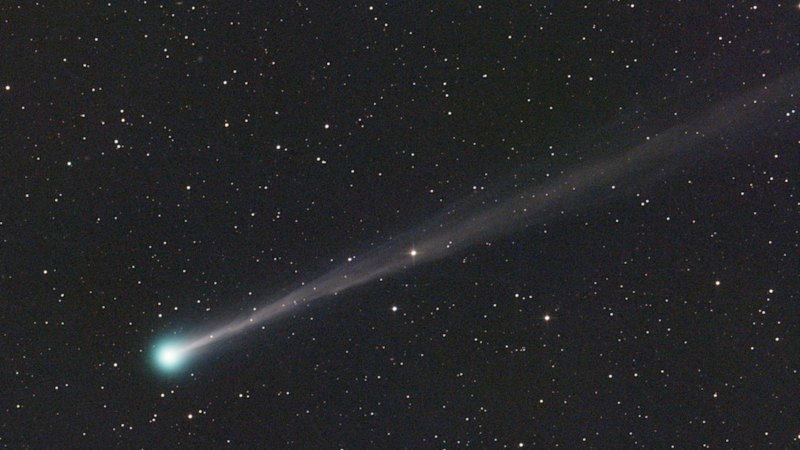
Australians will have their only chance to spy a newly discovered blue-green comet scorching past Earth during the next fortnight – coinciding with the flashy peak of a meteor shower – before the cosmic visitor fires off into deep space.
The comet was found last September and has shown off to northern hemisphere stargazers for the past few weeks, before it slingshotted around the sun in late April and soared into our view.
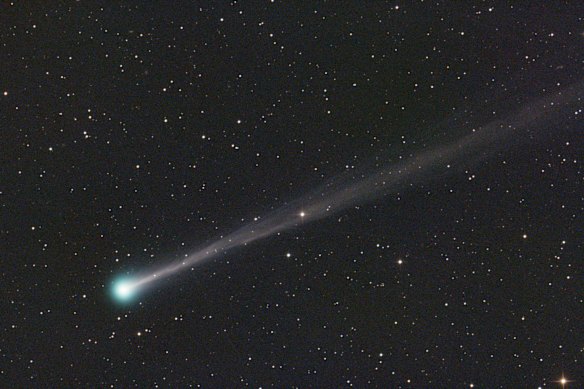 C/2025 R3 PanSTARRS, captured above from Crete in April, is now visible in Australian skies.Wikimedia
“I’m getting a tail that’s about 10 degrees long, beautifully running up into Orion,” said Professor Jonti Horner, an astronomer who has had his camera aimed at the comet as it skates towards the chin of the Witch Head Nebula.
The comet, C/2025 R3 PanSTARRS, originated from the Oort cloud, an enormous reservoir of trillions of icy interstellar rock chunks fringing the outermost edge of the sun’s gravity.
Every so often, one of the objects peels away and becomes a comet, a “dirty snowball” blasting past the sun and releasing a streaked tail of dust and plasma.
That’s how C/2025 R3 PanSTARRS came to brighten the Australian horizon until about May 10.
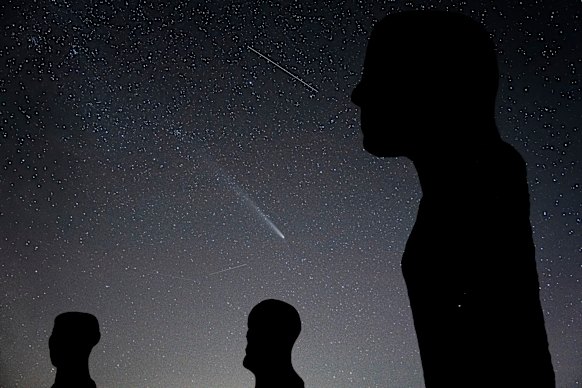 Comet C/2023 A3 (Tsuchinshan–ATLAS) was a rare comet – also from the Oort cloud – visible with the naked eye in 2024 skies.AP
“It is our only chance to see it because it’s been nudged by the planets as it’s come through, so it will never return,” Horner, from the University of Southern Queensland, said. “It is being ejected from the solar system utterly and entirely, which means that it will go to float among the stars forevermore.”
It’s not uncommon to find new comets, but most are 10,000 to 100,000 times too dim to see without serious telescopic firepower.
“You tend to get one comet per year that will tease the edge of naked-eye visibility, and this is one of those,” Horner said, although the comet has passed its brightest point and will probably only be visible through binoculars, a camera or telescope.
How to spot the comet
The comet is best spotted just after sunset once it’s dark, but it will set below the horizon by 9pm (AEST), offering a limited viewing window.
Aspiring comet-hunters should look west, to Orion’s belt, made of three bright stars in a line. The bright red star Betelgeuse lies to the right and the bright blue star Rigel is to the left.
Drop towards the horizon from Rigel and you’ll find the comet.
“It should be quite obvious because all of the stars that you’re seeing will be sharp points,” Horner said, while the comet will have a smudgy tail.
The comet may have a blue-green hue in photos – generated by cyanogen and carbon gas – but probably won’t give off enough light for the cone cells in our eyes to pick up colour.
It’s the perfect object to catch with binoculars or astrophotography, ideally with an SLR, although Horner said some people had luck snapping photos of the comet with their smartphones.
What’s in a name?
Comets are named after the year and fortnight of their discovery, and the telescope which spotted them.
The “C” in C/2025 R3 PanSTARRS’s name refers to the fact it’s a “non-periodic” or “long-period” comet, as opposed to a comet with a regular or “periodic” orbit like Halley’s Comet (which would be denoted with a “P”).
Next comes the year it was first spotted, 2025.
Then comes a letter which denotes the fortnight of the comet’s discovery. The first fortnight of January is A, the second is B, and so on. This comet was found in the first fortnight of September, denoted by “R”.
It was the third comet discovered in that fortnight, hence the next number, “3”.
The comet was discovered by the Panoramic Survey Telescope and Rapid Response System (PanSTARRS), a network of telescopes and astronomical cameras in Hawaii constantly scanning the sky for comets and near-Earth asteroids.
Put it all together and you get C/2025 R3 PanSTARRS. Catchy!
Meteors for early birds
For pre-dawn stargazers, Thursday morning will offer peak views of the Eta Aquariids.
The annual meteor shower occurs as Earth passes through the dusty trail left behind by Halley’s Comet, which circles the sun and will be visible next in 2061.
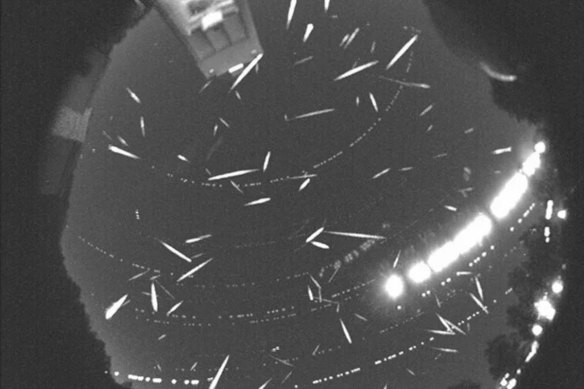 A composite of more than 100 meteors during 2014’s Geminid shower, set to return in December.NASA/MSFC/Danielle Moser, NASA’s Meteoroid Environment Office
This year’s show may not be worth getting up for, though. A very bright waxing gibbous moon will drown out many of the smaller flashes.
 University of Southern Queensland astrophysicist Professor Jonti Horner.
“That means that the number of Eta Aquariids you’d see per hour this year will be down compared to last year by a factor of three or four times,” Horner said.
For those up between 3am and dawn, it’s worth training an eye on the sky and catching the odd spectacular streak.
“If people really want to see a good meteor shower, my advice is always wait until December because the Geminids are the best shower of the year, much better than the Eta Aquariids and the moon is going to be perfect for them,” Horner said.
It’s also an excellent time to admire Venus, the brightest thing in the western night sky. “It looks like an aircraft coming with its headlights on low,” he said.
Jupiter will inch down towards Venus until they dance in a conjunction, when two planets move very close to each other, on June 10.
Related Article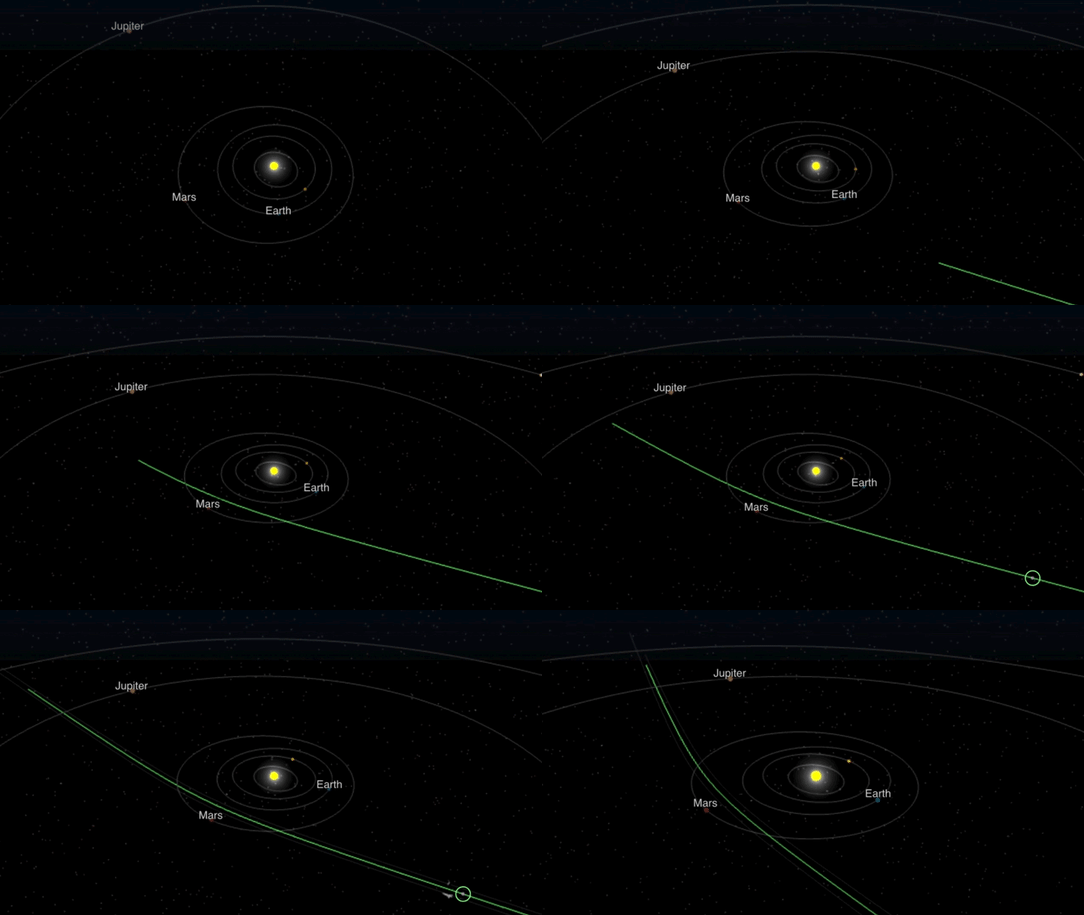
Rounding out this month’s cosmic extravaganza is a blue micromoon on May 31.
A blue moon isn’t actually blue – it’s just the name of the second full moon in one month; a lunar double-act that only happens about once every two and a half years.
This month’s event will be a micromoon, which means it’ll be full when the moon is at its “apogee” furthest from Earth – the opposite of a supermoon.
The Examine newsletter explains and analyses science with a rigorous focus on the evidence. Sign up to get it each week.
Save
You have reached your maximum number of saved items.
Remove items from your saved list to add more.
 Angus Dalton is the science reporter for The Sydney Morning Herald.Connect via X or email.From our partners