
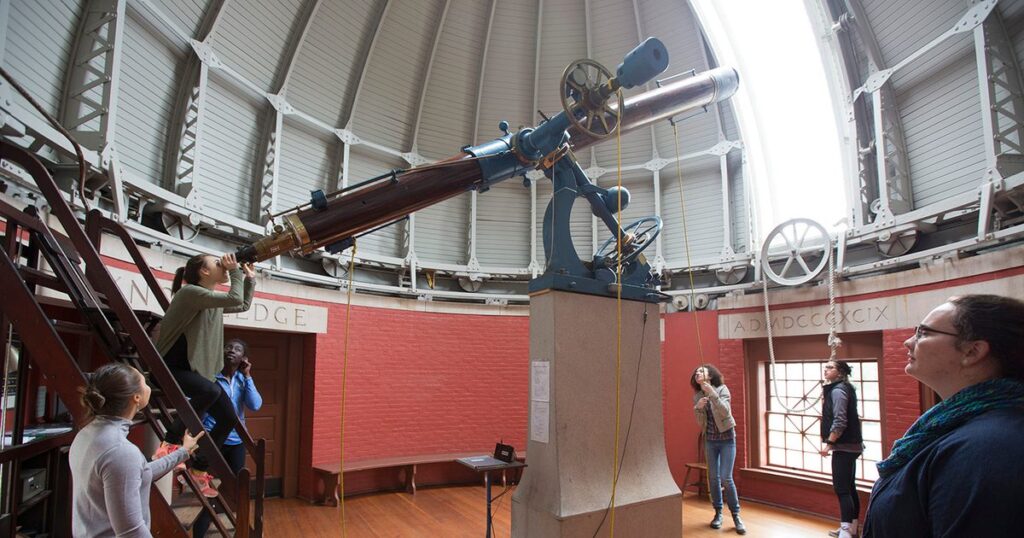
The Whitin Observatory community’s commitment to public engagement is also integral to its identity. McLeod jokes that she is “supposed” to say that building a science‑literate public is critical for a democratic society, “and right now this seems particularly important,” but her motivation is even more direct: “Honestly, to me, it’s much simpler than that. I have been privileged enough to see Saturn’s rings with my own eyes, and I wish every person on Earth could have the same awe‑inspiring experience.”
Kemp agrees: “To see the night sky magnified is often a very powerful thing.”
Students in the A.S.T.R.O. club have embraced this vision. They organize and manage all aspects of the monthly public nights, including talks, telescope operations, and logistics, which consistently attract families, high school students, and community members from beyond the campus.
“It’s really cool to see a lot of families come with little children, and lots of high school students who may not have access to astronomy at their schools,” says astrophysics major Nora Chase‑Tatko ’27. “I love seeing the kids seeing the rings of Saturn for the first time. They’re just blown away.”
Public night also doubles as a communication workshop. Students in ASTR 206: Astronomical Techniques present their research to a general audience at the final public night of the fall semester.
Chase‑Tatko says doing research is most useful if you can communicate it to others. “Getting that opportunity in undergrad to practice presenting your own scientific research to a general community, not just to people with background knowledge, is really important. More people should have access to science, even if it’s not their main interest,” she says.
In recent years, Whitin Observatory has broadened its outreach by integrating astronomy into a range of campus events. Lamiya Mowla ’13, assistant professor of astronomy, describes a growing slate of collaborations: a Ramadan moon‑viewing with the Multifaith Center, connecting Islamic lunar calendar traditions with modern telescopic observations. A harvest moon festival with the Department of East Asian Languages and Cultures, where students and faculty shared mooncakes, stories, and mythology while observing the full moon through Whitin’s historic telescopes. A special event during International Student Orientation, where 60 to 70 students from Beijing, Shanghai, Delhi, Rio, London, and other brightly lit cities saw some of the darkest skies they’d ever experienced.
“Our observatory is a treasure. For 125 years, it has provided firsthand views of the universe, and a space to contemplate it, to both students and the public.”
Kim McLeod, Louise Sherwood McDowell and Sarah Frances Whiting Professor in Astrophysics
“For many of them, this is the darkest area they’ve been to,” says Mowla, who grew up in Dhaka, Bangladesh, and first saw stars at Wellesley. “They come to an observatory, and they just have the full exposure through the telescope. I saw the same reaction that I had when I was a student.”
At the harvest moon event, Kemp offered a brief “science side” introduction to the moon, its phases, age, geological diversity, and formation theories, while East Asian studies faculty shared myths of Chang’e (the Chinese goddess of the moon), rabbits, and toads on the lunar surface, and poetry that uses the moon as a metaphor for longing, wholeness, and family.
“Astronomy is a tailor‑made discipline, in the true spirit of the liberal arts, to connect across disciplines,” Kemp says. “We think of ourselves as a very interdisciplinary, inclusive place.”
“These are not astronomy events,” Mowla emphasizes. “They are events that other groups are doing, and we are just tying on to them. We want to bring Whitin Observatory to the people, rather than waiting for people to come to Whitin.”
Any anniversary at Whitin leads naturally back to its founding director, Sarah Frances Whiting, who joined Wellesley in the 1870s and helped build one of the country’s first undergraduate physics labs. She founded the observatory in 1900 and the astronomy department the following year.
McLeod believes Whiting would recognize the core of her vision in today’s observatory.
“Whiting set up the second undergraduate physics lab in the country after MIT,” McLeod notes. “I think she would be satisfied with our continued focus on getting young women’s hands on scientific equipment in physics and astronomy.”
The same telescopes Whiting installed are still in regular use in every introductory class, and students now also control a sophisticated research telescope and analyze data from space-based observatories, including the James Webb Space Telescope.
“[Whiting] started this program so that women could be physicists, women could be astronomers. They could get the same training that men were having at the time,” Mowla says. “Now we have expanded. That’s still our work, but now we are trying to be a lot more intersectional about it. We are trying to engage women from around the world, women from all types of groups.”
On any given public night or international‑student event, she points out, students from 30 or more countries might be looking through Whitin’s telescopes.
“If I think of that international event we had, there were students looking through the telescope who came from all these very big cities,” she says. “I think [Whiting] would be very proud of the reach that this observatory she once created now has. It’s no longer just a small college in Massachusetts. Our students are coming from everywhere, and they are getting the opportunity she wanted to provide.”
On Observatory Hill, under domes that have rotated for more than a century, that mandate is alive and well. Some of the instruments have changed and so does the sky. And for 125 years, and counting, Whitin Observatory has been Wellesley’s way of reaching for it.