
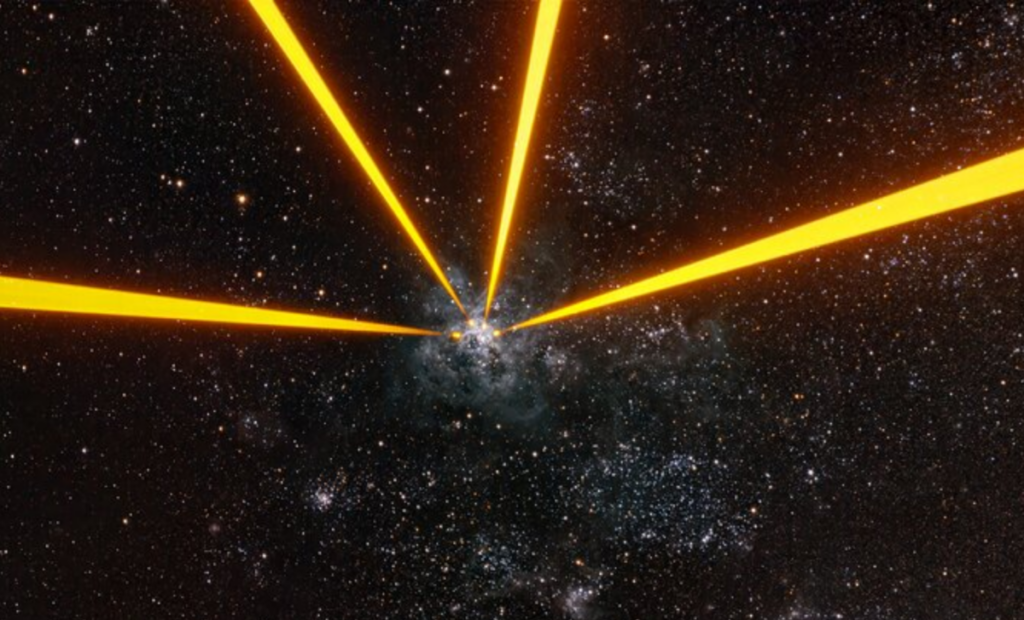
A striking image from the European Southern Observatory’s (ESO) Very Large Telescope Interferometer (VLTI) reveals four blazing laser beams cutting through the night sky, an extraordinary visual tied to a major leap in how humanity observes the cosmos. Far from spectacle alone, this system plays a critical role in overcoming one of astronomy’s oldest challenges: Earth’s turbulent atmosphere.
A Futuristic System That Mimics Stars
At first glance, the scene resembles something pulled straight from science fiction, with beams of light stretching skyward like signals in a galactic conflict. In reality, these lasers serve a precise scientific purpose. They create what astronomers call artificial guide stars high in Earth’s atmosphere.
These artificial stars form when the lasers excite sodium atoms located about 90 kilometers above the surface. The result is a set of bright reference points that telescopes can track in real time. As light from distant celestial objects passes through Earth’s atmosphere, it becomes distorted by temperature shifts and air motion. The artificial stars allow scientists to measure exactly how that distortion occurs.
From there, advanced adaptive optics systems step in. Using complex algorithms and ultra-fast mirrors, the telescope adjusts its optics hundreds of times per second. This process effectively cancels out atmospheric blur, producing images that approach the clarity of space-based telescopes, while remaining firmly on the ground.
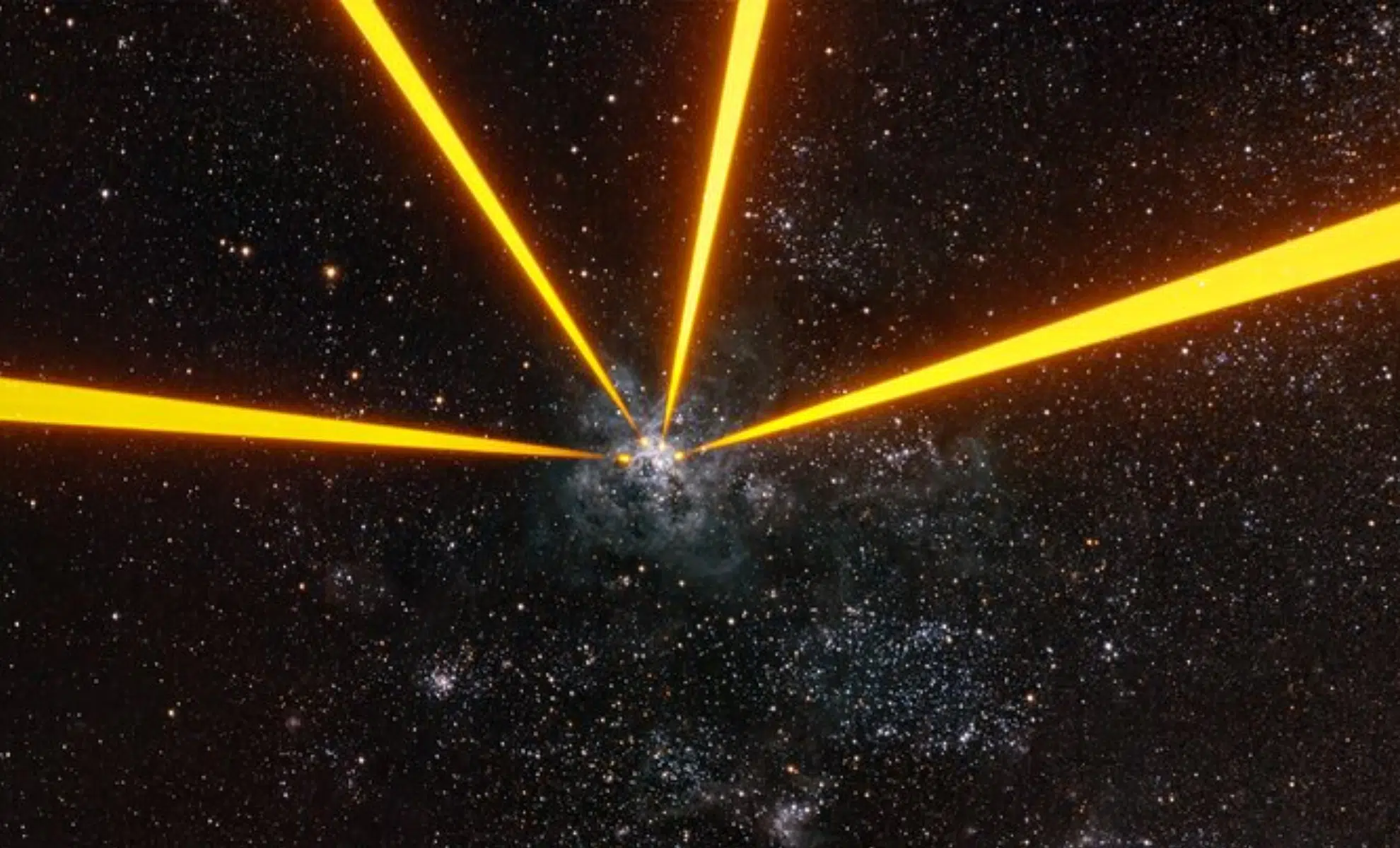 Credit: A. Berdeu/ESO
The VLTI: A Powerful Observatory In The Atacama Desert
The system behind this breakthrough operates at one of the most advanced observatories on Earth: the Very Large Telescope Interferometer (VLTI), located atop Cerro Paranal in Chile’s Atacama Desert. This region offers some of the clearest skies on the planet, making it ideal for cutting-edge astronomical research.
The VLTI combines four separate telescopes into a single, coordinated instrument, effectively creating a massive “virtual telescope” with far greater resolving power than any individual unit. Since 2016, it has been equipped with the Four Laser Guide Star Facility, a system that dramatically enhances its observational precision.
According to the European Southern Observatory (ESO), this setup allows astronomers to study distant cosmic structures in unprecedented detail. One such target is the Tarantula Nebula, located roughly 160,000 light-years away in the Large Magellanic Cloud. This stellar nursery is one of the most active star-forming regions near the Milky Way, making it a prime candidate for high-resolution observation.
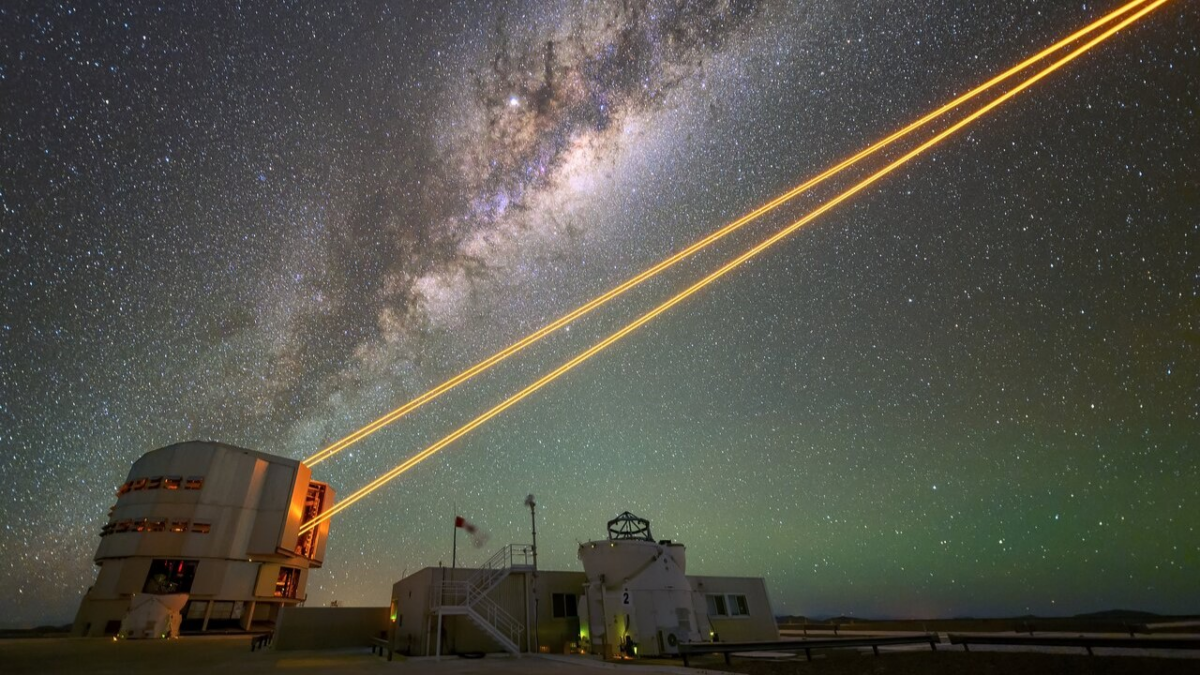 Lasers from the 4LGS instrument on the VLT’s Unit Telescope 4 shine into the night sky as part of the telescope’s adaptive optics system.
Image credit: ESO/A. Ghizzi Panizza
Peering Deeper Into The Cosmos Than Ever Before
The implications of this technology extend far beyond a single image. By correcting atmospheric interference, astronomers can capture sharper views of stars, planets, and galaxies that were previously blurred or inaccessible from Earth-based observatories.
This capability is especially important for studying faint or distant objects. Fine details, such as the structure of protoplanetary disks, the motion of stars near black holes, or the composition of distant nebulae, become much easier to analyze. The result is a deeper, more accurate understanding of how the universe evolves.
Only a limited number of observatories worldwide currently use such advanced adaptive optics systems. The VLTI stands among the leaders, pushing the boundaries of what ground-based astronomy can achieve. Its laser system represents a turning point where engineering and astrophysics converge to overcome natural limitations.