
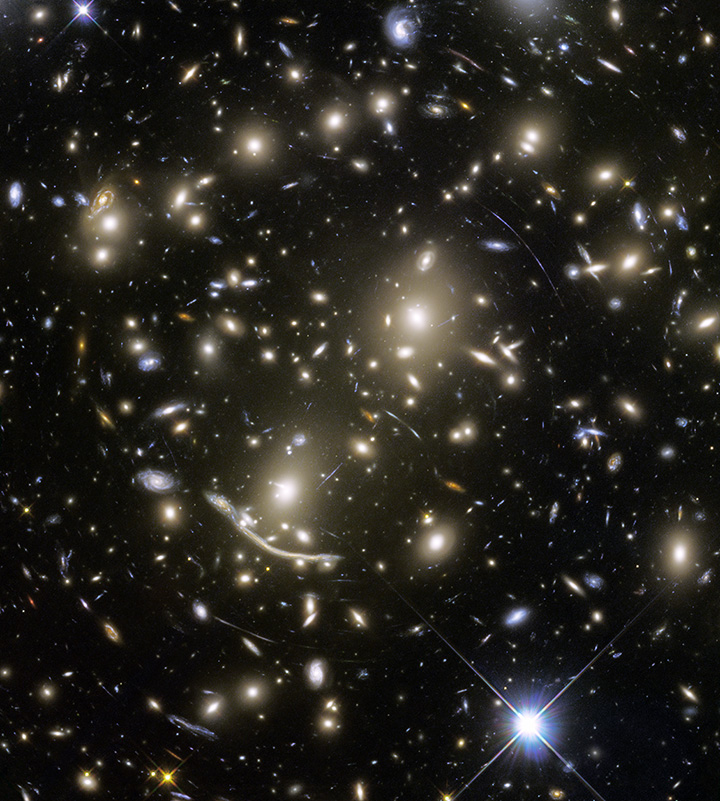
More than three centuries ago, Isaac Newton described how gravitational force decreases with distance. Now astrophysicists have tested this law on the largest structures in the Universe and obtained a clear answer.
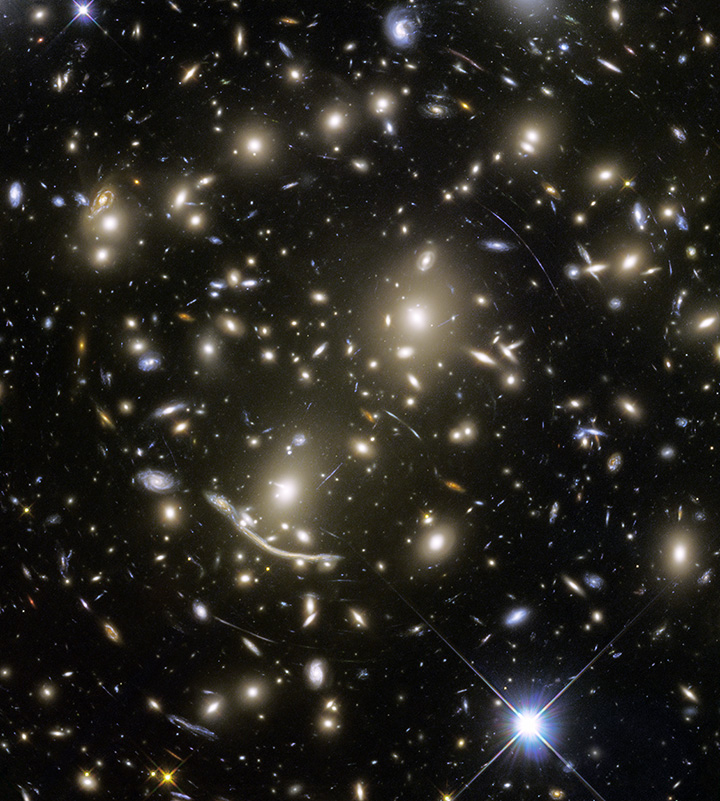 The Abell 370 galaxy cluster, demonstrating the curvature of spacetime caused by gravity. Photo: NASA; ESA; J. LOTZ AND THE HFF TEAM/STSCI. Source: nasa.gov
What was checked and how
Researchers working with the Atacama Cosmology Telescope (ACT) in Chile have compared the positions and velocities of hundreds of thousands of galaxy clusters. Clusters are gravitationally bound systems consisting of hundreds of galaxies. A single cluster can have a mass of a quadrillion times that of the Sun and span tens of millions of light-years.
The closer two clusters are to each other, the faster they move relative to one another—just as planets closer to the Sun have higher orbital speeds. It is precisely this relationship that allows us to test the nature of gravity.
Relic radiation as a tool
Scientists measured the speeds of the clusters using a specific effect: photons of the cosmic microwave background—ancient light that filled the Universe after the Big Bang—collide with electrons as they pass through the clusters and, depending on their direction of travel, gain or lose energy.
This phenomenon is known as the Sunyaev-Zeldovich (kSZ) effect. It allows us not only to detect clusters but also to directly measure their velocities. Data on the spatial distribution of galaxies were obtained as part of the Sloan Digital Sky Survey (SDSS), which has been mapping millions of galaxies since 2000.
To avoid distortions caused by the expansion of the Universe, the authors focused on clusters located between 5.6 and 7.7 billion light-years away from us. On scales ranging from 80 to 800 million light-years, the gravitational force varied exactly according to Newton’s inverse-square law. The study was published in the journal Physical Review Letters.
A blow to the alternative theory
The results deal another blow to Modified Newtonian Dynamics (MOND)—a theory proposed in the 1980s as an alternative to dark matter. According to MOND, on large scales, gravity should decrease more slowly—in inverse proportion to the first power of distance, rather than the square. The new data do not support this.
Priyamvada Natarajan, an astrophysicist at Yale University, notes that this result is not surprising, but it significantly narrows the scope for alternative explanations.
What’s next?
The ACT telescope completed its mission in 2022, but it has already been replaced by the Simons Observatory, a network of microwave telescopes, which has officially begun collecting scientific data.
According to study co-author Kris Pardo, the new instrument will measure the Sunyaev–Zeldovich kinematic effect with much greater precision and will serve as a powerful tool for studying dark energy and the history of the universe’s expansion.
According to science.org