
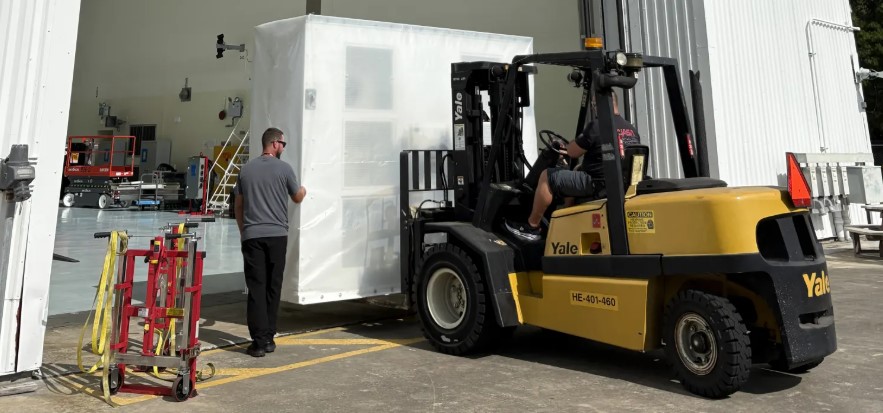
On 27th April, technicians at NASA’s Payload Hazardous Servicing Facility in Florida offloaded eight high-efficiency particulate air wall modules and other ground-support equipment to support the Nancy Grace Roman Space Telescope’s upcoming launch processing.
About the Nancy Grace Roman Space Telescope
The Nancy Grace Roman Space Telescope, which is named after NASA’s first Chief of Astronomy, will study the universe in infrared light, using two key instruments: a Wide Field Instrument and a Coronagraph Instrument technology demonstration. The broad view provided by the telescope will allow for panoramic images, while the coronagraph will utilise a novel starlight-blocking technology combined with a narrow-field camera and spectrometer. Used in conjunction, these instruments will aid researchers as they tackle major cosmic questions such as confirming the observation that the universe’s expansion seems to be accelerating.
With multiple complementary approaches, the team behind the Roman Space Telescope aims to map how the universe has changed over vast periods of time. The mission is expected to yield fresh insights into the nature of dark energy, the force thought to drive the accelerated expansion. In addition, the telescope will be used to contribute to the study of exoplanets and will help chart the distribution of ordinary matter and dark matter across different regions of space and epochs.
Officials are planning a launch as early as September, using a SpaceX Falcon Heavy rocket from Launch Complex 39A at the Kennedy Space Center. The timeline remains contingent on ongoing processing tasks and associated checks at facilities on site.
 Published by James Hydzik
James Hydzik is a technology geek focused on the junction of engineering, writing, and coffee. He joined Orbital Today in 2020 to help make sense of the Johnson government’s decision to buy OneWeb. Since then, he has taken on interviewing and editor-in-chief roles. James learned the ropes of editing and writing with Financial Times magazines, The World Bank, PwC, and Ericsson. Thus far, interviewing New Space movers has put the biggest smile on his workaday face. The son of an Electrical Engineer, James understands the value of putting complex topics into clear language for those with a lay person’s understanding of the subject. James is a European transplant from the United States, and as ex-KA3LLL, he now holds European amateur radio licenses. His next radio project is a portable 10GHz EME (moonbounce) station, as it combines his childhood interests in antennas and space.