
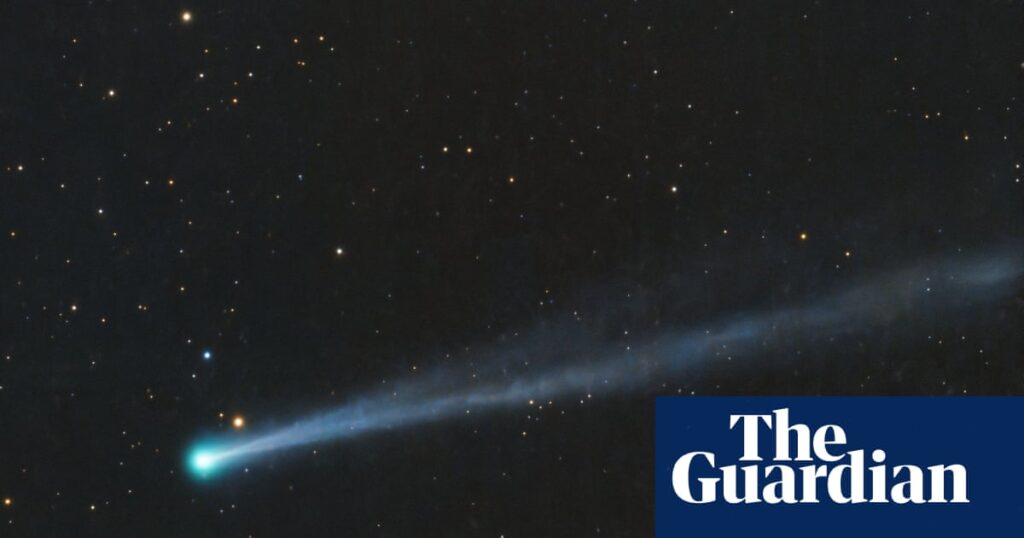
A silent visitor from the frozen periphery of the solar system has begun its final act over the Southern Hemisphere, offering a visual spectacle that will not be repeated for another 1,700 centuries. Comet C/2025 R3 PanSTARRS, a glowing blue-green orb with a sprawling debris tail, is now visible from Auckland to Nairobi, marking a rare convergence for global stargazers.
Discovered in late 2025 by the Panoramic Survey Telescope and Rapid Response System in Hawaii, the comet has completed its perilous swing around the sun—a journey that often destroys such icy bodies—and is now moving outward through the southern sky. For astronomers at Te Whatu Stardome in New Zealand and the Kenya Astronomical Society, the next 14 days represent a critical window for observation before the object retreats into the dark vacuum of the Oort Cloud.
The Anatomy of a Long-Period Visitor
Comet C/2025 R3 PanSTARRS is what scientists classify as a long-period comet, with an orbital path so vast it takes approximately 170,000 years to complete. Its distinctive blue-green hue is caused by the presence of diatomic carbon and cyanogen gas, which fluoresce under the ultraviolet light of the sun as the comet’s nucleus heats up. As the comet “outgasses,” it creates a coma—a temporary atmosphere—and a tail that can stretch for millions of kilometers.
Josh Aoraki, a senior astronomer at Te Whatu Stardome, notes that the comet is currently at its peak photographic brightness. While not yet bright enough for the naked eye in urban areas with significant light pollution, it remains a “decently easy” target for those with basic binoculars or telescopes. The comet is currently located low on the western horizon, best viewed roughly 60 minutes after sunset when the sky is dark but the object has not yet set below the earth’s edge.
Viewing Guide and Technical Specifications
For enthusiasts in East Africa, the comet’s positioning is particularly favorable. Due to Kenya’s proximity to the equator, the comet will appear slightly higher in the sky than for observers in extreme northern or southern latitudes. Experts recommend seeking out elevated locations with clear western horizons, such as the Ngong Hills or the outskirts of the Rift Valley, to minimize atmospheric distortion.
Object Designation: C/2025 R3 PanSTARRSEstimated Orbital Period: 170,000 YearsMaximum Magnitude: 5.2 (Binocular Visibility)Dominant Chemical Signature: Diatomic Carbon (Green)Origin: Oort Cloud (Outer Solar System)
The logistical challenge of tracking such an object highlights the importance of international cooperation in planetary defense and astronomical research. Data collected during this passage will help scientists refine their understanding of the Oort Cloud’s composition, which contains the primordial leftovers from the formation of our solar system 4.6 billion years ago.
A Final Glimpse Before the Void
The urgency for stargazers cannot be overstated. By mid-May 2026, C/2025 R3 PanSTARRS will have moved sufficiently far from the sun that its ice will cease to sublimate, causing its luminous tail to fade and vanish. Its path will then carry it far beyond the orbit of Neptune, into a region of space where temperatures hover near absolute zero. It will not return until the year 172,026—a timeline that dwarfs human civilization.
“You get the coma and the tail looking like a little fuzzy meteor in the sky,” Aoraki said in a statement on Monday. This “fuzzy meteor” is a reminder of the sheer scale of the cosmos. As the comet fades, it leaves behind a trail of dust that may one day interact with Earth’s atmosphere to create a minor meteor shower, a ghostly signature of a visitor that has passed our way only once in the history of the modern human species.