
Scientists have finished the largest high-resolution 3D map of the universe, logging more than 47 million galaxies and bright black-hole systems.
The map turns distant light into a record of cosmic expansion over the past 11 billion years. But the force theorized to be steering that expansion, dark energy, remains a mystery.
DESI maps galaxies, not dark energy

Across five years of sky watching, the Dark Energy Spectroscopic Instrument (DESI), a telescope-mounted galaxy mapper, gathered the evidence behind that record.
Using those measurements, Michael Levi, DESI director at Lawrence Berkeley National Laboratory (Berkley Lab), connected the map to the universe’s hidden driver.
Designers expected 34 million galaxies and quasars, extremely bright galaxy cores powered by black holes, before observations passed 47 million.
That extra reach gives researchers a sharper test of the hidden energy controlling the universe’s long-term future, not just its past.
Why expansion matters
Astronomers call that hidden driver dark energy , the force tied to faster cosmic expansion. As space expands, galaxies drift apart, and dark energy appears to push that widening pace harder over time.
NASA estimates that dark energy fills about 68% to 70% of the cosmos, while ordinary matter, the stuff in atoms, accounts for roughly five percent.
Future forecasts depend on whether that force stays steady, weakens, or changes in a way current physics cannot yet explain.
Light becomes distance
For each target, DESI measured redshift, the stretching of light that reveals how fast an object recedes.
A published instrument description explains how ten spectrographs, devices that split light by color, turned faint signals into measurable positions.
With millions of distances stacked together, the flat sky became a 3D record reaching back about 11 billion years of history.
Even that reach cannot show every region, because our own galaxy blocks some faint background light from beyond it.
Patterns hold clues
Galaxy positions matter because gravity pulls matter into clusters, leaving patterns that expansion stretches across deep cosmic time.
Cosmologists measure baryon acoustic oscillations, ancient spacing patterns in matter, to compare early structure with later structure.
A three-year analysis found that those patterns fit standard expectations, yet fit better when dark energy can change.
That result raises pressure on a familiar idea, although a hidden data problem could still weaken it.
Certainty under pressure
A familiar idea is the cosmological constant, Einstein’s fixed-energy term for empty space.
In that view, dark energy never changes, so cosmic expansion should follow one steady long-term path.
DESI’s newer measurements reduce some tensions, yet they do not erase the case for time-changing dark energy.
Stronger proof will require the completed map to survive checks against exploding stars and older light from the early universe.
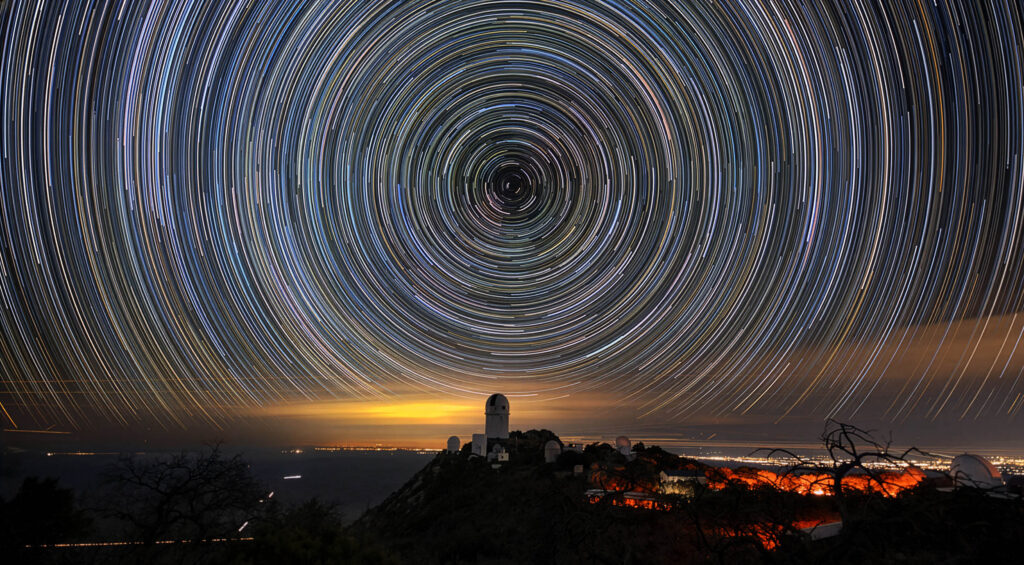
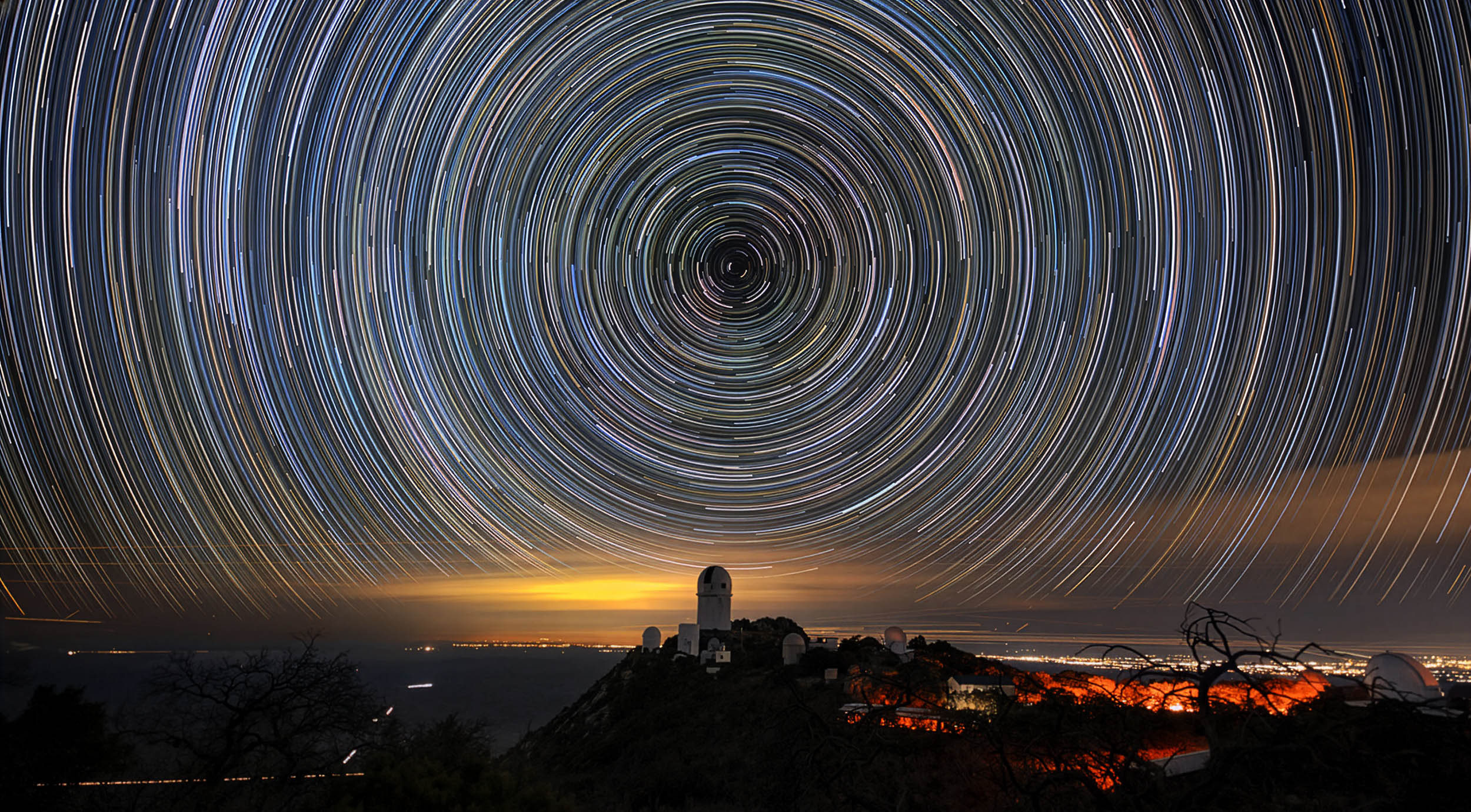 Star trails over the Mayall Telescope that houses DESI, where the biggest 3D map of the universe was created. Credit: Luke Tyas/Berkeley Lab and KPNO/NOIRLab/NSF/AURA. Click image to enlarge.Incredible performance by DESI
At the Kitt Peak National Observatory, an Arizona mountaintop observatory, DESI worked through heat, weather, and shutdowns.
Its robotic fiber positioners, tiny arms that aim light-carrying fibers, retargeted the sky about every 10 to 20 minutes.
A 2022 wildfire cut power and internet service for months, but crews recovered enough observing nights to finish early.
After the planned survey ended, the team kept DESI observing through 2028 instead of parking the instrument and waiting.
That extension aims to expand how much of the sky the survey covers, increasing its reach by about one-fifth.
Harder regions sit near the Milky Way’s bright plane or lower in the southern sky, where atmosphere interferes.
More coverage can tighten expansion tests, but it also brings messier light that analysts must handle carefully before trusting.
Nearby darkness too
The same observations also recorded more than 20 million nearby stars inside and around the Milky Way.
Those stars help map dark matter, invisible mass detected by gravity, because their motions reveal hidden pull.
Small dwarf galaxies, low-mass companions of larger galaxies, trace that pull especially well when gravity distorts their stars.
This nearby work cannot name dark matter’s particles, but it can narrow where theorists should look for evidence.
Mapping dark energy with DESI
The completed dataset now moves into processing, where scientists check positions, remove errors, and prepare public measurements.
DESI’s first public data release covered 13 months of observations and already held 18.7 million dependable distances to cosmic objects.
Full five-year dark energy results are expected in 2027, after the collaboration tests the map’s hardest claims against all observing years.
Until then, the strongest finding is not an answer, but a much better way to ask for one with evidence.
A larger map now joins sharper distance measurements, tougher model tests, and new targets that stretch beyond the original plan’s limits.
“We don’t know what we’ll find, but we think it’ll be pretty exciting,” said Levi.
The study is published in Physical Review D.
—–
Like what you read? Subscribe to our newsletter for engaging articles, exclusive content, and the latest updates.
Check us out on EarthSnap, a free app brought to you by Eric Ralls and Earth.com.
—–