I captured this image in eastern Morocco during an astrophotography trip last October. The sky there was exceptionally pure, with absolutely no light pollution (Bortle 1).
This photo was taken on the last night of the trip. The location itself wasn’t as visually impressive as some of the other places we had explored, but getting there was an experience on its own. We drove off-road through a completely dark and empty desert, heading toward the Algerian border, with absolutely nothing around us.
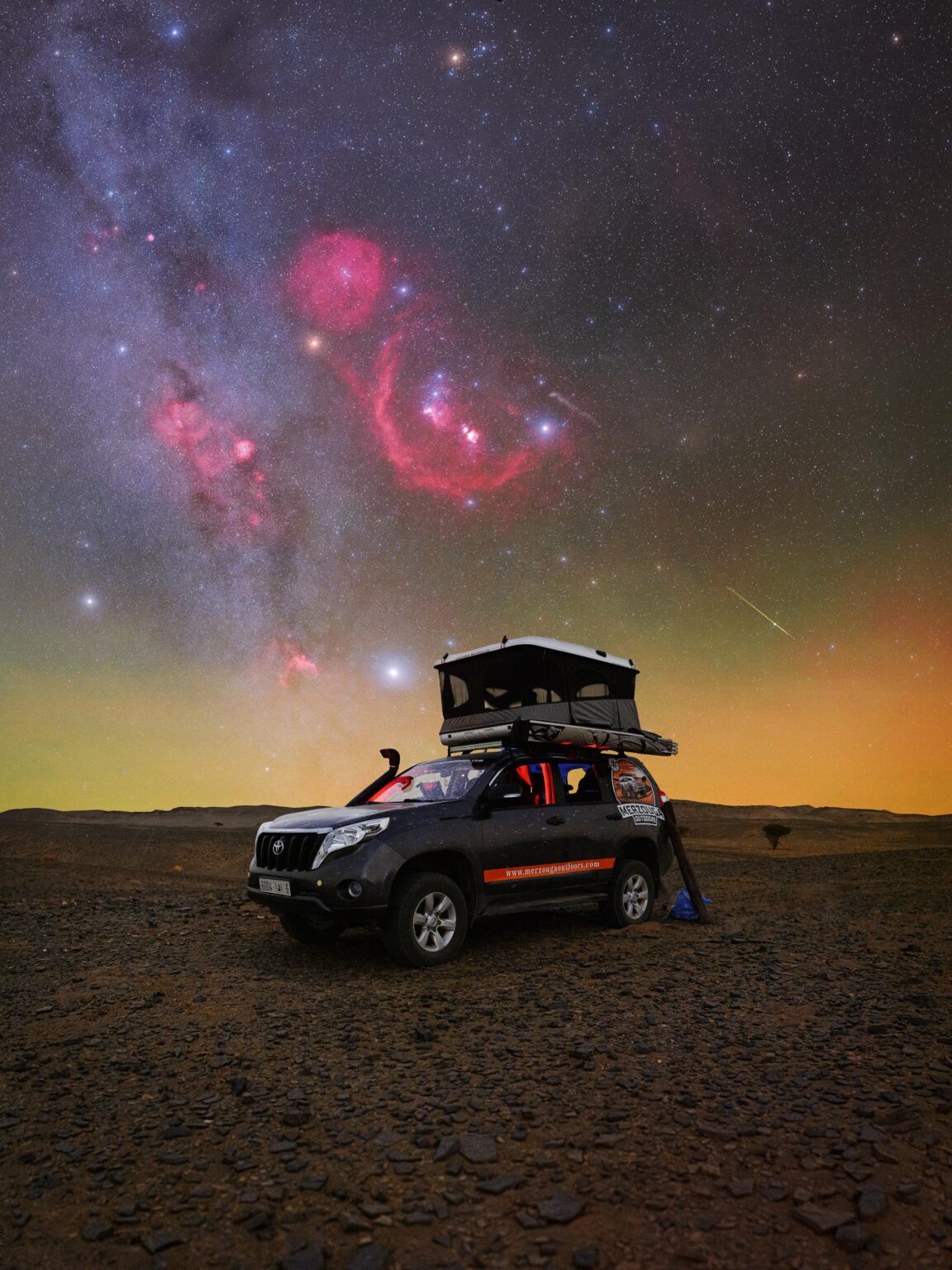
Since the landscape wasn’t as striking as our previous spots, I decided to focus on our 4×4 camp, with Orion rising above it.
Cone nebula, Rosette Nebula, the Orion Nebula and Barnard’s Loop are visible in this pic. I also captured a meteor!
I shot this image as a panorama using a 35mm lens. The sky is made of 4 tiles, each stacked from 4 exposures. As I was quite close to the 4×4 I did a technique called focus stacking to get the foreground and background well focused.
I also took additional images using an H-alpha filter to capture the hydrogen emission from the nebulae. The red tones you see here come from that data.
Like on the previous nights, we had strong airglow, both red and green, visible near the horizon.
—-
As a reminder, the sky looks very different to the naked eye than it does in long-exposure astrophotography. With unaided vision, you can easily recognize the shape of the Milky Way and notice a few of the brightest nebula regions as very faint, diffuse glows, but you cannot see the deep reds or the intricate structures shown here.
—-
The Bortle Scale is a nine-level system used to measure light pollution and the quality of the night sky at a given location. It ranges from Class 1, representing the darkest skies available on Earth, where the Milky Way appears highly detailed and the zodiacal light is visible, to Class 9, which corresponds to inner-city skies where only the brightest stars and planets can be seen.
—-
📷
Sigma Art 35mm – Canon 6D astromodded – Skywatcher Star Adventurer
Sky: 4 tiles – Stack of 4 pictures at 30 seconds – ISO 3200 – F/1.8
Foreground: 4 tiles – 45seconds – ISO 4000 – F/1.8
daduude on
This looks so amazing. I hope the Moroccan people treated you well.
BrennusSokol on
Nice
Thanks for sharing this
LackingUtility on
I’m going to a class 1 this summer!
Only shame is I had to wait until middle age and my eyes aren’t as good. :/


5 Comments
I captured this image in eastern Morocco during an astrophotography trip last October. The sky there was exceptionally pure, with absolutely no light pollution (Bortle 1).
If you’re interested, you can find more of my work on [Instagram](https://www.instagram.com/tinmar_g/).
This photo was taken on the last night of the trip. The location itself wasn’t as visually impressive as some of the other places we had explored, but getting there was an experience on its own. We drove off-road through a completely dark and empty desert, heading toward the Algerian border, with absolutely nothing around us.
Since the landscape wasn’t as striking as our previous spots, I decided to focus on our 4×4 camp, with Orion rising above it.
Cone nebula, Rosette Nebula, the Orion Nebula and Barnard’s Loop are visible in this pic. I also captured a meteor!
I shot this image as a panorama using a 35mm lens. The sky is made of 4 tiles, each stacked from 4 exposures. As I was quite close to the 4×4 I did a technique called focus stacking to get the foreground and background well focused.
I also took additional images using an H-alpha filter to capture the hydrogen emission from the nebulae. The red tones you see here come from that data.
Like on the previous nights, we had strong airglow, both red and green, visible near the horizon.
—-
As a reminder, the sky looks very different to the naked eye than it does in long-exposure astrophotography. With unaided vision, you can easily recognize the shape of the Milky Way and notice a few of the brightest nebula regions as very faint, diffuse glows, but you cannot see the deep reds or the intricate structures shown here.
—-
The Bortle Scale is a nine-level system used to measure light pollution and the quality of the night sky at a given location. It ranges from Class 1, representing the darkest skies available on Earth, where the Milky Way appears highly detailed and the zodiacal light is visible, to Class 9, which corresponds to inner-city skies where only the brightest stars and planets can be seen.
—-
📷
Sigma Art 35mm – Canon 6D astromodded – Skywatcher Star Adventurer
Sky: 4 tiles – Stack of 4 pictures at 30 seconds – ISO 3200 – F/1.8
Foreground: 4 tiles – 45seconds – ISO 4000 – F/1.8
This looks so amazing. I hope the Moroccan people treated you well.
Nice
Thanks for sharing this
I’m going to a class 1 this summer!
Only shame is I had to wait until middle age and my eyes aren’t as good. :/
This looks incredible, amazing view