
Bulgarian astronomers have studied an object known as GP Com. It is an extremely close binary system. One of the stars in the cluster is a white dwarf, but the other remained a mystery for a long time.
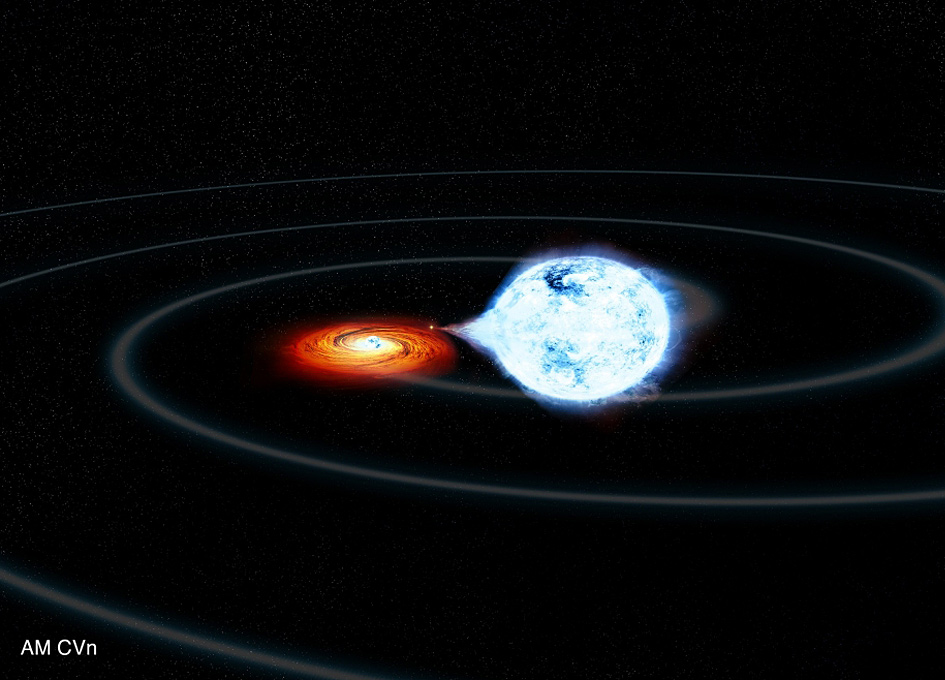
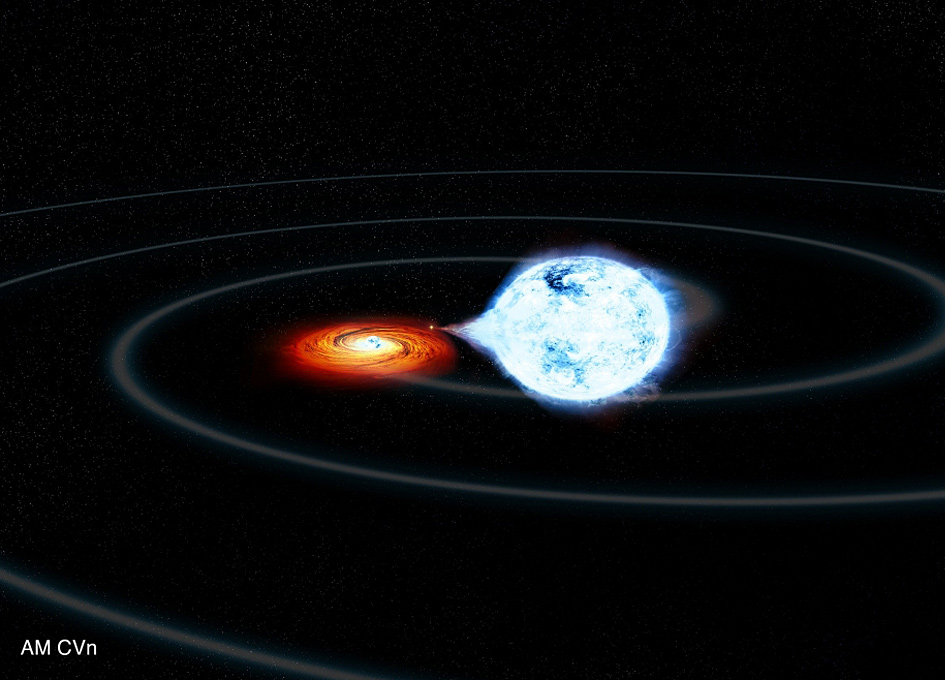 A variable of the AM Canum Venaticorum (AM CVn) type. Source: media2.spaceref.com
GP Com
Astronomers from the Rozen National Observatory recently presented the results of their photometric studies of the GP Com binary system. The results have been published in the journal Proceedings of the Bulgarian Academy of Sciences.
GP Com system is located 237 light-years away from us. It belongs to an extremely rare class of cataclysmic variables of the AM Canum Venaticorum (AM CVn) type. This type of variable, in turn, consists of systems containing two stars.
There are a vast number of types of cataclysmic variable stars, and most of them share the characteristic that one of the two stars is a white dwarf, and the systems themselves are fairly compact. Typically, a small, dense object exerts a strong gravitational pull, drawing matter from a much larger but less massive companion, which then forms a shell around it. From time to time, a thermonuclear reaction begins within this shell—a phenomenon we know as a nova. After that, the whole thing usually starts all over again.
Variables of AM CVn type
But what would happen if the second star in a close binary system were another white dwarf, but one that is smaller? The answer to this question lies in systems like AM CVn. They’re a bit more complicated, but let’s go through them step by step.
First, these are among the closest binary star systems known to astronomers. The rotation periods of the components in these systems range from 5 to 68 minutes, which means that these pairs are closer together than the Earth and the Moon.
Second, matter is constantly flowing from the lighter of the two components into the heavier one, which is usually a carbon-oxygen white dwarf. This is one of the few known processes in which matter from a white dwarf—which is much denser than anything we have on Earth—behaves in this way.
Most of the material flowing onto the more massive white dwarf forms an accretion disk around it. It is noticeably asymmetrical and, as it orbits, alternately turns one side and then the other toward us, causing the system’s brightness to fluctuate noticeably for short periods.
However, the material accumulates not only in the accretion disk but also in the outer envelope of the white dwarf. And from time to time, it flares up in a thermonuclear explosion. That is why variables of the AM CVn type are called binary variables.
Mystery of the second component
However, there is one mystery surrounding the AM CVn-type variables that greatly puzzles scientists. The fact is, they aren’t sure that the second object in such systems is also a white dwarf. They suspect it might be a degenerate helium star that has simply shed all its outer layers.
And that is precisely why scientists are studying GP Com. The orbital period of this system is 46.57 minutes. Scientists observed it for 10.6 hours using the 2-meter RCC telescope and the 1.5-meter AZ1500 telescope. They confirmed the presence of a bright spot where the accretion disk should be.
The mass transfer rate is 2×10⁻² solar masses per year. The mass of the second component is 0.025 solar masses, with a radius of 0.054 solar radii, confirming that it is a helium star.
According to phys.org