
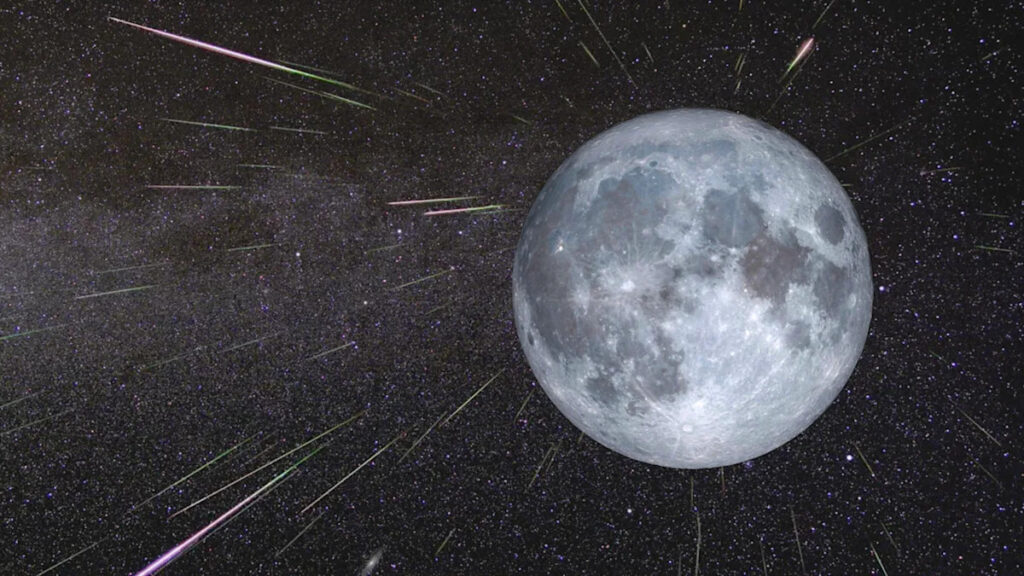
The nights may be getting shorter as summer draws nearer, but there is still plenty to see in the sky throughout the month of May, including a meteor shower from Halley’s Comet, clusters of planets on both horizons, and a rare Blue Micromoon the likes of which we will not see again for decades.
Keep an eye on your local weather forecast to find those clear nights throughout the month, so that you don’t miss out on the amazing sights to see.
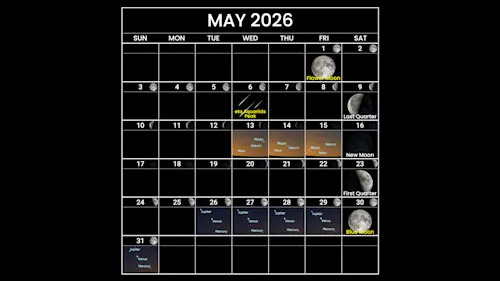
Astronomy Calendar – May 2026
Click here for a zoomable version of the above calendar.
Visit our Complete Guide to Spring 2026 for an in-depth look at the Spring Forecast, tips for planning for it and much more!
The Moon
The first night of the month will be brightly lit by the Full Flower Moon, which will appear full (over 98 per cent illuminated) again on the night of the 2nd.
The Waning Gibbous Moon will shine up in the sky up until the 8th, leading up to the Last Quarter Moon on the 9th. The Waxing Crescent Moon will then be visible in the eastern sky between midnight and dawn from the 10th through the 15th, with the New Moon occurring on the 16th.
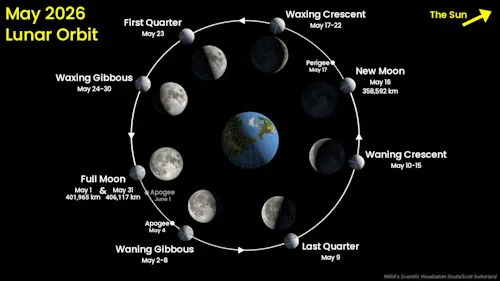
Moon orbit – May 2026 – NASA SVS
The Moon’s orbit around Earth for May 2026, including the phases of the Moon we will see throughout the month. (NASA’s Scientific Visualization Studio/Scott Sutherland)
Afterward, the Waxing Crescent Moon will reappear in the western sky after sunset, becoming more and more illuminated from the 17th through the 22nd, leading up to the First Quarter Moon on the 23rd. Then, the Waxing Gibbous Moon will be seen from the 24th to the 29th, preparing us for a special treat at the end of the month.
On the night of May 30 to 31, another Full Moon will rise — a calendar Blue Moon.
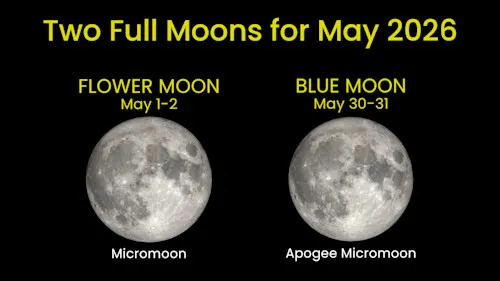
May 2026 – 2 Full Moons
The two Full Moons of May 2026. (NASA’s Scientific Visualization Studio/Scott Sutherland)
The last time we saw a calendar Blue Moon was nearly 3 years ago, on August 31, 2023, and the next one will occur on December 31, 2028.
However, this particular Blue Moon is a bit special, as it coincides with the Apogee Micromoon — the farthest, smallest, and dimmest Full Moon of the year.
The last time we saw a Full Moon with those two characteristics was back on October 31, 2020. That’s not too long ago, but we’ll have a much longer wait for the next one.
Those of us across Canada will see one on June 30-July 1, 2053. Observers in Europe, Africa, Asia, and Australia, though, will have to wait until July 31, 2080 for the next Blue Apogee Micromoon!
READ MORE: What’s in the sky for Spring 2026?
eta Aquariid meteor shower
As the month of May begins, we are receiving a little ‘gift’ from Halley’s Comet, in the form of the eta Aquariids.
The comet itself is currently far out in the solar system, and we won’t see it again until its return in 2061.
However, each year from April 19 to May 28, Earth crosses the stream of dusty debris the comet leaves behind as it passes around the Sun. As the bits of debris are swept up by our planet’s atmosphere, they produce streaks of light across the sky. Since these flashes of light can all be traced back to the constellation Aquarius, and specifically closest to the star eta Aquarii, astronomers named this the eta Aquariid meteor shower.
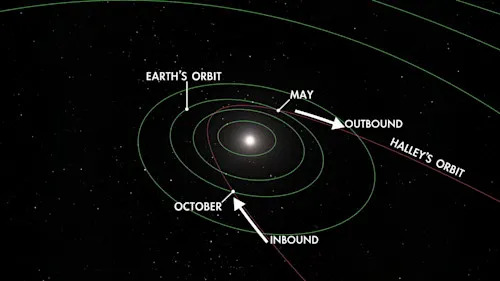
Halleys Comet Orbit inbound outbound meteors
The path of Halley’s Comet and its debris stream through the inner solar system, which Earth crosses twice each year — the outbound part of the stream producing the eta Aquariids in April and May, and the inbound part causing the Orionids in October. (NASA/JPL/Scott Sutherland)
In April and May, we cross the ‘outbound’ portion of Halley’s debris stream. Since the bits of dust and ice in the stream fly at us from the direction of the Sun, this particular meteor shower is only seen in the hours prior to sunrise.
The radiant of the shower — the point in the sky where the meteors appear to radiate outward from — only rises around 3 a.m., local time.
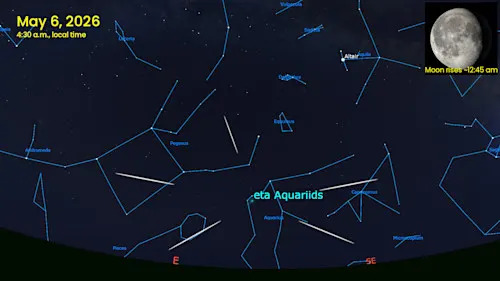
eta Aquariid meteor shower peak – 2026
The radiant of the eta Aquariid meteor shower — the location in the sky where the meteors appear to originate from — in the predawn hours of May 6, 2026. (Stellarium/Scott Sutherland)
READ MORE: How to get the most out of meteor showers and other night sky events
During the peak of this shower, on the morning of May 6, observers with a clear, dark sky could see anywhere from 20-40 meteors per hour.
Unfortunately, this year, a Waning Gibbous Moon will be shining in the sky that same morning, and its light could limit the number of meteors we can spot. The Moon will be off to the west as the meteor shower becomes visible, so try to keep the Moon at your back, and look straight up to catch as many meteors as possible.
Also, if an eta Aquariid meteor does flash by overhead, keep a close eye on that same location afterward, to see if it leaves behind a persistent train!
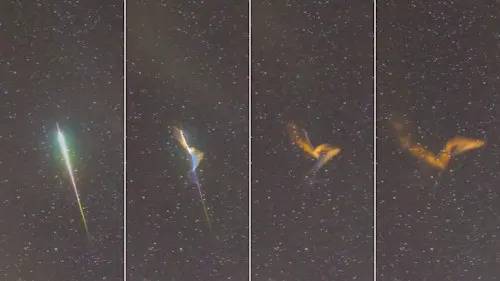
Persistent train Orionids 2022 10 21 – Brenda Tate Tim Doucette
This persistent train was captured during the Orionid meteor shower, on October 21, 2022. (Brenda Tate/Tim Doucette)
These are wispy glowing trails that can remain for minutes to even hours after one of these meteors winks out, and scientists still aren’t sure exactly what causes them!
DON’T MISS: Amazing fireballs captured during the Lyrids, the oldest meteor shower on record
The Constellations
Spring Constellations dominate the night sky during the month of May.
At the start, each night we can see Ophiuchus rising, after sunset, with Libra, Virgo, Leo, Cancer, Gemini, and Orion lined up from east to west, with Hydra stretching across the sky under them, closer to the southern horizon. Before sunrise, only Libra, Virgo, and Leo will remain, but will be joined in the east by Aquarius, Capricornus, Sagittarius, Scorpius, and Aquila.
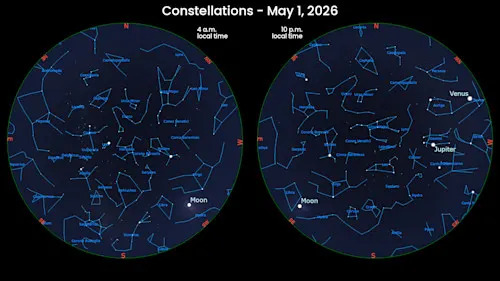
May 1st 2026 – Constellations – allsky view
The constellations in the sky at 4 a.m. and 10 p.m. on May 1, 2026. (Stellarium)
In the northern sky, Draco, Hercules, Bootes, Ursa Major (the Big Dipper), Ursa Minor (the Little Dipper), and Cygnus are most prominent, with Pegasus near the northeast horizon.
By the end of the month, the evening constellations will be shifted slightly, with Ophiuchus fully risen in the east after sunset and Orion having set in the east. By morning, Virgo will be setting in the west, while the stars of Pisces can be seen rising in the east.
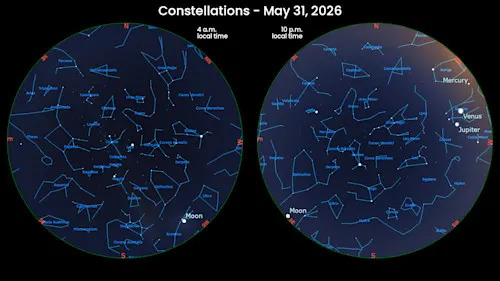
May-2026-Constellations-31st-allsky
The constellations in the northern sky at midnight on May 15, 2025. (Stellarium)
To the north, the same constellations dominate, but with Ursa Major (the Big Dipper) closer to the horizon, and Pegasus climbing higher in the sky.
Thumbnail image combines two NASA images, the first, in the background, depicting a meteor shower with the backdrop of deep space, and the second a representation of the May 30, 2026 Full Moon compiled from Lunar Reconnaissance Orbiter data. Although the Moon will not actually change colour on that date, this image shows it shaded slightly blue for effect, as it will be a rare Blue Moon.
Watch below: Fireball captured streaking across B.C. sky on Wednesday, April 29
Click here to view the video