

Just over 40 years ago, in his novel Contact, astronomer Carl Sagan imagined what it would be like to detect radio signals beamed from other intelligent lifeforms in the galaxy. In the story, these extraterrestrial beings send blueprints to build a spaceship to carry a handful of Earth travelers to meet with them.
While the book lies firmly in the realm of science fiction, Sagan’s expertise gave it a rare level of technical realism, offering a plausible sequence of events in which astronomers identify a radio signal of alien origin.
Yet after a century of listening, we are still alone in the vast cosmos – though that has not killed the hope that radio telescopes could open a line of communication to alien civilizations. In fact, we have barely begun to search the galaxy, having scanned only a fraction of its star systems. But that could soon change thanks to next-generation telescopes and AI-assisted data analysis.
The coming decade will see the biggest jump in search capabilities since the field began, raking in unprecedented torrents of data – a welcome development for astronomers. If we want to understand why we haven’t found anything, “we need to do more of everything – expanded frequency ranges, broader sky coverage, more frequent and detailed observations,” said Steve Croft, an astronomer at the SETI (Search for Extraterrestrial Intelligence) Institute and the University of California, Berkeley. “We haven’t looked well enough yet to say much so far.”

Cutting-edge radio observatories have unprecedented sensitivity, as demonstrated in this image of the center of our galaxy taken by MeerKAT in South Africa – a precursor array to the larger Square Kilometer Array. This image, released in 2022, reveals striking, parallel radio filaments whose origins remain mysterious. Credit: SARAO, Heywood et al. (2022)/J. C. Muñoz-Mateos
Radio static
When Contact was published in 1985, the SETI Institute had just begun its hunt. But scientists had already been searching the stars for alien radio signals for decades.
The first organized effort took place in 1924 during an opposition in which Mars and Earth made a particularly close approach to each other. Astronomer David Peck Todd convinced the U.S. military to ask their radio stations across the country to observe radio silence and listen for any unusual transmissions from the Red Planet. They even had cryptographers standing by to translate potential messages they picked up. Private broadcasters mostly didn’t cooperate, and even military radio silence was patchy. The effort didn’t turn up any alien signals, but it helped lay the foundation for later searches.
In 1960, the then-29-year-old astronomer Frank Drake kicked off the modern SETI movement using an 85-foot radio dish in Green Bank, West Virginia. He named the roughly $2,000 effort Project Ozma after the ruler of Oz – a place described as “very far away, difficult to reach, and populated by strange and exotic beings.”
Drake singled out two stars to study – Tau (τ) Ceti and Epsilon (ε) Eridani, each 11 light-years away – using a radio receiver designed to home in with extreme precision on a single frequency channel. He and his small team spent six hours each day for a few months listening over loudspeakers and monitoring a chart recorder tuned into 1420.4 megahertz, a frequency associated with hydrogen, the most abundant element in the universe.
It seemed a logical place to start: Like us, other advanced civilizations measuring large clouds of neutral hydrogen across the galaxy could detect their characteristic radio emission at 1420 MHz. Perhaps they might use it as a universal hailing frequency. Carl Sagan would later employ the idea as a plot point in Contact, when astronomers detect pulsing light from the Vega system at 1420 MHz that contains a message encoded in the universal language of math: a sequence of prime numbers, too specific to be produced naturally by any celestial object.
But no clear and obvious signals surfaced from the static as Drake and his team listened.
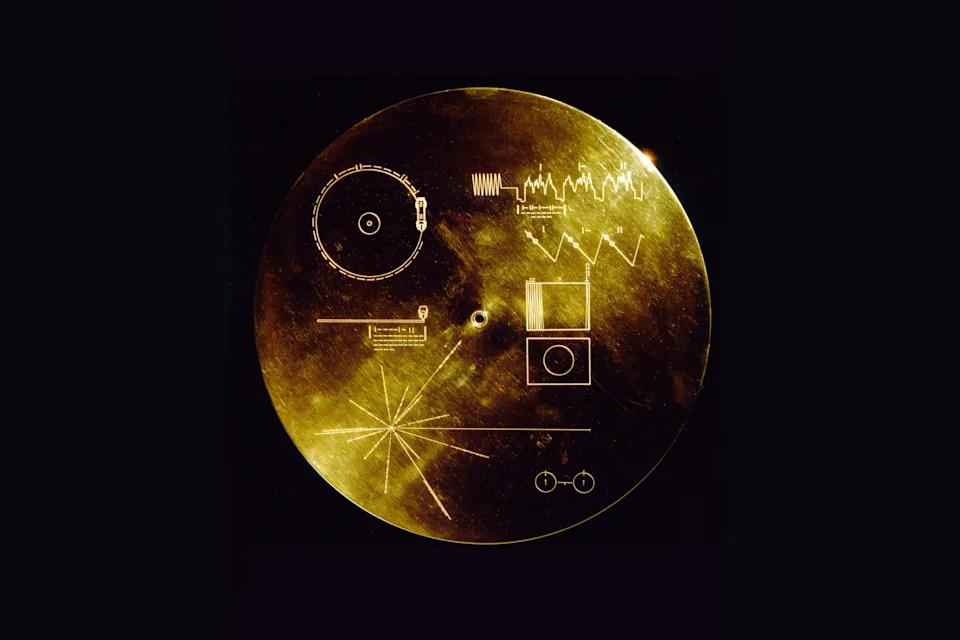
When the twin Voyager probes launched in 1977, each carried a copy of a gold-plated phonograph record featuring audio and video recordings from Earth. Their protective covers, pictured here, featured schematic explanations of how to play and decode the data (top and center); a map of the location of our Sun relative to 14 known pulsars (lower left); and a diagram of the spin-flip transition of the hydrogen atom which produces emission at 1420.4 MHz. The time period between passing wave crests at this frequency provided the reference unit for time periods in the other diagrams, which were expressed in binary. Credit: NASA/JPL
The field has made dramatic technological progress since 1960. “Instead of a single-channel receiver on an 85-foot telescope, we can now tune into a billion channels at once on the 330-foot telescope now at Green Bank,” Croft said. Croft is also a project scientist for Breakthrough Listen, a project searching for extraterrestrial communications that is funded by Soviet-born Israeli billionaire Yuri Milner. “We’ve looked at thousands of targets with incredible frequency range at Green Bank alone,” Croft said. “Combine that with other searches and we’ve looked at over a million stars, and done so with much greater computing power and better algorithms.”
It’s a big galaxy, though. Tally up all the searches conducted so far and it still only amounts to about 0.00001 percent of the Milky Way.
Hot mic
Part of the difficulty is that no one is certain exactly how we should be looking for alien signals.
“You might say it’s like looking for a needle in a haystack, but at least in that case you know what a needle looks like,” Croft said. “And you know that there is a needle in the haystack.”
Without that knowledge, astronomers have to cast a very wide net. Luckily, technology is helping to make it wider. Instead of relying on aliens to deliberately send messages designed for us to detect, astronomers now can also look for fainter signs of technology that might leak out from advanced civilizations.
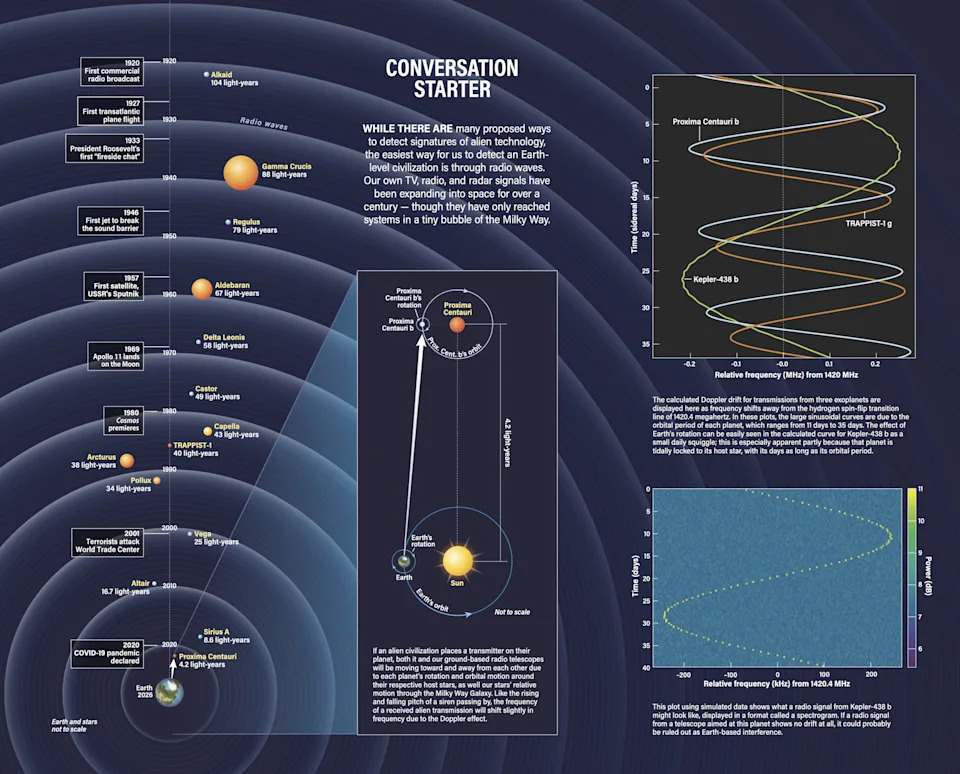
Every radio transmission we’ve generated, from early Morse code communication to modern news and entertainment, travels far beyond Earth listeners; they radiate out into space in all directions, gradually weakening as they go. Because radio waves travel at the speed of light, our radio bubble now extends about 100 light-years from Earth.
Since the dawn of SETI, astronomers have mainly focused on looking for intentional radio messages sent by alien civilizations. But with new observatories, detecting radio leakage from other planetary systems is becoming a real possibility. Instruments like the Green Bank Telescope and Allen Telescope Array in Northern California search for both beacons and latent signals – including those resembling Earth-like broadband radio, radar, and even satellite emissions – from planets up to hundreds of light-years away.

The name of the Square Kilometre Array refers to the project’s ultimate goal of having dishes and antennas with a collecting area totaling 1 square kilometer. However, the project – pictured here in a photo illustration – will begin its science operations at roughly 10 percent that level. Credit: SPDO/TDP/DRAO/Swinburne Astronomy Productions (CC BY 3.0)
And in the early 2030s, the Square Kilometre Array Observatory (SKAO) will come online. This facility, currently under construction, will consist of a pair of telescope arrays, one in South Africa and the other in Australia, collectively made up of hundreds of radio dishes and thousands of antennas. A 2025 study led by the SETI Institute’s Sofia Sheikh found that SKAO would be capable of detecting signals like those broadcast by NASA’s Deep Space Network to robotic spacecraft from a distance of 65 light-years. And it could pick up a deliberate message – comparable to those sent by the Arecibo Observatory – from a distance of 12,000 light-years.
“Originally the idea was to create a radio telescope that had enough collecting area that you could detect neutral hydrogen at redshift 1,” said Michael Garrett, director of Jodrell Bank Centre for Astrophysics, which hosts the SKAO Headquarters. Redshift is a measure of how much the universe’s expansion stretches the wavelength of light traveling through it. Redshift 1 is so far away that it’s like looking nearly 8 billion years into the past. “But if you build a telescope that can do that, you can do all sorts of other things too,” Garrett said.
Since it will take many years and ample funding to achieve an entire square kilometer of collecting area, the SKAO team is rolling out construction in stages. But even its first phase, at roughly 10 percent of the hoped-for eventual area, will be a generational leap over previous radio arrays.
SKAO is targeting neutral hydrogen because by tracing its distribution over time, you can see how it evolved to form stars and galaxies. The observatory will be capable of testing out fundamental physics on vast scales. But since it involves homing in on 1420 MHz for some observations (along with covering a broader range from 350 MHz to 15.4 gigahertz), it could just pick up a long-distance phone call of sorts as well.
Phase one is “basically a factor of five more sensitive than some of the big single dishes that have up until now dominated the kind of searching that we do for extraterrestrial intelligence,” Garrett said. “And with a much larger field of view, it will see something like an order of magnitude more stars at any given time. So astronomers can comb through the data SKAO will already be getting for other purposes and look for signs of other lifeforms, and I’d like to think we’ll dedicate some time to [SETI observations] specifically at some point as well.”
Where is everyone?
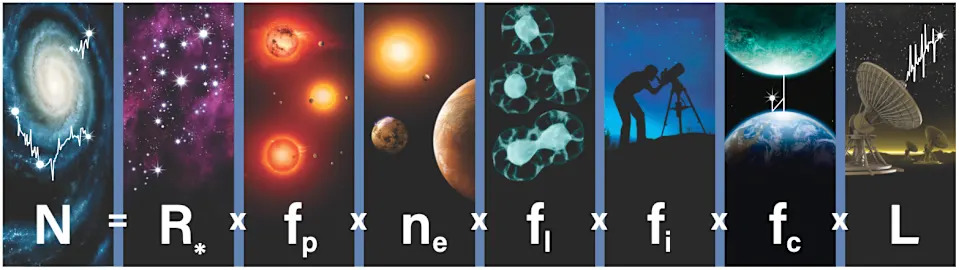
In 1961, the year after he conducted Project Ozma, Frank Drake laid out an equation to understand how many technologically advanced civilizations there could be in our galaxy (N), and how likely we are to “hear” them:

At the time, astronomers really only had a solid estimate for the first factor (R*), which represents the number of new stars that form each year in the Milky Way, then thought to be around 10. So Drake filled in the rest with guesses just as a thought experiment: Assuming 1/5 to 1/2 of those stars host planets (fp); at each planet-hosting star, one to five of those planets are habitable (ne); 100 percent of those planets develop life (fl); 1 to 10 percent of those life-bearing planets develop intelligence (fi); 10 to 20 percent of those civilizations develop technology we could detect (fc); and that civilizations last between 1,000 and 100 million years (L), Drake arrived at anywhere between a couple of dozen and 50 million possible communicating civilizations across the Milky Way.
Credit: Astronomy: Roen Kelly
Modern measurements have brought a couple of those values down – our galaxy forms one to three new stars each year, and between 0.1 and 0.5 of planets are Earth-size and in their star’s habitable zone. But we also now know that nearly every star in the galaxy has planets. The rest of the values remain unknown. Even with very conservative estimates, however, it seems so improbable that it’s almost outrageous to think that we’re the only beings in the galaxy capable of interstellar communication.
And yet … where is everyone? Fermi’s Paradox describes the contradiction between the apparent high likelihood that other intelligent civilizations should exist in the Milky Way, and the fact that we can’t seem to find a trace of them. Solutions to the paradox generally boil down to one of three explanations: Either they’re not as common as we suspect, they don’t last very long, or they’re out there and we have yet to detect them. The answer could teach us invaluable lessons not only about other civilizations, but also the future of our own.
Missed calls?
But we may have actually detected a signal from other lifeforms already. It just may be buried in mountains of data.
“We’re living in this era of Big Data astronomy, where we have a deluge of observations,” Croft said. “We’ve come a long way from Project Ozma, where they had a pen recorder and did everything manually. We just can’t do that anymore with a billion channels and millions of stars.”
Astronomers have begun using AI to sift out all of the uninteresting stuff from huge datasets. Using machine learning to flag anything weird helps scientists search for signals on a scale that would have been unimaginable just 10 or 20 years ago.
While astronomers continue collecting potential signals, they’re also busy developing new ways to analyze the ones they’ve already amassed. “I work with undergrads and I always tell them, you know, we may already have an alien signal on disk somewhere and one of you might be the one to write the algorithm that’s smart enough to find it,” Croft said.
To do so, an algorithm must first filter out humanity’s signals. “When you do a SETI survey, then you get many, many SETI detections, but like 99.99 percent of them are radio frequency interference produced by our own radio systems,” said Garrett.
Astronomers often try to disentangle human-made radio signals from potential alien ones by exploiting the Doppler effect. Signals from space experience shifts in frequency due to Earth’s rotation, orbit, and the source’s own motion – what researchers call Doppler drift. Terrestrial sources typically show little to no drift, while satellites and planes produce characteristic patterns based on their movement.
But this analysis is still a difficult task, one that astronomers say AI will be very important for performing on larger datasets like those from the SKAO.
 Making contact
Say we find a signal. Then we’ll have to figure out what to do next. Should we reply? What would we say?
In 1989, the International Academy of Astronautics (IAA) established a post-detection protocol, beginning with a thorough vetting of the signal’s source. The plan stipulates sharing information with the global scientific community, notifying international organizations like the United Nations Office for Outer Space Affairs, and waiting to reply until after a worldwide consultation.
A 2010 update to the protocol made verification requirements stronger, clarified expectations for international coordination, and more firmly discouraged any reply from a single nation or organization. Still, enforcing such a restriction would be tricky: While amateur equipment is generally weak compared to professional facilities, anyone with a radio transmitter could send their own signal.
The update also attempted to account for the internet, which was still in extremely early stages when the protocol was first adopted, and the recent rise of social media.
But Croft, who is also a member of the IAA’s SETI committee, says that another update is in store. “The last revision was before things went viral on social media platforms,” he said.
In 2010, less than half of U.S. households had social media. Now, that number has risen to include the vast majority of Americans, and the trend is similar across much of the globe. And in their early days, social media platforms were usually designed to be friend-centric, whereas now content is often shared publicly for a global audience.
While different people are sure to prefer different approaches, “I think with such a big endeavor like this, the search has the potential to bring humanity together as a whole,” Croft said.
It wouldn’t be the first time SETI has drawn people together. Between 1999 and 2020, millions of volunteers from around the globe participated in a crowd-sourced project called SETI@home. Participants downloaded software that ran in their computers’ idle time, sometimes as a screensaver. This effectively gave the project access to a supercomputer in the form of the collective computing power from all the volunteers – essential to analyze the flood of data they were then gathering from the Arecibo Observatory in Puerto Rico.
Out of 12 billion flagged signals, 100 emerged as good candidates for a closer look. In July 2025, the SETI@home project leaders pivoted to follow-up observations using China’s Five-hundred-meter Aperture Spherical Telescope (FAST). Time may tell whether any of them will bring us the revelation of a lifetime.
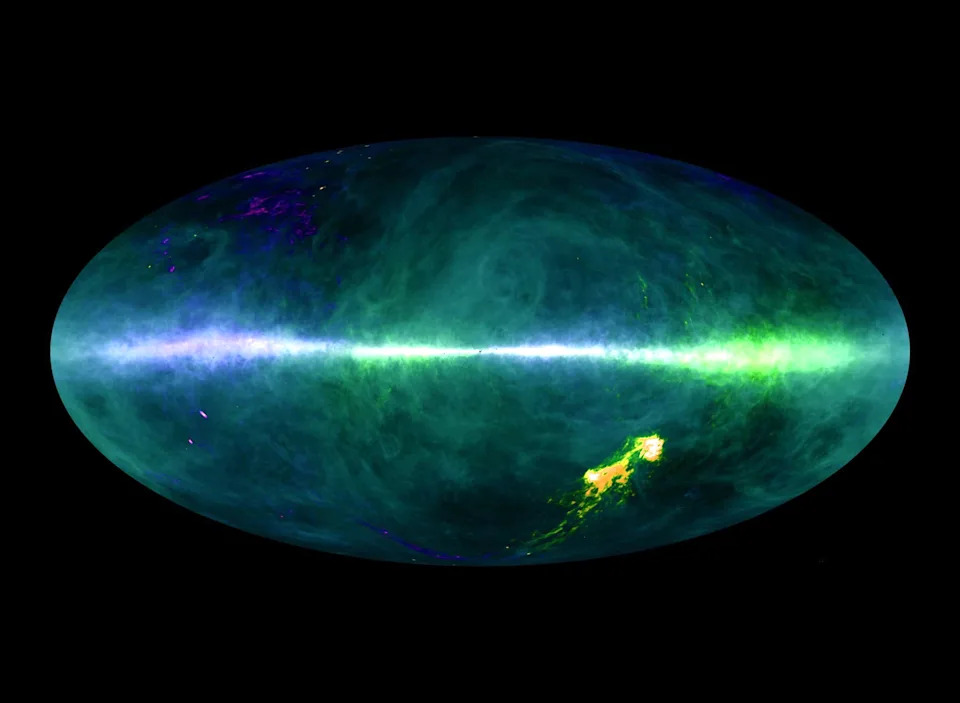
One of the most important frequencies in radio astronomy is 1420.4 MHz. Cold hydrogen atoms emit radio waves at this frequency when their electrons reverse the orientation of their spin. This so-called spin-flip transition occurs while the atom is in its ground state – it does not require the gas to be heated by a nearby star to a higher energy level. Though this emission is faint, it allows astronomers to map the structure of hydrogen clouds across the entire sky, seeing more than just the clouds that are lit by stars. The ubiquity of this emission has led SETI researchers to hypothesize that extraterrestrial civilizations might use the frequency as a hailing channel. Credit: Benjamin Winkel and the HI4PI collaboration
Whether we find that we are one Milky Way civilization among many or likely truly alone in the cosmos, the impact it has on humanity could be immense.
“For me, there’s no other question that’s more important than ‘Are we alone in the universe?’ ” Garrett said. “That’s the thing that gets me out of bed in the morning. If intelligent life is out there, would they be like us with the same ways of communication, the same ethics and morals, music and literature? What the hell would they even look like?”
If we’re not alone, might that encourage us to shape up, draw together as one human species, and put our best foot forward for our galactic debutante ball? And if we are alone, shouldn’t that make us value our planet more than ever? Could we really risk extinguishing all the life that has ever existed in the galaxy as a result of mindless wars and small-minded contentions? Perhaps we’ll find that if and when we shape up, then our cosmic neighbors will come knocking.
The post The search for aliens levels up appeared first on Astronomy Magazine.