
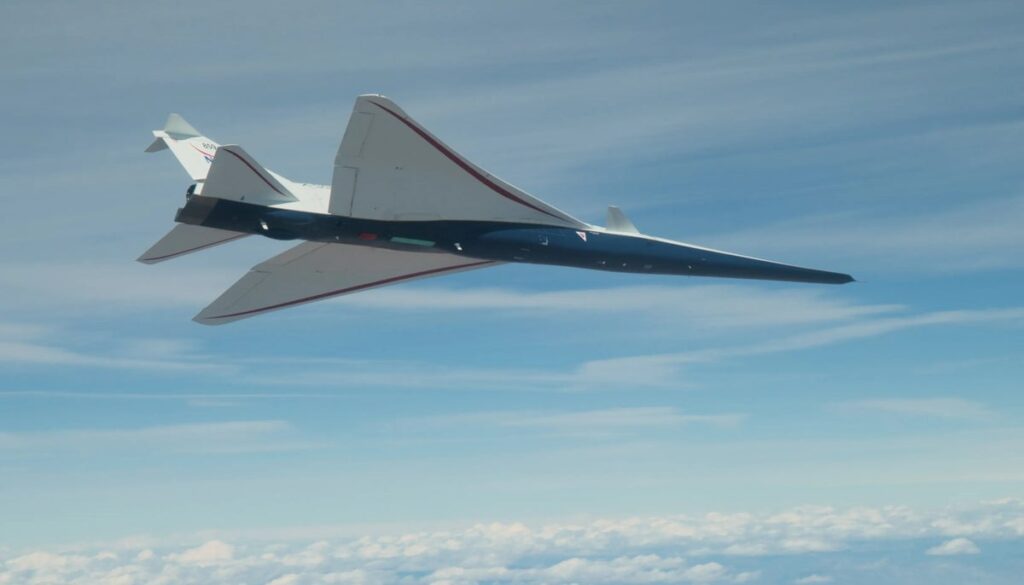
NASA wants to make supersonic travel quieter. On Thursday the agency released new footage of its X-59 jet, a still-in-development plane that is designed to break the sound barrier over land—but with a sonic “thud” rather than a boom.
Faster air travel speeds mean shorter flights. But when an aircraft travels more rapidly than the speed of sound, it creates shock waves, generating a sonic boom. Those sonic booms can be a nuisance for people living nearby and can even cause damage to homes and startle animals.
The X-59 jet is NASA’s answer to that problem. Featuring a needlelike tip, it’s designed to travel at more than 1,000 miles per hour—about twice as fast as a commercial jet—while limiting the noise of the boom. NASA expects its sonic “thump” to be as loud as “distant thunder” or the thud of a car door closing down the block.
On supporting science journalism
If you’re enjoying this article, consider supporting our award-winning journalism by subscribing. By purchasing a subscription you are helping to ensure the future of impactful stories about the discoveries and ideas shaping our world today.
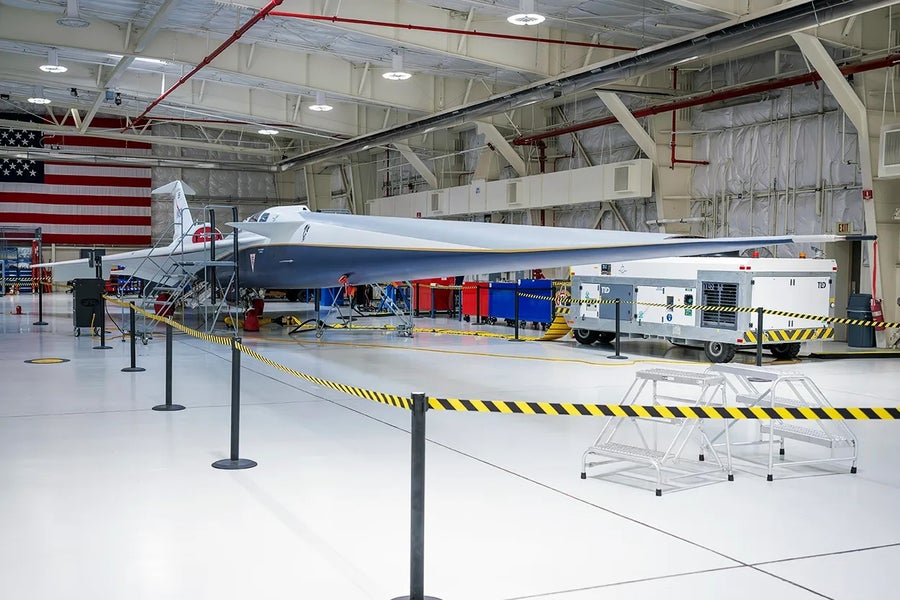
NASA’s X-59 quiet supersonic research aircraft sits inside Hangar 4826 at the agency’s Armstrong Flight Research Center in Edwards, Calif., on November 18, 2025.
NASA/Christopher LC Clark
The new test footage shows the X-59 jet performing various in-air maneuvers, including rolling from side to side, up, and down and deploying its landing gear, above the Mojave Desert in California.
Eventually, NASA hopes to deliberately fly the jet over neighborhoods in the U.S. and to survey residents about their experience with hearing the reduced sound.
It’s Time to Stand Up for Science
If you enjoyed this article, I’d like to ask for your support. Scientific American has served as an advocate for science and industry for 180 years, and right now may be the most critical moment in that two-century history.
I’ve been a Scientific American subscriber since I was 12 years old, and it helped shape the way I look at the world. SciAm always educates and delights me, and inspires a sense of awe for our vast, beautiful universe. I hope it does that for you, too.
If you subscribe to Scientific American, you help ensure that our coverage is centered on meaningful research and discovery; that we have the resources to report on the decisions that threaten labs across the U.S.; and that we support both budding and working scientists at a time when the value of science itself too often goes unrecognized.
In return, you get essential news, captivating podcasts, brilliant infographics, can’t-miss newsletters, must-watch videos, challenging games, and the science world’s best writing and reporting. You can even gift someone a subscription.
There has never been a more important time for us to stand up and show why science matters. I hope you’ll support us in that mission.