
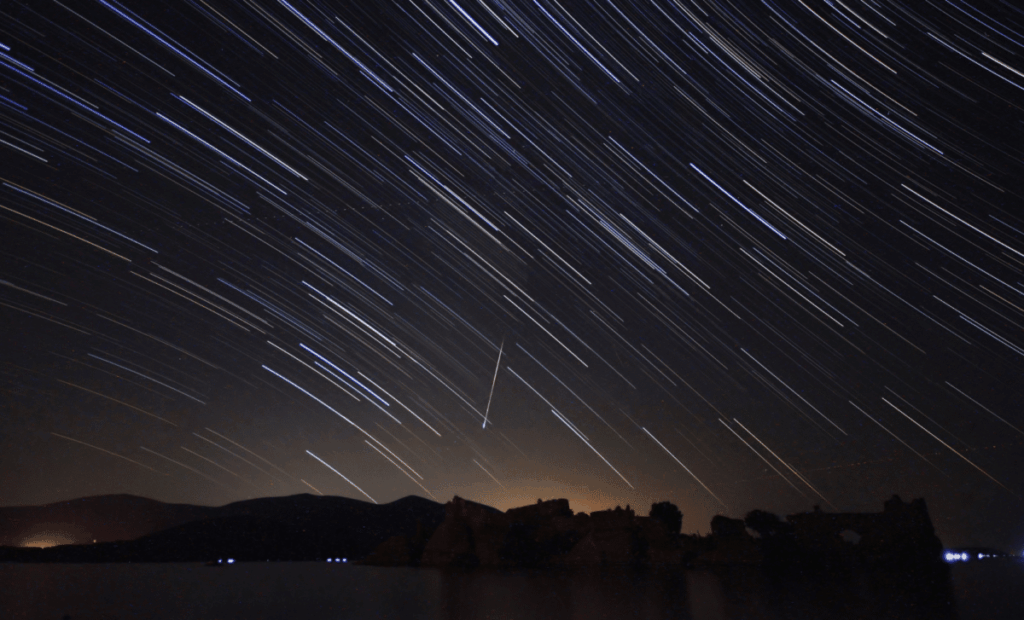
A surge of fast-moving meteors tied to Halley’s Comet will reach its peak in early May, offering one of the most dynamic skywatching events of the season.
A Night Sky Event Driven By A Legendary Comet
Each year, Earth crosses a stream of ancient debris left behind by Halley’s Comet, one of the most recognized objects in astronomy. These tiny fragments, often described as “comet crumbs,” slam into Earth’s atmosphere at tremendous speeds, igniting into bright streaks of light known as the Eta Aquarid meteor shower.
According to Space.com, this celestial event is active from April 19 through May 28, with peak activity expected overnight between May 5 and May 6. At that moment, the alignment between Earth and the debris stream becomes optimal, producing a noticeable spike in meteor activity.
The connection to Halley’s Comet gives this shower added scientific interest. The comet itself completes an orbit around the Sun roughly every 76 years and will not return to the inner solar system until 2061. What observers see now are remnants from past passes, offering a rare opportunity to witness the long-lasting footprint of a comet across decades.
The meteors themselves are exceptionally fast, entering Earth’s atmosphere at about 41 miles (66 kilometers) per second. That velocity contributes to their brightness and the long glowing trails that sometimes linger briefly in the sky.
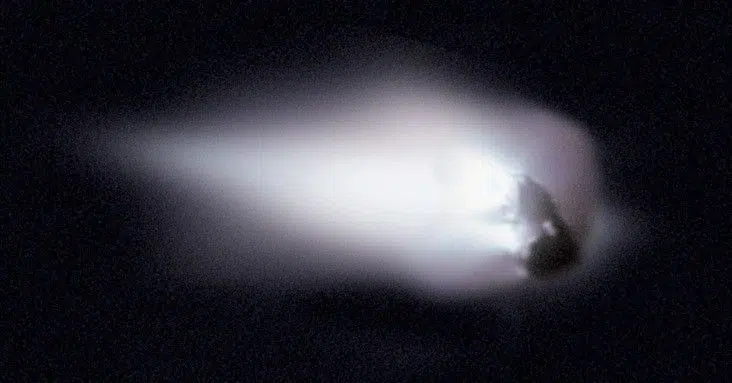 In 1986, the European spacecraft Giotto became one of the first spacecraft to encounter and photograph the nucleus of a comet, passing and imaging Halley’s nucleus as it receded from the Sun.
Halley Multicolor Camera Team, Giotto Project, ESA
When And Where Viewing Conditions Reach Their Peak
The most favorable viewing window occurs just before dawn on May 6, when the meteor shower’s radiant point in the Aquarius constellation climbs highest in the sky. According to NASA Meteoroid Environment Office expert Bill Cooke, observers should head outside around 2:00 a.m. local time, as activity steadily increases until sunrise.
Geography plays a major role in what viewers can expect. The Southern Hemisphere offers the most impressive display, with up to 50 meteors per hour under ideal dark-sky conditions. Near the equator, rates remain strong, making it one of the most active showers of the year in those regions.
In contrast, Northern Hemisphere observers will see fewer meteors, typically ranging from 10 to 30 per hour at peak. Even so, the speed and brightness of Eta Aquarids can still make the experience worthwhile, especially in areas with minimal light pollution.
Moonlight will be a complicating factor this year. A bright waning gibbous moon coincides with the peak, reducing visibility of fainter meteors and slightly diminishing overall viewing quality.
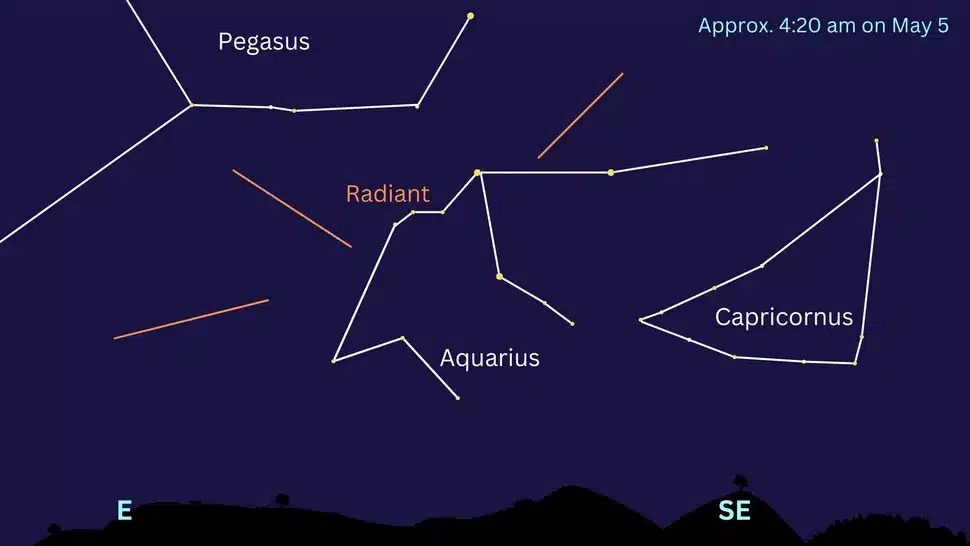 Graphic showing the Eta Aquarid meteor shower radiant in the predawn hours on May 6.
(Image credit: Future/Daisy Dobrijevic)
How To Maximize Your Chances Of Seeing Shooting Stars
Despite the presence of moonlight, careful viewing strategies can significantly improve the experience. Observers are advised not to stare directly at the Aquarius constellation, even though it marks the radiant point. Meteors appearing farther from that area often produce longer, more dramatic trails and are easier to detect.
Instead, scanning broader sections of the sky increases the likelihood of spotting brighter streaks. A comfortable viewing position, patience, and avoiding artificial light sources remain essential for success. No telescope or binoculars are required, as meteors move too quickly for magnified observation.
The key ingredients remain simple: darkness, time, and clear skies. With these in place, even a modest meteor rate can feel spectacular when multiple streaks cut across the sky within minutes.
A Reminder Of Halley’S Enduring Legacy
The Eta Aquarids highlight how a single comet can influence Earth’s environment long after it has passed. Edmond Halley first identified the periodic nature of the comet in the 18th century by linking historical observations from 1531, 1607, and 1682. His prediction of its return in 1758 marked a turning point in astronomy, demonstrating that comets follow predictable orbits.
Today, every meteor from the Eta Aquarids serves as a visible reminder of that discovery. Each streak across the sky is a fragment of cosmic history, tracing a path laid down decades or even centuries ago.
For observers willing to wake before dawn, the 2026 peak offers a chance to witness that legacy in motion, even as the comet itself remains far from view.