
Space Rider is set to be the first reusable European spacecraft. The uncrewed robotic laboratory will stay in low orbit for about two months. Space Rider’s cargo bay will allow for all manner of experiments and operations to be run. At the end of its missions, the reentry module will return to Earth, landing through an automated parafoil glide.
Any spacecraft returning from Earth hits our atmosphere at speeds of over 27 000 km/h. At these speeds the particles in our upper atmosphere hit spacecraft so intensely that heat from friction builds up – the gases become ionised and all spacecraft are enveloped in a burning ball of plasma with temperatures easily exceeding 1600 °C.
Ceramic tile testing
Spacecraft that return to Earth – such as Space Rider – have to protect themselves from these intense temperatures, and Space Rider uses reusable ceramic tiles on its belly and nose to insulate from the heat.
Space Rider has 21 tiles, made in ISiComp, a ceramic material developed by the Italian Aerospace Research Centre (CIRA) and Petroceramics, that form lightweight and resilient skin. The tiles were first put to the test in February when they were subjected to the severe vibrations generated by the Vega-C rocket’s powerful engines, simulated on a 200 kN shaker.
Flaps for hypersonic heated control
Space Rider’s reentry module is unique as it can generate lift like an aircraft and target a precise landing point – but instead of wings Space Rider’s body itself provides lift.
The Space Rider reentry module has two flaps to steer the spacecraft during reentry, weighing just 10 kg and at just 90 x 70 cm they steer the 3000 kg module as it flies into Earth’s atmosphere at hypersonic speeds. Made of the same ISiComp ceramic material the thermal protection is fixed with titanium alloy supports printed in additive layers. They are controlled by the spaceraft’s avionics “brain”.
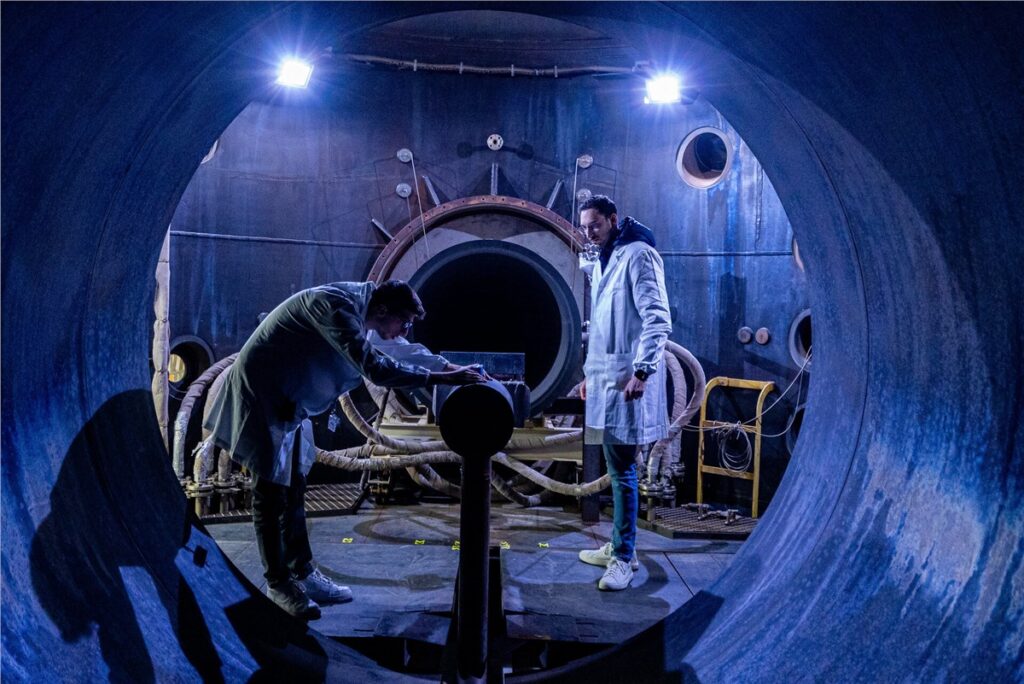
To test the flaps as if they were in flight, CIRA subjected them to their plasma wind tunnel, the world’s largest. The flaps were hit with an arc jet of gas bombarding them at ten times the speed of sound.
Space Rider has been acing its tests so far, even surviving the conditions of reentry with a purposefully damaged tile – just in case Space Rider were to be hit by a micro-meterorite while in orbit.
More tests await Space Rider’s thermal protection system and guidance system before they are qualified for spaceflight – and reentry.