
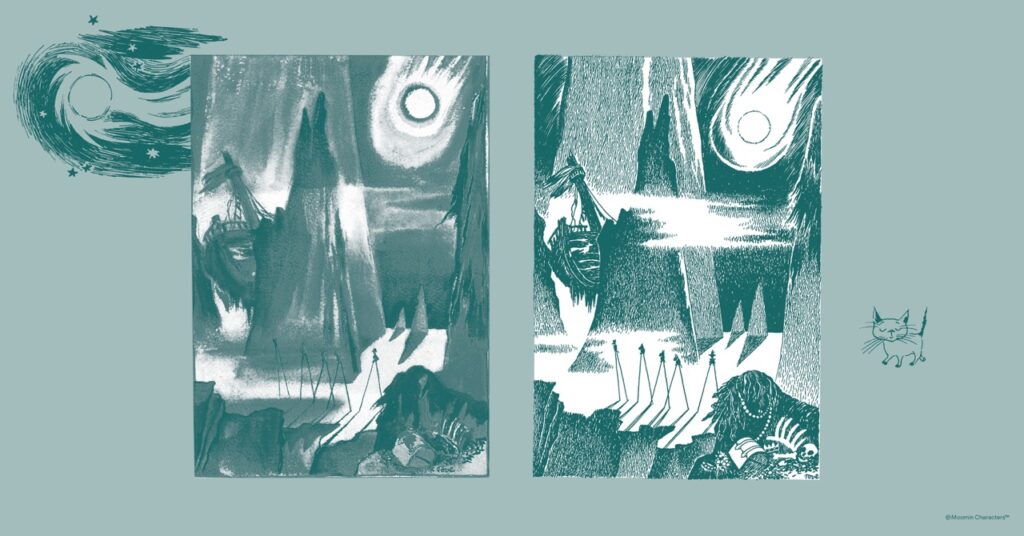
The colouristic Kometjakten
When Tove Jansson was weeding out the more exotic elements, she also abridged descriptive passages and deleted some individual adjectives. A closer examination of the language in Kometjakten shows it to be the most colourist of the Moomin books. To give only some examples, it features blue and purple mountains, a silver-grey river, white foam tinged with green, a rust-coloured sail, blue grey lyme grass, a dark red sky, grubby yellow precipices, a pale green snork sister and a sea that glitters silky blue.
In the later versions, the colours are toned down. The shells that shimmer purple, dusky blue and sea green in Kometjakten and cause Snorkmaiden to lose herself in admiration have evolved into colours that are simply “vibrant and beautiful”⁵ in Kometen kommer (“Here Comes the Comet”). These revisions made by Jansson to her later versions highlight her aim to achieve a sparser, more direct mode of expression, a tendency which she develops still further in the 1960s. This serves to point up the special and distinctive qualities of the original version of Kometjakten. It is the most plot-driven of the Moomin books but at the same time contains an abundance of descriptive passages.
The lively Snufkin became calmer
The divergent nature of Kometjakten is particularly evident in the portrayal of Snufkin. In Kometjakten he is an intense young artist type, thrilled to get some visitors in the wilderness. In the scene in which Snufkin makes his entry into the world of the Moomins he jumps up and down eagerly and shouts “Ahoy! Ship ahoy!” “Throw me the painter!” to Moomintroll and Sniff as their raft comes sailing down the river towards him and “Fancy that! What fun!”, taking for granted that the guests have come all that way to see him. This Snufkin gives long accounts of his adventures, sings, plays his mouth organ and is altogether extremely active.
Whereas Snufkin’s behaviour here can be interpreted as a reaction to isolation and lack of an audience, the later Snufkin in Kometen kommer is friendly to his guests but keeps his distance. At their first meeting, coffee is what he appears to have missed the most.
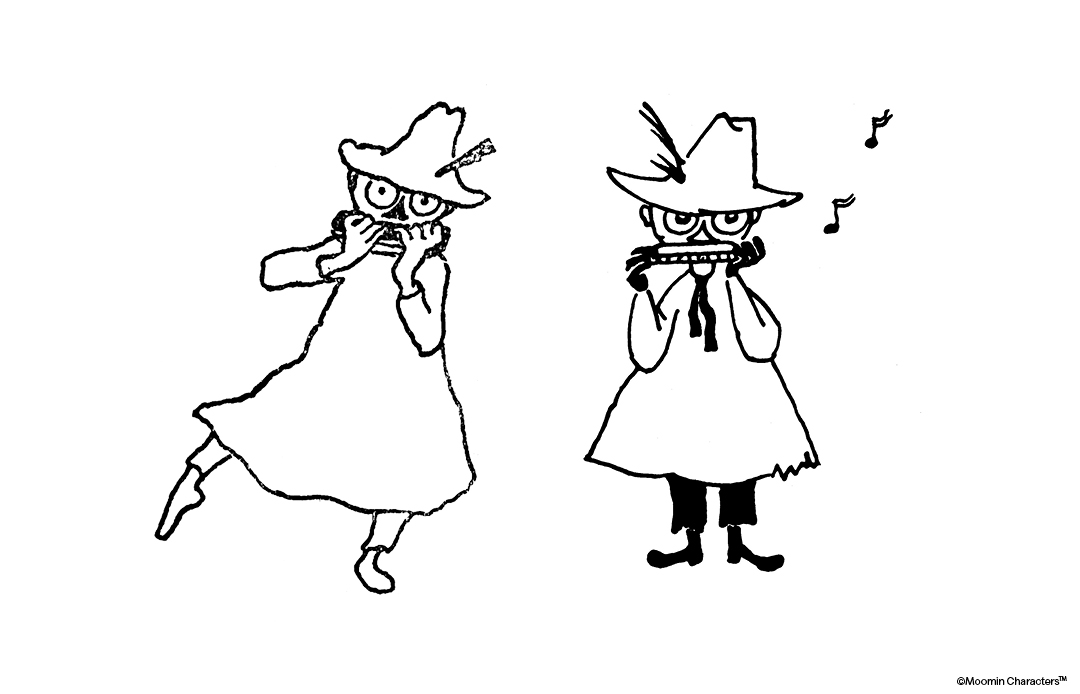 The illustration of Snufkin on the left was published in the 1946 edition of Kometjakten, while the one on the right has appeared in all editions of the book since the 1951 English translation.
The earlier Snufkin also uses visual language. He describes the place where he has currently set up camp in painting-like terms: a black velvet tree with shades of grey in the background, a blue buffalo on the riverbank and the purple mountains in the distance. This is another of the descriptive passages deleted by Jansson in the late 1960s. Some of Snufkin’s escapades are only to be found in Kometjakten. The mischievous tale of a melon theft, in which Snufkin has to run away from a “nasty, ugly old man” who turns out to be a policeman, is completely absent from the two later versions, not to mention Snufkin’s escape from jail, in which he digs his way out and finds his way to Snork and Snorkmaiden’s crayfish party, where the only thing missing is said to be wine.
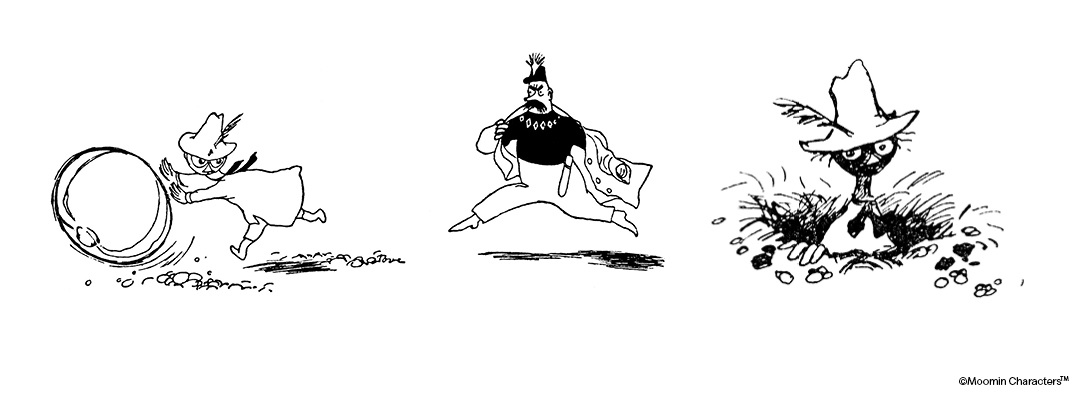 The radical Snufkin in Kometjakten, 1946.
In Kometen kommer, Snufkin is the laconic recluse that we know from the rest of the Moomin series. He also comes across as clearly older than Moomintroll. It falls to Snufkin to tell the others what a comet is and to teach them to play poker, whereas Moomintroll and Sniff have already mastered the game in Kometjakten. This reorganisation of the narrative fits well with the Bildungsroman aspect of the series as a whole. In the final version of the comet story, Mumintroll is in addition portrayed as more of a child, so that he can mature in the later books. The childlike element is accentuated in relations with his parents. The expedition to the observatory is Moominpappa and Moominmamma’s idea, not his own.
In Kometjakten Jansson places a greater burden on Moomintroll’s shoulders and the reader has an image of him as responsible and keen to take the initiative. There are also repeated references to Moomintroll’s anxious awareness that the world could be about to end, something he hides from his travelling companion Sniff for as long as he can. In comparison with Kometjakten the clearer, more concentrated Kometen kommer is possibly more consciously aimed at a young readership.